
Battle of Barnet: Mist, Treason, and Victory
- 15 April 2025
- 0 Comment
- 7 Min Read

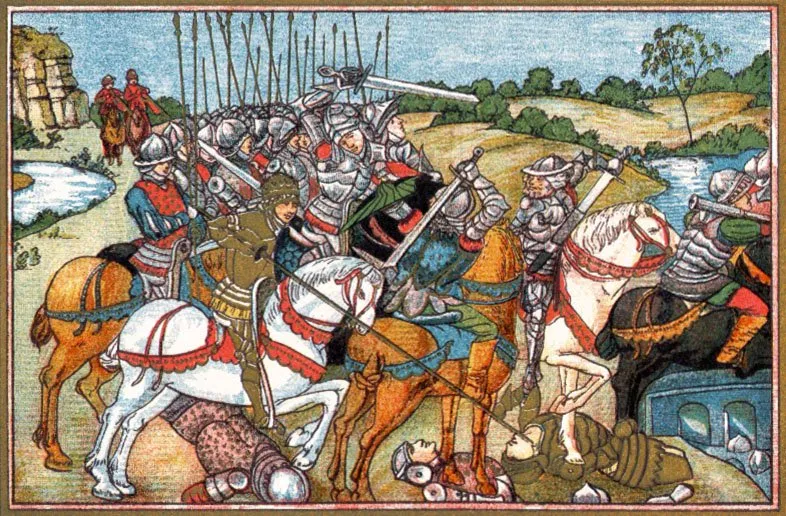
1885 lithograph portraying the rout of Warwick’s forces in the manner of Paolo Uccello
Edward IV in Exile and the Support from Burgundy
King Edward IV was forced into exile in the Low Countries in 1470 after a rebellion led by his former ally, Richard Neville, Earl of Warwick. However, his brother-in-law, Charles the Bold, Duke of Burgundy, supported him there and provided the funds to enable Edward to return to England to reclaim the throne.
Landing at Ravenspur and the Gathering of Forces
On March 14, 1471, Edward landed at Ravenspur on the Humber after his fleet of thirty-six ships had been scattered by storms. He then spent some time gathering his troops, which numbered around 1300 men, including his brother Richard, Duke of Gloucester, and William, Lord Hastings. On March 18, 1471, the Yorkist force arrived in York, with Edward claiming that he had only returned to claim his rightful inheritance as Duke of York.
March to London and Lack of Opposition
The invading force then marched past Pontefract, Wakefield, and Doncaster, recruiting soldiers on the way, and then to Nottingham, but was not attacked by any hostile Lancastrian troops.
Warwick’s Inaction and Clarence’s Defection
The Earl of Warwick, at that time, retreated behind the walls of Coventry with his men and refused to give battle on 29th March because of Edward’s reputation as a good general. The Duke of Clarence, Edward’s brother, then decided to defect from his alliance with the Earl of Warwick and rejoined his brother together with his followers on 3rd April.
Edward Enters London and Captures Henry VI
The Lancastrian leaders in London, led by Edmund Beaufort, Duke of Somerset, left to ride to the southwest to meet up with the force led by Margaret of Anjou. Therefore, there was no one left to oppose the Lord Mayor’s decision to open the city gates to King Edward and his troops on 11th April. Edward was taken by Archbishop Neville to King Henry VI, who embraced him and stated, ‘My cousin of York, you are very welcome. I know that in your hands, my life will not be in danger.’ King Henry was taken to the Tower of London while Edward organized his troops for the coming battle.
The Armies Prepare for Battle at Barnet
In the afternoon of 13th April, Edward rode out of London with around 12,000 men to the little town of Barnet. At that time, the Earl of Warwick had arrived north of the town and set up his forces, which numbered about 15,000 troops, on a ridge facing the Yorkist army and ordered his gunners to fire during the night. However, the two armies were closer together than he thought, with the two wings overlapping each other, so the cannon fire overshot or landed on open ground.
The Battle of Barnet on Easter Morning
The following day, 14th April 1471, was Easter Sunday, and a thick mist obscured the battlefield. King Edward, at around four o’clock according to the contemporary Historie of the Arrivall, ‘committed his cause and quarrel to almighty God.’
Chaos and Confusion on the Battlefield
The battle was fierce and unrelenting with cannon fire, swords, and battleaxes, and the Earl of Oxford on the Lancastrian right wing was able to chase the Yorkist left, led by Lord Hastings, to Barnet town because of the overlap. Similarly, the Yorkist right wing, led by Richard, Duke of Gloucester, pushed back the Lancastrian left, led by the Duke of Exeter.
Mistaken Identity and Warwick’s Death
The Earl of Oxford managed to rally 800 of his men who had been looting the town of Barnet back to the battlefield. However, the line of battle had changed from north-south to east-west and in the morning mist, his banner of ‘star in Rays’ was mistaken by the Lancastrian troops led by Lord Montagu to King Edward’s ‘Sun in Splendour.’ Montagu’s men fired several volleys of arrows at Oxford’s troops, who hit back and then withdrew from the battle with cries of treason. Lord Montagu was killed in the confusion, and the Earl of Warwick tried to flee back to his horse but was killed by Yorkist troops.
Aftermath of the Battle
The battle was over by eight in the morning, with around 1,000 Lancastrians dead and 500 Yorkist soldiers, including many of King Edward’s personal retinue.
Display and Burial of the Dead
The bodies of the Earl of Warwick and Lord Montagu were taken to London and laid in open coffins, naked apart from loincloths, at St. Paul’s Cathedral to prevent further rebellions in their names. They were later taken to Bisham Priory in Berkshire, which later became an abbey, for burial, but the abbey was destroyed in the Reformation.
Edward’s Victory and the Coming Challenge
King Edward IV had won a great victory, but he was aware that the battle was not over and that he would have to deal with an invasion in the southwest led by Margaret of Anjou, Edward Prince of Wales, and their followers.




David Cohen
David Cohen, a retired civil servant from the Ministry of Justice, holds a degree in social sciences from Leicester University. With over 40 years of dedicated study in medieval history, he is a member of the Royal Historical Society and a passionate researcher of the Wars of the Roses. He frequently visits significant battle sites, including St Albans, Barnet, Tewkesbury, and Bosworth, deepening his understanding of the period. As co-admin of the popular Wars of the Roses and Medieval History group alongside historian Sharon Bennett Connolly, he contributes insightful articles on key battles and prominent conflict figures.




