
Battle of Towton: Yorkist Triumph in Blood and Snow
- 18 March 2025
- 0 Comment
- 5 Min Read


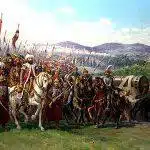
The Battle of Towton (1922) by Richard Caton Woodville Jr.
The Bloodiest Battle of the Wars of the Roses
The Battle of Towton, fought in a snowstorm on Palm Sunday, 29 March 1461, is generally regarded as the biggest and bloodiest battle during the Wars of the Roses and the bloodiest on English soil.
Fighting for the House of York were around 25,000 troops led by the newly proclaimed King Edward IV at only eighteen years of age, his uncle Lord Fauconberg, and his cousin the Earl of Warwick.
They faced about 35,000 Lancastrians led by Henry Beaufort, third Duke of Somerset; Henry Percy, third Earl of Northumberland; Henry Holland, third Duke of Exeter; and Sir Andrew Trollope.
A Battle on the Brink: Norfolk’s Timely Arrival

Initial deployments – the Yorkists (white) and Lancastrians (red) at Towton
The Yorkist archers were commanded by Lord Fauconberg, who soon noticed that the wind had changed direction and was blowing against the Lancastrian army. He therefore commanded his troops to fire their volleys of arrows carried by the wind and driving snow. This caused considerable casualties in the Lancastrian ranks, whose return fire fell well short of the Yorkist lines.
With no other option, the Lancastrians moved forward to attack the Yorkist army with their bills, poleaxes, and swords. A cavalry charge by the Lancastrians from the nearby Castle Hill Wood achieved some degree of success, but King Edward was able to stabilize his lines.
The battle was savage and relentless with no quarter asked or given, with Edward an inspirational general amid his men. Despite this, the Yorkists were being pushed back through the weight of numbers and appeared to be on the verge of losing the battle. However, help was soon at hand with the late arrival of several thousand troops led by the Duke of Norfolk who pushed the Lancastrian soldiers back, down the Bloody Meadow and across the freezing stream, the Cock Beck.
The Yorkists had lost around 8,000 men and the Lancastrians, 20,000, including the Earl of Northumberland, his brother Sir Richard Percy, Lord Dacre, Lord Welles, and Sir Andrew Trollope. Modern research, however, points to a much lower figure, although the battle was undoubtedly the bloodiest of the wars.
A Kingdom Seized: Edward IV’s Triumph
King Henry VI, who had sat out the battle with his wife, Margaret of Anjou, and son, Edward, in York, received news of the defeat of his army and decided to flee north to Scotland with his family and surviving commanders.
King Edward then rode to York the following day with his troops and ordered the heads of his father, Richard Duke of York; brother, Edmund Earl of Rutland; and uncle, Earl of Salisbury, to be removed from Micklegate Bar, where they had been placed by the Lancastrians, for burial at Pontefract.
Edward spent a few weeks in the north to guard against further rebellions before returning to London, where he received a hero’s welcome for having saved the Londoners from being ravaged by the northerners.
On Sunday, 28th June 1461, King Edward issued a proclamation promising a good and just government and condemned the oppression and lawlessness that had previously taken place among his subjects. He was then formally crowned at Westminster Abbey in a ceremony of splendour by Archbishop of Canterbury Thomas Bourchier to great public acclaim.




David Cohen
David Cohen, a retired civil servant from the Ministry of Justice, holds a degree in social sciences from Leicester University. With over 40 years of dedicated study in medieval history, he is a member of the Royal Historical Society and a passionate researcher of the Wars of the Roses. He frequently visits significant battle sites, including St Albans, Barnet, Tewkesbury, and Bosworth, deepening his understanding of the period. As co-admin of the popular Wars of the Roses and Medieval History group alongside historian Sharon Bennett Connolly, he contributes insightful articles on key battles and prominent conflict figures.




