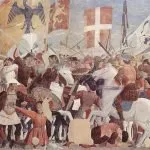
Byzantine Cataphracts: Masters of Shock and Awe
- Michael G. Stroud
- 20 November 2024
- 0 Comment
- 6 Min Read

BYZANTINE CATAPHRACTS
Introduction
Rome had fallen. Its successor, the Byzantine Empire (337–1453), would endure for another millennium. This longevity was due in part to the adaptability of the Romans to learn from friend and foe alike, and their centuries of exposure to steppe nomads and Persian cavalry became deeply entrenched in the psyche and military organization of Byzantine armies. The development and use of cataphracts and their intrinsic shock value were such a martial lesson learned by the Byzantines that they would adapt their tactical organization to give prominence to cavalry. They would fight fire with fire—cataphract against cataphract. The martial potential of the Byzantine cataphracts and their power to decisively own the battlefield were rendered ineffective at the battle of Manzikert due to poor leadership and faulty command decisions.
The Evolution of the Byzantine Cataphract
The development of the cataphract came about from the harsh lessons learned by the Romans at the hands of Parthian cavalry and others. The debacle at Carrhae in 53 BCE showcased the fault of a solely infantry-based system, so the armoured cataphract was born to fill this need. At its inception, the Roman cataphract “functioned as a heavily armoured lancer or as a mounted archer, fusing heavy and light cavalry into one weapon system. With the adoption of the stirrup sometime in the late sixth century, the cataphract became for the first time a true lancer” due to the symbioses of the rider and horse to “aim through his target.” These cataphracts were both the thunder and the lightning of Byzantine armies and, as such, were armed for both ranged warfare and close-quarter combat. Various forms and styles of armour were utilized for protecting both the rider and his companion warhorse, who was seen as a vital soldier as well.
Tactics that Redefined Medieval Warfare
This tactical evolution of the cataphract as a counterbalance to the light and heavy cavalry-centric armies of their adversaries continued to drive their importance in the makeup of Byzantine armies over the centuries. The fifth century saw cavalry constituting “one out of three units” in the Byzantine army with “fifteen percent of all cavalry units consist[ing] of heavy cavalry cataphractii, now called kataphraktoi.” Their tactical importance would grow with the cavalry arm surpassing that of the infantry for the dominant position in Byzantine armies. “Their tasks were to drive off enemy cavalry and to break up enemy formations by a combination of missile assaults and charges leading to close-order combat; much rested on the psychological impact of the charge.”
Victories Under Belisarios: Dara and Tricameron
The martial power of the cataphracts was put into play against Byzantium’s enemies at Dara and Tricameron. The battle of Dara in 530 saw Belisarios (500–565), at the head of 25,000 Byzantine soldiers, march to the tactically important city of Dara to prevent it from falling into the hands of the Sassanian Persians under King Kavad (r. 488–531). The Persians eventually fielded an army of over 50,000 strong to oppose the Byzantines. During the two-day battle, Belisarios utilized his cataphracts to spring ambushes against the Persians, execute carefully directed and timed counterattacks by Hunnic cavalry to break the enemy’s momentum, and most importantly, launch 1,200 horsemen in a “wheel and strike” manoeuvre to pin the Persian left wing. This was soon followed up by the launching of the heavy cataphract reserve that broke the Persians, resulting in their defeat.
At Tricameron in 533, Belisarios and 15,000 soldiers faced off against a Vandal army of almost 50,000 in what is now modern-day Tunisia. Here, recognizing the importance of taking the fight to the Vandals, the Byzantines utilized the shock value of their cataphracts by charging the Vandal centre numerous times, literally hammering them. The arrival of Belisarios and his ordering of two more cavalry divisions proved fatal to the Vandals, as it shattered their line, costing them around 800 men and the battle. The shock and awe of the cataphracts carried the day.
Manzikert: A Turning Point for Byzantium
The year 1071 AD saw the Byzantines under Romanus IV Diogenes (r. 1068-1071) engage the Seljuk Turks under Alp Arslan (r. 1063-1072) at the strategically important town of Manzikert. The very future of the Byzantine Empire would be determined here, unbeknownst to the participants, and where the abilities of the Byzantine cataphracts would be needed at their best. They would instead be squandered by poor decisions early on.
First, Romanus split his force in half based on faulty assumptions, disregarding the critical importance of gathering accurate intelligence on the enemies’ whereabouts. He sent his best 25,000 men, including cataphracts, heavy cavalry, and archers, away to retake Chliat, leaving the emperor with around 23,000 to engage the Turks. Next, Romanus disregarded Byzantine military combined-arms doctrine by engaging the Turks without his missile troops who were sent against Chliat. His third and truly fatal error was entrusting the command of his vital 5,000-man-strong reserves to Andronikos Doukas, who was the son of his greatest political enemy.
Lessons Learned from Byzantine Leadership Failures
Romanus’s poor tactical (and political with Andronikos) decisions negated the military might that his cataphracts could have provided on the battlefield. In not adhering to sound combined-arms tactics by sending away the best of his troops early on, Romanus effectively capitulated the battle of Manzikert before it was even fought. The full might of the Byzantine cataphract was not allowed to play out at Manzikert due to these leadership missteps, the result of which would lead to the demise of the Byzantine empire and the very death of Romanus.
RELATED POSTS
-
20 Nov 2024Byzantine Cataphracts: Masters of Shock and Awe
-
28 Apr 2024Justinian's Reign: From Stability to Strain
-
20 Apr 2024The Empire Before Justinian: The Economy and Military Situation
-
15 Sep 2023Varangian Guard: Protectors of the Byzantine Empire
-
24 Feb 2023Siege of Constantinople: The Ultimate Clash
-
22 Jan 2023Byzantine Victory in 626 Siege
-
21 Jan 2023The Byzantine Empire In Art
-
15 Jan 2023Byzantine's Transformation In The 700s
SOURCES
Bennett, M. (2009). The Medieval world at war. Thames & Hudson.
Carey, B. T., Allfree, J. B., & Cairns, J. (2012). Road to Manzikert: Byzantine and Islamic warfare, 527-1071. Pen & Sword.
Carey, B. T., Allfree, J. B., & Cairns, J. (2006). Warfare in the medieval world. Pen & Sword.
Haldon, J. (2001). The Byzantine wars: Battles and campaigns of the Byzantine era. Tempus.
Luttwak, E. N. (2011). The grand strategy of the Byzantine Empire. Belknap Press of Harvard University Press.
LICENSE & COPYRIGHT
The copyright holder has published this content under the following license: Creative Commons Attribution-NonCommercial-ShareAlike. This license lets others remix, tweak, and build upon this content non-commercially, as long as they credit the author and license their new creations under the identical terms. When republishing on the web a hyperlink back to the original content source URL must be included. Please note that content linked from this page may have different licensing terms.
If I have mistakenly misused any of your content, artwork, images, or videos, please contact me on historymedieval62@gmail.com and I will take the necessary corrective action.
This website uses affiliate links. If you purchase via these links, we might earn a commission that contributes to sustaining the HistoryMedieval.com platform.
Michael G. Stroud
Michael G. Stroud is a Michigan-based military historian with a lifelong passion for history deeply rooted in his family's extensive military service. His lineage includes his father’s service in Vietnam, his grandparents’ involvement in WWII, and connections to the War of 1812, the American Revolution, and earlier conflicts. Michael has explored numerous historical landmarks across Europe, such as Napoleon's Tomb, Stonehenge, the Colosseum, and Pompeii, and has conducted extensive visits to American Civil War battlefields. He holds an MA in Military History and offers his expertise for lectures, project collaborations, and historical consultations.