

SYNOPSIS
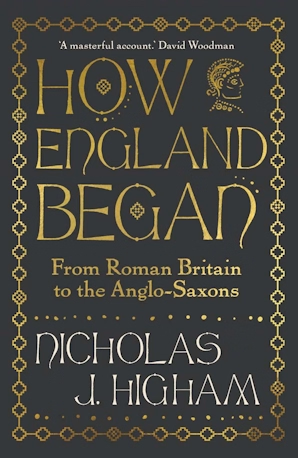
Nicholas J. Higham’s How England Began: From Roman Britain to the Anglo-Saxons is an ambitious, deeply informed reappraisal of one of the most contested transitions in British history: the passage from Roman Britain to an English south and east, and a British west and north. Higham states from the outset that this is not merely a reworking of his earlier scholarship, but a fresh reconsideration of the whole problem in light of newer research, especially on archaeology, language, ethnicity, and genetics. He frames the central historical question with admirable clarity: not simply whether migration occurred, but why English language and culture prevailed in Britain in ways that differed so sharply from developments in post-Roman Gaul.
Verdict: this is a major and persuasive contribution to early medieval studies, scholarly without being lifeless, revisionist without being reckless, and broad in scope without collapsing into vagueness. It is not an easy, popularising narrative of the “Age of Arthur”; Higham explicitly resists that route. Instead, it is a serious interpretive work that rewards attentive reading with fresh insight into how England emerged from the ruins of Roman Britain. For readers interested in the deep origins of English identity, it is one of the strongest recent syntheses available.
Genre: Non-Fiction
Age Range: Adult
Star Rating: 4.6 stars
Publication Date: March 10, 2026
This website uses affiliate links. If you purchase via these links, we might earn a commission that contributes to sustaining the HistoryMedieval.com platform.
OVERVIEW
Higham, professor emeritus of history at the University of Manchester, organises the book across eight substantive chapters, framed by an introduction and an afterword. The structure is carefully designed: first Roman Britain itself, then its slow ending, then the problem of fifth-century Britain, followed by two substantial chapters centred on Gildas, a chapter on the arrival of the English, one on Rome’s return through the Gregorian mission of 597, and finally a synthetic chapter modelling transition. The back matter is substantial: endnotes, bibliography, and index occupy a significant portion of the volume, while Yale’s edition adds 32 colour illustrations and 7 maps.
The book’s strongest conceptual move comes very early. Higham refuses to reduce the formation of England to a stale binary between “mass migration” and “continuity.” Instead, he argues that the real explanatory challenge lies in understanding why a continental north-European cultural identity took root in Britain so successfully, why English did not yield to Latin or Brittonic, and why a largely Roman-Christian framework survived in places like Gaul but not in lowland Britain. That gives the whole study unusual force. This is not just a book about invasions, burials, or place-names in isolation; it is a book about historical outcomes and the uneven triumph of one cultural order over another.
Higham also deserves credit for widening the chronological lens. He warns against treating the fifth century as if it alone must explain everything. The book repeatedly returns to the idea that the making of England was a long transition, not a single collapse-and-replacement moment. In particular, the later chapter on the Roman mission argues that the Roman-directed English Church played a major role in suppressing insular Christian traditions and, with them, important supports of British identity. That is one of the book’s most stimulating arguments, because it extends the story of England’s making beyond migration and war into ecclesiastical and ideological transformation.
For anyone seeking to understand how Roman Britain became Anglo-Saxon England, Nicholas J. Higham’s How England Began is authoritative and rewarding reading.
Enjoyed this Article?
Join The Medieval Chronicle on Substack for weekly medieval discoveries, book notes, and behind-the-scenes commentary from HistoryMedieval.
CRITICAL EVALUATION
Contributions
The great achievement of How England Began is methodological confidence paired with disciplinary breadth. Higham openly argues that this field has suffered when archaeology and history have been held apart, and he sets out to restore written sources, especially difficult ones such as Gildas, to a central place in the debate. That ambition matters. Rather than treating the period as voiceless and purely material, he insists that texts, however partial and agenda-driven, still preserve historically meaningful ways of seeing the transition from Roman to British to English Britain. This gives the book unusual interpretive depth.
Equally impressive is the way Higham reframes older debates without pretending that uncertainty can be eliminated. He does not deny migration; indeed, he argues that major cultural change in England required it. But he also shows why sheer numbers alone cannot do all the explanatory work. Time and again, he asks why England diverged from more “normal” continental patterns, particularly Frankish Gaul, where incoming elites more readily adopted provincial language and institutions. That comparative dimension gives the book real scholarly value, because it prevents post-Roman Britain from being treated as a closed, exceptional case study.
Another major contribution is Higham’s treatment of language and identity. He makes plain that the spread of English and the collapse of British Latin are not side issues but central historical facts requiring explanation. He also handles ethnicity with more care than many polarised accounts. Material culture, place-names, literary testimony, and scientific evidence are all weighed together, but rarely forced into simplistic certainty. That balance between firmness and caution is one of the book’s defining strengths. It gives the argument credibility, especially in a field where overstatement is always tempting.
Higham’s prose is also worth noting. This is a serious academic book, and it is dense in places, but it is rarely obscure. He has a gift for stating large historiographical problems in direct, intelligible prose. His dismissal of Arthurian pseudo-history is brisk and refreshing, and his larger refusal to romanticise the so-called Dark Ages gives the book welcome discipline. He is especially good at explaining why certain older models became influential and why newer evidence complicates them. That makes the book valuable not only as an argument, but as a guide to the development of scholarship itself.
Limitations
The book’s chief limitation is the unavoidable one created by its subject: the evidence is fragmentary, and Higham knows it. He repeatedly emphasises uncertainty, and rightly so, but that means some readers may finish the book wanting firmer conclusions than the sources allow. This is not a fault of scholarship so much as a feature of responsible scholarship; still, it occasionally gives the argument a deliberately provisional quality. Readers hoping for neat solutions to the old questions of population replacement, elite dominance, or cultural adoption will not always get them.
A second limitation is that the book is more analytical than dramatic. Higham explicitly acknowledges that a person-centred, event-based history of sub-Roman Britain cannot really be written from surviving evidence. As a result, the narrative pulse depends less on memorable individuals than on shifting models, categories, and comparative frameworks. That is intellectually honest, but it does mean the book will appeal more strongly to historically engaged readers than to those simply seeking a vividly peopled story of post-Roman Britain.
There is also a mild imbalance in accessibility. The organisation is coherent, but the density of historiography, especially in the discussions around ethnicity, language, and the uses of archaeology, can make sections feel demanding for non-specialists. More synthetic diagrams or additional interpretive maps might have eased the burden, particularly in a book dealing with overlapping regional, linguistic, and political transitions. The visual apparatus is useful and respectable, but the complexity of the subject occasionally outpaces the book’s navigational aids.
Even so, these limitations do not diminish the book’s achievement. They define its seriousness. Higham is not writing myth-history, and he is not producing a simplified origin tale. He is doing something much more valuable: explaining why the making of England was historically messy, regionally uneven, and far more entangled with Roman survival, British resilience, and later ecclesiastical change than older narratives allowed. That makes the book both more demanding and more rewarding.

BOOK REVIEW METER
Editorial Assessment — HistoryMedieval.com
OVERALL SCORE 4.6/5
A compelling, authoritative and readable reassessment of how Roman Britain became Anglo-Saxon England, rewarding enthusiasts and serious readers alike.
AUTHOR: Nicholas J. Higham

Nicholas J. Higham is a historian and archaeologist specialising in early medieval Britain. His research has significantly shaped modern understanding of Anglo-Saxon society, landscape, identity and the historical traditions surrounding King Arthur. Drawing on written sources, archaeology, place-names and landscape evidence, he has produced influential studies including The Kingdom of Northumbria: AD 350–1100 and The English Conquest: Gildas and Britain in the Fifth Century. His scholarship continues to inform debate on the transformation of post-Roman Britain and the emergence of Anglo-Saxon England.

LICENSE & COPYRIGHT
The copyright holder has published this content under the following license: Creative Commons Attribution-NonCommercial-ShareAlike. This license lets others remix, tweak, and build upon this content non-commercially, as long as they credit the author and license their new creations under the identical terms. When republishing on the web, a hyperlink back to the original content source URL must be included. Please note that content linked from this page may have different licensing terms.
If I have mistakenly misused any of your content, artwork, images, or videos, please contact me at historymedieval62@gmail.com, and I will take the necessary corrective action.
This website uses affiliate links. If you purchase via these links, we might earn a commission that contributes to sustaining the HistoryMedieval.com platform.

Luciano Anastasi
Luciano is the founder of the MedievalHistory platform and the LinkedIn History Enthusiasts Group, where he is dedicated to curating and sharing high-quality medieval history content. His goal is to engage scholars, teachers, students, and enthusiasts by fostering insightful discussions and promoting scholarly resources on topics from medieval warfare and religion to societal transformations and daily life in the Middle Ages.
Luciano is also an active book reviewer, focusing on academic publications related to medieval history. He recently collaborated with Yale University Press to review forthcoming medieval history titles, aiming to deepen educators' and researchers' understanding of the period. Alongside his history endeavors, he has over 40 years of experience in IT leadership roles across various industries, including the public sector, banking, insurance, airlines and consulting, and has contributed to United Nations projects.
With a Master of Arts in Business Process Management, Luciano combines his expertise in IT strategy and governance with his passion for medieval history. He leverages technology to bridge the academic community and the wider public, making historical scholarship more accessible through engaging online content.




