Lighting a Fire in the Medieval Sky
Advertisement Feature—Paid partnership. HistoryMedieval received payment to publish this article. Some links are part of that paid arrangement.
How Medieval Europe Made Sense of the Northern Lights
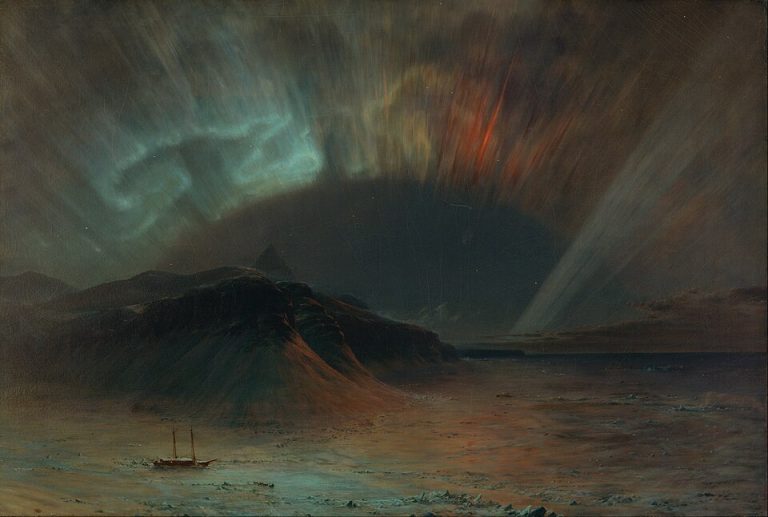
Long before scientists connected the northern lights with charged solar particles and Earth’s magnetic field, people still watched the sky very closely. Medieval observers described glowing arcs, red vapours, moving rays and shapes that looked like armies or dragons. Their accounts tell us what appeared overhead, but they also reveal how societies made sense of events they couldn’t explain.
A vivid celestial display could become a warning, a religious sign or evidence that disorder was about to reach the earth below, yet medieval responses were not simply superstitious reactions to glowing skies. Some writers compared physical explanations, recorded changes in brightness and admitted when the cause was unknown.
A Chronicle Recorded Meaning, Not Just Weather
Medieval chronicles weren’t written as neutral logs of daily conditions. Their authors selected events that supported a moral, political or religious account of the past. A strange light in the sky could appear beside famine, warfare, plague or the death of a ruler because the writer believed those events belonged together.
Such an approach creates a challenge for modern historians. Descriptions of “fire”, “blood”, “spears” or “armies” in the heavens could refer to auroras, but they might also describe comets, meteors, lightning, halos or literary imagery. The vocabulary was expressive rather than scientific, and later copyists could preserve, shorten, or alter accounts.
One approach is to compare the written description with location, season, direction, colour and known astronomical conditions. Descriptions of repeated movement across the northern sky can strengthen an auroral interpretation, while a single vague reference to a red glow in the evening sky offers much less certainty.
A thorough look at the northern lights through history shows how accounts from different civilisations can be read alongside one another without pretending that every unusual sky was the same phenomenon.
Fiery Dragons Over Northumbria
The Anglo-Saxon Chronicle’s entry for 793 is among the most quoted descriptions of ominous weather in medieval England. It reports whirlwinds, lightning and “fiery dragons” flying through the air before famine and the Viking attack on Lindisfarne.
The passage became associated with the devastating raid on Lindisfarne, an assault that struck one of Northumbria’s religious centres. In the chronicler’s telling, the signs in the sky prepared readers for the destruction that followed.
Could those dragons have been the northern lights? Possibly. Moving auroral forms can resemble bands, serpents or twisting bodies, especially during intense activity. Researchers have considered the aurora among several explanations for the Chronicle’s language; however, the entry groups multiple portents together, and the Chronicle’s account was written down after the events it describes. Calling it a confirmed aurora would lend the evidence more certainty than it can carry.
Its historical value doesn’t depend on a definite identification. The passage shows how an early medieval writer arranged natural events and human catastrophe into one meaningful sequence. The chronicler placed the celestial signs within his understanding of history rather than treating them as decorative details.
The King’s Mirror Asked a Different Question
A Norwegian text written around the middle of the thirteenth century offers a striking contrast. Konungs skuggsjá, or The King’s Mirror, is a didactic work framed as a conversation between a father and son. It discusses trade, navigation, geography, proper conduct and the natural world, including the northern lights as observed in Greenland.
The author describes a glow resembling fire seen from a great distance, with rays extending upward and changing in brightness. He then considers three possible causes. Perhaps fire encircled the outer ocean. Perhaps sunlight reached the northern sky while the sun itself was below the horizon. Alternatively, Greenland’s cold, frost and glaciers might themselves produce light.
None of these explanations agrees with modern space science, but the more intriguing point lies elsewhere. The writer compared several natural theories instead of assigning the display directly to divine anger or supernatural intervention. He also acknowledged that the true cause wasn’t known, although he regarded the explanation involving frost and glaciers as plausible.
This is medieval inquiry in practice: observation, competing explanations and an honest limit on certainty. Scientific knowledge doesn’t develop in a clean jump from superstition to reason. People could interpret celestial events religiously while also investigating how the physical world worked.
The Viking Explanation We Can’t Confirm
Modern retellings of Norse mythology often claim that Vikings saw the aurora as light reflected from the armour or shields of the valkyries. It’s a memorable image, especially when paired with snowy mountains and a green sky, but no clear evidence for this particular explanation has been identified in surviving Old Norse sources.
The difficulty begins with the evidence itself. Viking Age Scandinavian belief was largely transmitted orally, while many detailed mythological works were written down after conversion to Christianity. The Poetic Edda, Prose Edda and later sagas preserve invaluable material, but they can’t automatically be treated as direct transcripts of belief several centuries earlier.
Valkyries unquestionably appear in Norse tradition, and they are connected with battle, death, Odin, and the selection of fallen warriors. The specific link between their armour and the aurora is not attested in the surviving medieval texts. The same caution applies to claims that the lights were Bifröst; medieval Norse sources identify Bifröst with the rainbow.
Lack of written evidence doesn’t disprove that a northern community attached a story to the lights. It means historians shouldn’t turn an attractive modern claim into a documented Viking belief.
What Medieval Witnesses Still Give Us
Historical aurora research works best when descriptions are neither dismissed as fantasy nor translated too eagerly into modern terminology. A chronicler who wrote about armies in the sky wasn’t attempting to produce a space-weather report. He recorded an experience through the language, theology and political concerns available to him.
Those accounts can still contribute to the study of past solar activity when dates and descriptions are sufficiently precise. Just as importantly, they show how people responded emotionally and intellectually to an unpredictable natural display.
The northern lights haven’t changed because we now understand their physical cause. What has changed is the framework used to read them. Medieval observers saw warnings, questions, divine messages and possible natural processes. Their records preserve the sky they witnessed and the human effort to ascribe meaning to it.
Copyright, Licensing and Disclosure
© HistoryMedieval. All rights reserved.
This article may not be copied, republished, adapted, translated, distributed, scraped or otherwise reused without prior written permission, except where permitted by law. Unauthorised use for AI training, dataset creation, text and data mining or generative-AI systems is prohibited.
Third-party images and materials may be subject to separate copyright or licensing terms. For copyright concerns, contact info@historymedieval.com. We will review the matter and take any necessary corrective action.
This article may contain affiliate links. We may earn a commission from qualifying purchases at no additional cost to the buyer.