Medieval Abbot May Lie in Reused Roman Sarcophagus
- Luciano Anastasi
- 23 October 2026
- 0 Comment
- 25 Min Read

Overview
Archaeological research at Westminster Abbey has renewed a centuries-old mystery surrounding a Roman sarcophagus reused in Anglo-Saxon England. Radiocarbon dating, skeletal analysis and historical evidence suggest that its medieval occupant may have been Abbot Ælfwig, although another Westminster abbot remains a credible possibility.
Cite This Work
A Roman Coffin and an Anglo-Saxon Mystery

The west front of Westminster Abbey, Westminster, London, England. Credit: Mike Peel / Wikimedia Commons — CC BY-SA 4.0.
For more than 150 years, a Roman limestone sarcophagus at Westminster Abbey has presented historians with an intriguing problem. Its carved inscription identifies a man who lived in Roman Britain, yet a large Christian cross on the lid belongs to a much later period. Inside were human remains whose identity had never been convincingly established. The object appeared to preserve two different chapters of London’s history, separated by several centuries.
Now, research published on 20 October 2026 in the Journal of the British Archaeological Association offers a compelling explanation. Professor Warwick Rodwell, Westminster Abbey’s consultant archaeologist, argues that the sarcophagus was reused during the late Anglo-Saxon period for the burial of a high-ranking churchman. His preferred candidate is Ælfwig, Abbot of Westminster from 993 until approximately 1020, although his successor, Wulfnoth, remains a possibility.
The investigation combines archaeological observations, scientific dating, the study of human remains and historical records. Particularly significant is evidence recovered during conservation work in 2016, when researchers unexpectedly discovered that the sarcophagus still contained a substantial skeleton. Previous accounts had suggested that the bones had disappeared during the nineteenth century.
The proposed identification is important, but it requires careful qualification. Radiocarbon dating places the individual in the right period, and the elaborate burial strongly suggests someone of considerable standing within the monastery. Neither finding, however, establishes a personal identity. Rodwell’s argument rests on how several independent strands of evidence fit together.
What makes this discovery especially interesting is not simply the possibility of naming the deceased. The sarcophagus offers an unusually tangible connection between Roman London, the Benedictine community of Anglo-Saxon Westminster and the rebuilding of the abbey during the thirteenth century. Its history illustrates how a single object could acquire new religious and commemorative meanings as successive generations reshaped their surroundings.
A Discovery That Actually Began in 1820
The Forgotten First Encounter
The sarcophagus is usually described as having been discovered in 1869, when workmen excavating the northern precinct of Westminster Abbey exposed the stone coffin. Rodwell’s research, however, draws attention to an earlier discovery that had largely disappeared from the historical narrative.
An annotated pencil drawing preserved in the abbey’s archives records that workmen first encountered the sarcophagus on Easter Monday, 3 April 1820. The drawing shows part of the coffin and its lid, which had been damaged by workmen. Rodwell suggests that the discovery probably occurred during the digging of a grave associated with nearby St Margaret’s Church.
The consequences appear to have been considerable. The eastern end of the stone lid was broken into five pieces, and the skeleton inside was disturbed. Bones were removed from their original positions and subsequently returned without regard to their anatomical arrangement. Although the lid was eventually repaired, no substantial contemporary account of the disturbance has survived.
Rodwell considers it possible that the workmen were searching for valuables. Such an explanation is plausible given the disruption of the remains, but there is no direct evidence that treasure was actually recovered. The possibility of lost burial objects must therefore remain conjectural.
This overlooked episode helps explain why nineteenth-century observers encountered such an apparently confusing burial. What they found was not necessarily the arrangement left by the people who had buried the deceased, but a collection of bones already disturbed by an earlier intervention.
The Rediscovery of 1869
The better-documented discovery occurred during improvement works that Sir George Gilbert Scott commissioned, as he was the architect responsible for extensive restoration at Westminster Abbey.
Henry Poole, the abbey mason, supervised the removal of accumulated soil and rubble from North Green, immediately north of the abbey church. Excavations exposed the foundations of buildings that had previously occupied the area, including elements associated with the medieval great sacristy.
During this work, the broken lid of the sarcophagus was encountered beneath the ground. The coffin lay alongside the foundation of the sacristy’s inner wall, orientated approximately east–west. Its position was especially puzzling because the decorated lid had been completely concealed beneath the surface rather than displayed as a visible memorial.
The sarcophagus was formally opened on 29 November 1869 in the presence of prominent antiquaries and members of the abbey community. Among those attending were Scott, Dean Arthur Stanley, Augustus Wollaston Franks and the artist George Scharf, whose sketches preserved valuable evidence of the coffin’s condition and contents.
The Roman inscription naturally attracted immediate attention. Some antiquaries even searched the surrounding ground for traces of a Roman road. Yet Poole recognised an important distinction: while the stone coffin was Roman, the burial itself appeared to be medieval.
That early observation would eventually prove fundamental to understanding the object.
Enjoyed this Article?
Join The Medieval Chronicle on Substack for weekly medieval discoveries, book notes, and behind-the-scenes commentary from HistoryMedieval.
The Roman Origins of the Sarcophagus

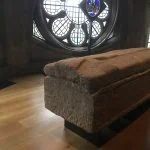
A Roman sarcophagus displayed in Westminster Abbey’s Queen’s Diamond Jubilee Galleries. New archaeological research suggests that the coffin was reused for the burial of a prominent Anglo-Saxon churchman, possibly Abbot Ælfwig. Photograph: Maggie Jones / Wikimedia Commons (Public Domain Mark).
A Monument to Valerius Amandinus
The sarcophagus itself dates to Roman Britain, probably the fourth century AD. It is made from a single block of limestone measuring approximately 2.09 metres long, 71 centimetres wide and 46 centimetres high. Geological analysis conducted in 2008 identified its stone as originating in the Taynton area of Oxfordshire.
Its most distinctive Roman feature is the decorated front, which carries an inscription commemorating Valerius Amandinus. The inscription is framed by moulding and flanked by carved ornamental panels. The craftsmanship suggests that this was an expensive funerary monument, created for an individual of some wealth or social importance.
Little is known about Amandinus himself. His precise occupation, family background and position within Romano-British society remain undocumented. Nevertheless, the quality of his memorial provides evidence that he belonged to a social world in which elaborate stone burial monuments were an established means of commemorating the dead.
Rodwell follows earlier scholarship in considering the sarcophagus a probable fourth-century Christian burial, possibly dating to the Constantinian period. This interpretation remains a scholarly judgement rather than a firmly demonstrated fact, since the surviving inscription provides no detailed biography of its original occupant.
The original coffin was probably intended for a mausoleum rather than an ordinary earth burial. Only its decorated front received careful finishing, while the back and ends remained comparatively rough. Such treatment suggests that the sarcophagus was designed to occupy a position where its inscribed face and lid could be seen, perhaps within a recess.
How did a Roman Sarcophagus Reach Westminster?
One question remains unanswered: where did the sarcophagus originally stand?
Roman London, or Londinium, possessed substantial cemeteries beyond the boundaries of the ancient city. A wealthy individual such as Amandinus might have been buried within one of these funerary landscapes, with the sarcophagus subsequently recovered and transported to Westminster during the early Middle Ages.
Another possibility is that the coffin came from the area around St Martin-in-the-Fields, where archaeological excavations have identified Roman and early medieval burials. A third explanation places its original setting somewhere closer to Westminster itself, perhaps in association with a Roman villa or funerary structure.
The latter suggestion would be particularly interesting, but the archaeological evidence remains weak. Excavations around Westminster Abbey have revealed some Roman pottery, tile fragments and reused building materials, yet no substantial Roman occupation complex has been securely identified beneath the abbey.
Rodwell therefore questions whether the presence of Roman stone and brick in medieval Westminster necessarily indicates a Roman building on the same site. Such materials could have been transported from elsewhere and reused during later construction campaigns.
This distinction matters because the sarcophagus demonstrates the survival and reuse of Roman material culture, but it does not independently establish the existence of an important Roman settlement beneath Westminster Abbey.
A Roman Monument Transformed into an Anglo-Saxon Tomb
The Cross that Changed the Coffin’s Meaning
The strongest visible evidence of medieval reuse is the large Latin cross carved along the sarcophagus lid.
Its form belongs to the late Anglo-Saxon period, probably the tenth or eleventh century. The arms widen towards their ends, while the lower section terminates in a worn decorative motif resembling foliage. The carving occupies almost the entire length of the lid, producing an unmistakably Christian monument.
The stone itself is Roman. Petrological analysis indicates that the lid and coffin were made from the same geological source, supporting Rodwell’s conclusion that the lid originally belonged with the sarcophagus and was subsequently recarved.
This distinction changes how the object should be understood. Rather than simply placing an Anglo-Saxon burial inside an old Roman coffin, those responsible for its reuse apparently transformed the monument into something suited to contemporary Christian funerary customs.
The Roman inscription continued to exist, but its significance changed. Rodwell proposes that the coffin was sunk beneath the church floor, leaving the newly carved cross visible as a grave cover. The Roman decoration would therefore have disappeared below floor level, while the Christian symbol became the principal means of identifying the burial as an important memorial.
Reusing Roman stone in medieval religious settings was not inherently unusual. Ancient buildings, monuments and decorative fragments were frequently incorporated into new structures, sometimes because they offered valuable building materials and sometimes because their antiquity carried prestige.
A particularly relevant literary parallel appears in Bede’s account of St Æthelthryth, also known as Etheldreda, whose remains were placed in a stone coffin obtained from Cambridge for her translation at Ely. The example illustrates how an older stone container could be given a new Christian purpose.
At Westminster, however, the recarved cross gives the reuse particular significance. The coffin was not merely a convenient receptacle for a body. It had been adapted to function as an ecclesiastical memorial within an important monastic church.
The Skeleton That Was Thought to Have Disappeared
A Surprising Discovery in 2016
For much of the twentieth century, scholars believed that the skeleton originally recovered from the sarcophagus had been lost.
Scott had reported that the bones were no longer present after the nineteenth-century investigations, an assertion repeated by subsequent researchers. Consequently, discussion of the burial focused predominantly on the coffin, its inscription and the unusual cross carved into the lid.
That understanding changed in 2016, when the sarcophagus was opened during conservation work undertaken in preparation for its redisplay.
The skeleton was still inside.
Archaeologists from Pre-Construct Archaeology examined the contents and found that approximately 90 per cent of the remains survived. Although earlier investigations had disturbed and rearranged the bones, their condition was sufficiently good to permit a detailed osteological assessment.
The arrangement itself revealed evidence of the object’s more recent history. The skull had been repaired, with parts glued together and the jaw secured using wire. Other bones had been placed in anatomically incorrect positions. In some cases, leg bones had apparently been used to represent parts of the arms.
These alterations were not evidence of an unusual medieval burial custom. They reflected the intervention of people handling the skeleton after its discovery, probably with a view to presenting it for public display.
This reconstruction of the skeleton’s treatment highlights an important problem in historical archaeology. Objects and human remains frequently acquire complicated histories after excavation, and the archaeological record encountered by modern researchers may have been substantially altered by earlier antiquarian practices.
What the Bones Revealed
James Langthorne of Pre-Construct Archaeology carried out the osteological analysis. He identified the principal skeleton as male, estimating the individual’s age at death as between 35 and 49 years and his stature at approximately 1.75 metres, or five feet nine inches.
These findings differed from the nineteenth-century assessment, which had suggested a younger man, probably no older than thirty, standing around five feet seven inches tall.
The skeleton also preserved evidence of the physical experiences of its occupant. Osteoarthritis affected several joints, including parts of the shoulders, vertebral column, wrist and foot. Two ribs on the left side exhibited well-healed fractures, while changes in the lower leg indicated an earlier localised infection. A possible instance of gout was also recorded.
None of these conditions securely establish the individual’s occupation or social status. Osteoarthritis could affect people from different backgrounds, and healed fractures reveal little about the circumstances in which an injury occurred.
Nevertheless, the observations help to describe the deceased as an individual rather than simply an anonymous collection of bones. He had experienced physical injury and joint degeneration but survived at least some of these conditions long enough for healing to occur.
His teeth were notably free of decay, although deposits of calculus were present. The absence of dental caries should not be taken as proof of a particular diet or privileged upbringing without further evidence.
One additional foot bone found in the sarcophagus was not part of the principal skeleton. Rodwell considers it likely to have entered accidentally during one of the historical disturbances, when human remains from surrounding burials were also being handled.
The study found no skeletal evidence establishing the man’s cause of death.
Radiocarbon Dating Places the Burial in Anglo-Saxon England
A date that fits two Westminster abbots
The most decisive scientific evidence came from radiocarbon analysis of a bone sample at the Scottish Universities Environmental Research Centre. The sample produced a radiocarbon age of 994 ± 30 years before present. After calibration, the reported date range was AD 987–1052 at a probability of 95.4 per cent.
The result supports the conclusion that the individual lived during the later Anglo-Saxon period rather than Roman antiquity. It is consistent with the date suggested by the cross carved on the lid and places the death within the period when Westminster was an established Benedictine community.
Importantly, the radiocarbon result does not identify the individual. Nor should the calibrated interval be interpreted as meaning that every year within it is equally probable.
The scientific dating establishes a chronological framework, while the historical identification depends on additional arguments concerning the importance of the burial and the individuals known to have held office at Westminster.
The Significance of Westminster’s Early Monastery
The foundation of Westminster’s Benedictine community is traditionally associated with the tenth-century monastic reforms in England. The abbey traces its foundation as a Benedictine monastery to AD 960, long before the church became closely associated with Edward the Confessor and the English monarchy.
During the decades around AD 1000, the monastery occupied a religious landscape very different from the Gothic building familiar to modern visitors. Its buildings, burial spaces and internal arrangements belonged to successive phases of early medieval construction, much of which disappeared during subsequent rebuilding.
A burial within the eastern part of the Anglo-Saxon abbey church would have represented a privileged position. Such locations were generally associated with important ecclesiastics, founders or other individuals whose memory was considered significant to the religious institution.
Rodwell proposes that the sarcophagus was originally installed in this part of the monastery, with its cross-bearing lid visible at floor level. This placement is an archaeological reconstruction rather than an excavated fact, but it offers a coherent explanation for the coffin’s medieval modification and later relocation.
Was the Medieval Occupant Abbot Ælfwig?
The Argument for Ælfwig
The proposed identification centres on the known succession of Westminster’s abbots during the late tenth and early eleventh centuries.
Rodwell considers three relevant figures: Wulfsige, Ælfwig and Wulfnoth. Wulfsige can be excluded as the likely occupant because he left Westminster to become Bishop of Sherborne in 993.
Ælfwig succeeded him and remained abbot until approximately 1020. According to Rodwell, he had already been a monk at Westminster before his election and appears to have spent his ecclesiastical career within the monastery.
His long abbacy, extending over approximately twenty-seven years, would make an important burial within the abbey a reasonable expectation. The quality of the sarcophagus and the prominent Christian cross are consistent with the commemoration of such a figure.
In Westminster Abbey’s announcement of the research, Rodwell explains the central argument for preferring Ælfwig:
The fact Aelfwig was already a monk of Westminster might favour him.
The statement is revealing because it is deliberately cautious. Ælfwig’s established association with Westminster makes him an attractive candidate, but the argument remains circumstantial.
There is no surviving medieval inscription naming Ælfwig on the reconstructed Christian lid. The Roman inscription names a different person, and the skeletal remains do not contain identifying evidence that could distinguish one abbot from another.
Why Wulfnoth Cannot be Excluded
Wulfnoth, Ælfwig’s successor, served as abbot until his death in 1049. He too is presumed to have been buried at Westminster, and his death falls comfortably within the radiocarbon date range.
The estimated age of the skeleton does little to separate the two men. Neither abbot’s date of birth is securely established, and the available historical evidence cannot determine how old either was when he took office.
Rodwell acknowledges the difficulty. The burial might belong to either man if each had been appointed as a relatively young adult and died towards the end of his forties.
The identification must therefore be considered a reasoned preference rather than a confirmed discovery. Ælfwig may be the stronger historical candidate, but Wulfnoth remains a serious alternative.
This is an important distinction for reporting the research. Archaeology can establish the date, character and treatment of a burial with considerable confidence, yet attaching a personal name to an otherwise anonymous skeleton generally requires more specific evidence.
In this case, the proposed identification depends on a convergence of chronology, architectural context, funerary prestige and the limited historical record of Westminster’s early abbots. It does not rest on a single conclusive discovery.
The Wooden Coffin Hidden Inside the Roman Stone
A Revealing Trace of Lime
One of the most distinctive findings emerged from the examination of deposits inside the sarcophagus. Historical descriptions had mentioned lime associated with the bones, but its significance was not fully understood. During modern conservation, the removal of accumulated dirt exposed a white residue on the floor of the stone coffin.
The deposit did not extend across the entire interior. Instead, it formed a clearly defined rectangular area, with straight edges set several centimetres inside the stone walls.
Rodwell interprets this as evidence that the deceased had originally been placed within a wooden coffin, which was then lowered into the larger Roman sarcophagus. The wood subsequently decayed, leaving the distribution of lime as a trace of its former position.
The interpretation is supported by deposits adhering to several bones, including parts of the shoulders, ribs and pelvis.
The lime itself had also been a subject of antiquarian investigation. Nineteenth-century analysis identified calcium carbonate rather than gypsum, distinguishing the material from the gypsum deposits associated with certain late Roman funerary practices.
The presence of lime is therefore not evidence that the skeleton belonged to the original Roman occupant. Instead, Rodwell understands it as part of the medieval burial arrangement.
The surviving rectangle offers an unusually detailed glimpse of a burial process for which the original wooden container has completely disappeared. It also demonstrates how apparently insignificant residues can preserve information about structures no longer visible in the archaeological record.
A Burial Designed to Endure
The arrangement of a wooden coffin inside a substantial stone sarcophagus suggests deliberate care in preparing the interment.
Whether the stone container was chosen primarily for its impressive appearance, its durability, its association with Roman antiquity or some combination of these factors cannot be established. Nevertheless, transporting and adapting such a monument would have required more effort than an ordinary burial.
The addition of a large carved cross also suggests that the commemorative function was important.
In my view, this is one of the more persuasive aspects of Rodwell’s interpretation. The combined treatment of the body, the stone container and the grave cover points towards an exceptional burial, although the precise identity of the deceased remains uncertain.
How Henry III's Rebuilding Changed the Tomb's Fate
From an Anglo-Saxon Church to a Gothic Abbey
The sarcophagus’s history did not end with its medieval burial.
In 1245, Henry III began the rebuilding of Westminster Abbey in the Gothic style. The project transformed the earlier church associated with Edward the Confessor into the magnificent structure that would become one of England’s principal royal and religious monuments.
Such extensive rebuilding inevitably affected older burials. The removal of foundations, alterations to floor levels and reconstruction of sacred spaces required decisions about how the remains of earlier generations should be treated.
Rodwell argues that the Roman sarcophagus was among the monuments removed from its original location during this process.
Its next resting place appears to have been the courtyard of the great sacristy, a structure commissioned during Henry III’s building programme. The sarcophagus was buried beside one of the courtyard walls, in a position where its lid was no longer visible.
The proposed relocation date is approximately 1258, although the exact year cannot be established.
This interpretation accounts for a particularly curious feature of the 1869 discovery: the coffin lay deep beneath the ground in a location that made little sense for the original display of its Christian memorial.
The same object had apparently moved from a prominent position within the Anglo-Saxon church to a concealed burial within the precinct of the new Gothic abbey.
A Deliberate Act of Reburial
Modern excavations of the former sacristy site, undertaken by Pre-Construct Archaeology in 2019–20 and completed in 2025, have provided further evidence for the context in which the sarcophagus was rediscovered.
The investigations located the former burial position and clarified its relationship with the medieval sacristy structures. They also demonstrated that the coffin was not part of a contemporary group of burials arranged along the courtyard wall.
The location appears to have been a separate, deliberate interment.
Rodwell interprets the relocation as part of the management of earlier graves during the rebuilding of the abbey. Rather than destroy the sarcophagus or discard the remains, those responsible apparently preserved the burial within the precinct.
The treatment could reflect continued respect for an important predecessor, although we cannot recover the motivations of the thirteenth-century community with certainty.
It is also possible that the identity of the deceased was already uncertain by the time the coffin was moved. The Roman inscription would have provided no information about the medieval individual, while the cross itself carried no surviving personal name.
Even if the tomb was originally recognised as belonging to an abbot, that knowledge may not have survived the centuries between his death and the rebuilding of Westminster. The monument continued to exist, but its precise commemorative meaning could gradually have faded.
What the Discovery Changes About Westminster's History
An Unusual Link Between Three Periods
The importance of the sarcophagus extends beyond the possible identification of a medieval abbot.
Its Roman inscription provides a physical connection with late antique Britain, while its recarved cross documents the transformation of an ancient funerary object into a Christian memorial during the Anglo-Saxon period.
The subsequent relocation associated with Henry III’s rebuilding adds a third major chapter, revealing how the medieval monastery responded to the material remains of its earlier history.
The object therefore demonstrates a continuity of use without requiring us to imagine an uninterrupted continuity of meaning. For Valerius Amandinus, the sarcophagus was originally a personal funerary monument. For the Anglo-Saxon monks, it became a prestigious Christian tomb. For those responsible for rebuilding the abbey, it was an older burial requiring accommodation within a changing religious complex.
Those different purposes are not interchangeable, but together they illuminate how medieval communities interacted with the physical inheritance of earlier generations.
A Reminder of Archaeology’s Limitations
The research also provides a useful example of how archaeological interpretations develop.
The sarcophagus has been known since the nineteenth century, yet important aspects of its history only became clear after researchers reconsidered old records, examined surviving material and applied modern scientific techniques.
The 1820 drawing explained disturbances that had previously seemed mysterious. The rediscovery of the skeleton made osteological analysis possible. Radiocarbon dating established a late Anglo-Saxon chronology, while careful examination of the lime deposits revealed the probable presence of a wooden inner coffin.
None of these discoveries alone identifies the deceased. Their importance lies in the way they combine to narrow the historical possibilities.
That distinction deserves emphasis. A convincing reconstruction of a burial’s circumstances is not necessarily the same as a proven identification, particularly when the surviving written record is incomplete.
The sarcophagus remains an archaeological object with a remarkably detailed history, but the individual inside it cannot yet be named with certainty.
A Forgotten Abbot, Perhaps, but an Important Discovery Regardless
The Roman sarcophagus at Westminster Abbey has travelled through an extraordinary sequence of historical circumstances. Created for Valerius Amandinus in Roman Britain, it was apparently adapted for a prominent Christian burial around the beginning of the eleventh century. During the thirteenth-century rebuilding of the abbey, it was probably relocated and buried beneath the grounds of the developing Gothic monastery.
Its rediscovery in the nineteenth century attracted considerable antiquarian interest, but the skeleton remained misunderstood until modern conservation and scientific investigation recovered evidence that earlier researchers could not fully appreciate.
Rodwell’s identification of Ælfwig as the most likely occupant offers an attractive explanation for the tomb’s unusual status. Nevertheless, Wulfnoth remains a plausible alternative, and neither the radiocarbon evidence nor the historical record provides a definitive answer.
The most important achievement of the research may therefore be broader than the proposed identification itself. It reconstructs the changing function of a single funerary monument across nearly a thousand years, revealing how successive communities reused, honoured, displaced and eventually rediscovered the material remains of their predecessors.
Whether or not the skeleton ultimately proves to be that of Abbot Ælfwig, the sarcophagus has become an unusually informative witness to the relationship between Roman Britain and medieval Westminster. What was once treated principally as an example of Roman funerary sculpture can now be understood as an object with a substantial Anglo-Saxon and later medieval history.
The original researcher’s own conclusion is appropriately restrained:
Consequently, we have two viable contenders for the occupant of the sarcophagus.
That uncertainty does not diminish the discovery. It is a reminder that the value of archaeological research lies not only in assigning names to the dead but also in recovering the historical circumstances that made their burials meaningful.
Frequently Asked Questions
Who was buried in the Roman sarcophagus at Westminster Abbey?
How old is the sarcophagus?
What did radiocarbon dating reveal?
Why was a Roman coffin reused in the Middle Ages?
What happened to the sarcophagus during Henry III's rebuilding?
Where is the sarcophagus today?
Sources
- Rodwell, W. (2026). Westminster Abbey’s Roman sarcophagus and its afterlife. Journal of the British Archaeological Association. https://doi.org/10.1080/00681288.2026.2675788
- Westminster Abbey. (2026, October 21). Mystery of Abbey’s Roman sarcophagus solved. https://www.westminster-abbey.org/abbey-news/mystery-of-abbeys-roman-sarcophagus-solved
Copyright, Licensing and Disclosure
© HistoryMedieval. This article is licensed under the Creative Commons Attribution–NonCommercial–NoDerivatives 4.0 International licence (CC BY-NC-ND 4.0). It may be shared unchanged for non-commercial purposes, provided that HistoryMedieval is credited and a link to the original article is included. Adaptation, commercial use and unauthorised AI reuse are prohibited.
Third-party images and materials may be subject to separate copyright terms. This article may contain affiliate links or clearly identified sponsored content.
If you believe that any text, artwork, photograph, video or other material published in this article infringes your copyright, please contact info@historymedieval.com, identifying the material concerned and the relevant article URL. We will investigate the matter and, where appropriate, take prompt corrective action.

Luciano Anastasi
Luciano is the founder of the MedievalHistory platform and the LinkedIn History Enthusiasts Group, where he is dedicated to curating and sharing high-quality medieval history content. His goal is to engage scholars, teachers, students, and enthusiasts by fostering insightful discussions and promoting scholarly resources on topics from medieval warfare and religion to societal transformations and daily life in the Middle Ages.
Luciano is also an active book reviewer, focusing on academic publications related to medieval history. He recently collaborated with Yale University Press to review forthcoming medieval history titles, aiming to deepen educators' and researchers' understanding of the period. Alongside his history endeavors, he has over 40 years of experience in IT leadership roles across various industries, including the public sector, banking, insurance, airlines and consulting, and has contributed to United Nations projects.
With a Master of Arts in Business Process Management, Luciano combines his expertise in IT strategy and governance with his passion for medieval history. He leverages technology to bridge the academic community and the wider public, making historical scholarship more accessible through engaging online content.