
Medieval Books Reveal the Hidden History of Sheeppox
- Luciano Anastasi
- 7 September 2026
- 0 Comment
- 13 Min Read

Overview
DNA preserved in medieval parchment, including the York Gospels and Corpus Glossary, has revealed that sheeppox circulated in European livestock centuries before modern veterinary records. Combined with Bronze Age sheep remains, the genomes trace the pathogen’s history back more than 3,700 years.
Cite This Work
Hidden DNA in Medieval Manuscripts Reveals Sheeppox
A medieval manuscript can preserve several kinds of history at once. There is the history deliberately written onto its pages: scripture, prayers, glosses, legal records and annotations. There is the history of the book itself, visible in its script, decoration, binding and later repairs. And, as a remarkable new study has demonstrated, there can also be a biological history hidden within the parchment.
Researchers led by University College Dublin have recovered ancient DNA belonging to sheeppox virus (SPPV) from the animal skins used to make medieval manuscripts, including the famous York Gospels. Published in Science Advances on 2 September 2026, the research reports 21 newly reconstructed ancient SPPV genomes ranging from the Bronze Age Eurasian steppe, around 1700 BCE, to early modern western Europe. Several of those genomes came from medieval parchment.
The result does more than extend the known history of a livestock disease. It opens another way of reading medieval manuscripts. Parchment pages, it turns out, may preserve evidence about the health of the animals from which they were made, and therefore about the farms, flocks and rural economies that existed behind some of Europe’s most treasured books.
A Medieval Page Was Once an Animal Skin
Before paper became widely available in Western Europe, books and documents were commonly written on parchment produced from specially prepared animal hides. Sheep, goats and cattle all supplied skins.
That material origin has always mattered to codicologists and conservators. The thickness of a skin, traces of hair follicles, repairs and differences between one folio and another can reveal something about how a manuscript was assembled. Modern biomolecular techniques have greatly expanded what we can learn from them.
DNA can survive within parchment for centuries. Proteins can identify the species of animal involved; genetic material can reveal information about the animal itself; microorganisms can leave evidence of a manuscript’s later history. The 2026 discovery adds something especially important: DNA from an animal pathogen can survive as well.
As lead author Louis L’Hôte explained:
“Parchment can also preserve animal pathogen DNA.”
This transforms parchment into what the UCD researchers describe as a biological archive. A manuscript does not simply tell historians what its scribes wanted to record. Its physical fabric may preserve information no medieval writer intended to leave behind.

Fol. 4r, the opening of the Glossary (MS 144). The manuscript was written in the early ninth century and is now held by the Parker’s Library, Corpus Christi College, University of Cambridge.
What the Researchers Found
The study reconstructed more than three millennia of sheeppox evolution by combining two very different kinds of evidence.
The oldest material came from sheep teeth recovered at Bronze Age pastoral settlements on the Eurasian steppe. Teeth are particularly useful for ancient DNA research because biological material can remain protected within them for thousands of years. The earliest viral genomes identified in the study date to roughly 1700 BCE.
The medieval evidence came from parchment manuscripts held in European collections. Among the most prominent was the York Gospels, a manuscript dating from around the turn of the eleventh century. Earlier biomolecular research places its production at Canterbury, probably around the year 1000. It contains the four Gospels as well as additional texts accumulated during its long life at York.
The new research found sheeppox DNA on multiple folios from some manuscripts. In the York Gospels, three folios tested positive: two belonging to the original manuscript and another associated with a later addition. Other positive manuscripts included the Corpus Glossary, produced around the beginning of the ninth century, and a copy of the Epistles of St Paul dated to approximately 700–800 and associated with Ireland or Northumbria.
The Corpus Glossary is particularly striking in this context. Now held at Corpus Christi College, Cambridge, it was probably produced at Canterbury around the turn of the ninth century. Its thousands of Latin, Greek and Old English entries make it one of the most important witnesses to early English literacy; Corpus Christi College describes it as the earliest substantial surviving manuscript containing Old English.
A book studied primarily for what it reveals about language can therefore also preserve evidence about medieval livestock disease.
How DNA Became Part of Manuscript Studies
Removing pieces from priceless manuscripts simply to extract DNA would clearly be unacceptable in most circumstances. One reason discoveries of this kind have become possible is the development of increasingly gentle sampling techniques.
Research on the York Gospels published in 2017 demonstrated how an eraser-based method known as eZooMS could recover proteins and DNA from parchment. Conservators already use PVC erasers in some forms of dry cleaning. Researchers discovered that the tiny eraser crumbs generated during this process could carry biological material lifted from the parchment surface. Rather than cutting into the manuscript, material that might otherwise be discarded can be analysed.
That earlier study described medieval manuscripts as reservoirs of biological information and recovered animal and microbial DNA from the York Gospels. The 2026 sheeppox research shows how far that approach can now be taken. Pathogen DNA can potentially be placed within a historical and codicological framework because scholars often know approximately where and when a manuscript was produced.
That combination is unusually valuable. Archaeological animal bones may reveal where an animal died, but dating can sometimes span generations. A manuscript can occasionally be situated much more closely within a particular cultural setting.
It does not provide an exact day or year when an animal became infected. Parchment could be stored before use, and the history of a manuscript can be complicated. Nevertheless, when biological evidence, palaeography, codicology and provenance converge, historians gain a new source for reconstructing animal disease.
The Puzzling DNA Found on Calfskin and Goatskin
One finding requires particular care. Sheeppox virus DNA was not restricted to parchment identified as sheepskin. Researchers also detected it on calfskin and goatskin. That does not prove that medieval cattle were routinely suffering from sheeppox.
The researchers offer two principal possibilities. One is occasional cross-species infection. The other is contamination introduced during parchment production, when skins and animal-derived materials could contact one another.
This distinction matters. A positive DNA result is evidence that viral material reached a particular piece of parchment. The route by which it arrived must still be interpreted.
The same caution applies more broadly. Finding sheeppox DNA in three folios of a manuscript does not tell us how many animals in a district were infected, how many died, or whether the parchment was produced during a major regional epidemic. Nor can the genetic evidence yet be matched confidently to every medieval written account of diseased sheep.
The discovery provides something slightly different, but no less important: direct physical evidence that the virus was circulating among animals connected with medieval parchment production.
Sheeppox Before the Middle Ages
The medieval manuscripts form only the middle portion of the newly reconstructed story. By comparing ancient viral genomes with modern examples, the researchers estimated that the main lineages within the genus Capripoxvirus, which includes sheeppox, goatpox and lumpy skin disease virus, diverged sometime between approximately 11,500 and 3,700 years ago.
That does not mean there is direct evidence of sheeppox 11,500 years ago. The earlier figure is an evolutionary estimate derived from genetic relationships. This study recovered the oldest direct SPPV evidence from Bronze Age sheep roughly 3,700 years ago.
The distinction is important because molecular dating and archaeological dating answer different questions. What the evidence securely demonstrates is that sheeppox had already emerged as a threat to Eurasian livestock by the Bronze Age.
Intriguingly, some important genetic changes associated with the virus were already present in those early genomes. According to the study, known gene-inactivation events found in sheeppox and goatpox viruses can be seen in the earliest ancient examples. The researchers consequently describe the sheeppox genome as having remained comparatively stable across the last few millennia.
That makes the medieval samples valuable stepping stones between Bronze Age disease and the virus known to veterinary medicine today.
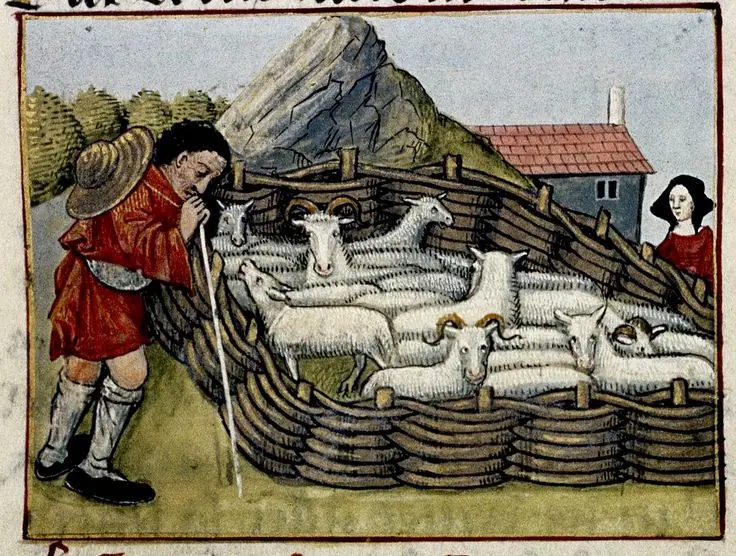
Print of sheep in woven hurdle pen. Medieval France. 15th century, MS Douce 195
What Sheeppox Meant for Medieval Livestock
Sheeppox should not be confused with human smallpox. Although both belong to the wider poxvirus family, sheeppox is a livestock disease. The World Organisation for Animal Health states that capripoxviruses are not infectious to humans.
For sheep, however, the consequences can be severe. Infection can cause fever, widespread skin lesions, internal lesions and death. Outbreaks can also damage hides and wool and reduce meat and milk production. Young and otherwise vulnerable animals can suffer especially badly.
Those effects would have mattered in medieval societies. Sheep were not simply a source of food. Depending upon region and period, they supplied wool, milk, meat, hides and manure. Wool in particular became a commodity of enormous importance to parts of medieval Europe. Disease within sheep flocks therefore had the potential to affect household survival, estate revenues and commercial production.
Yet it would be going beyond the evidence to claim that this new study has identified the economic consequences of a particular medieval sheeppox epidemic. It has not. What it provides historians is the possibility of eventually connecting pathogen evidence with surviving records of livestock mortality, estate accounts, archaeological animal assemblages and environmental evidence. That is where the discovery may ultimately prove most valuable.
Medieval Books as Archives of Animal Disease
For historians of human disease, ancient DNA has already transformed debates surrounding pathogens such as plague. Animal disease has been much harder to trace.
Medieval sources certainly record livestock mortality, often under broad terms such as cattle disease or murrain. But such descriptions rarely provide symptoms detailed enough to identify a pathogen with certainty. Different infections can produce similar outward signs, and chroniclers were not veterinary diagnosticians.
Parchment offers an entirely different kind of evidence. A surviving manuscript can sometimes connect animal tissue with an approximate date and geographical or institutional context. If sufficiently large numbers of manuscripts are tested, it may eventually become possible to map when particular livestock pathogens appear, disappear or change genetically.
Kevin G. Daly, supervising author of the study, captured the historical potential succinctly:
“Parchments not only preserve our cultural history … but also the landscape of disease in our livestock.”
Libraries and archives could therefore hold an enormous, largely unexplored collection of biological evidence.
There are limits. Contamination must be distinguished from genuine infection. Conservation treatments can alter manuscripts. The skin may not have been used immediately after slaughter. Most importantly, a single positive page cannot establish the scale of an epidemic.
But none of these qualifications diminishes the significance of the method. They simply define the questions historians can responsibly ask of it.
A Medieval Disease That Has Not Disappeared
The relevance of the research is not purely historical. Sheep pox and goat pox have re-emerged forcefully in parts of Europe recently. EFSA described their resurgence in 2024–2025 as of “unprecedented intensity”, particularly in Greece and Bulgaria. Between January 2024 and 29 January 2026, authorities reported 2,081 outbreaks in Greece and 203 in Bulgaria.
EFSA’s disease information was still being updated in August 2026, underlining that the pathogen studied in Bronze Age teeth and medieval parchment remains a contemporary veterinary problem.
Understanding its ancient evolution therefore has practical as well as historical value. If the virus has remained relatively genetically stable for thousands of years, identifying the earlier changes that enabled it to adapt to sheep may eventually help researchers understand its biology and host relationships.
Reading Medieval Manuscripts in a New Way
For more than a thousand years, people have valued the York Gospels for the words written upon their pages. Their script, decoration, additional documents and long association with York have allowed historians to reconstruct elements of Anglo-Saxon religion, book production and institutional memory.
No medieval reader could have known that another record lay inside the parchment itself. The discovery of sheeppox DNA does not transform the York Gospels into a veterinary document, nor does it prove the existence of a specific epidemic in Canterbury. Its importance lies precisely in something subtler: the physical book has preserved evidence from a world that its written text never describes.
The sheep, cattle and goats whose hides became parchment belonged to the agricultural economy supporting medieval monasteries, churches, towns and workshops. Their biological histories were literally incorporated into the books that survived them.
The 2026 study therefore represents more than an unusual application of ancient DNA. It shows how historical sources can acquire entirely new meanings when historians, geneticists, conservators and archaeologists work across traditional boundaries. A medieval manuscript remains a text. But it is also an artefact, an animal product and, unexpectedly, an archive of disease.
The next chapter in the history of medieval livestock may already be sitting quietly on a library shelf.
Sources
- L’Hôte, L., Sacristán, L., Ferguson, R., Siekmann, A., Rogers, L., Richter, B., Weissenböck, H., Lorke, J., Artemis, L., Lévêque, É., Hark, R., Engel, P., Webber, M. T. J., Bennett, M., Rose-Beers, K., Nichols, E., Munoz Alegre, M., Ramsøe, M., Fiddyment, S., … Daly, K. G. (2026). Three thousand five hundred years of sheeppox virus evolution inferred from archaeological and codicological genomes. Science Advances, 12(36), eaeh3571. doi:10.1126/sciadv.aeh3571.
- Teasdale, M. D., Fiddyment, S., Vnouček, J., Mattiangeli, V., Speller, C., Binois, A., Carver, M., Dand, C., Newfield, T. P., Webb, C. C., Bradley, D. G., & Collins, M. J. (2017). The York Gospels: A 1000-year biological palimpsest. Royal Society Open Science, 4(10), 170988. doi:10.1098/rsos.170988.
- University College Dublin. (2026, September 3). Hidden DNA in medieval gospels reveal history of deadly livestock virus.
- Corpus Christi College, University of Cambridge. (n.d.). Parker’s Anglo-Saxon Kingdoms: The Corpus Glossary (MS 144).
- World Organisation for Animal Health. (n.d.). Sheep pox and goat pox.
- European Food Safety Authority (EFSA), Alexandrov, T., Baltusytė, I., Broglia, A., Calistri, P., Gubbins, S., & De Regge, N. (2026). Sheep and goat pox: Vaccines and vaccination scenarios to control the epidemics in Greece and Bulgaria in 2025. EFSA Journal, 24(2), e9928. DOI: 10.2903/j.efsa.2026.9928.
Enjoyed this Article?
Join The Medieval Chronicle on Substack for weekly medieval discoveries, book notes, and behind-the-scenes commentary from HistoryMedieval.
Copyright, Licensing and Disclosure
© HistoryMedieval. This article is licensed under the Creative Commons Attribution–NonCommercial–NoDerivatives 4.0 International licence (CC BY-NC-ND 4.0). It may be shared unchanged for non-commercial purposes, provided that HistoryMedieval is credited and a link to the original article is included. Adaptation, commercial use and unauthorised AI reuse are prohibited.
Third-party images and materials may be subject to separate copyright terms. This article may contain affiliate links or clearly identified sponsored content.
If you believe that any text, artwork, photograph, video or other material published in this article infringes your copyright, please contact info@historymedieval.com, identifying the material concerned and the relevant article URL. We will investigate the matter and, where appropriate, take prompt corrective action.

Luciano Anastasi
Luciano is the founder of the MedievalHistory platform and the LinkedIn History Enthusiasts Group, where he is dedicated to curating and sharing high-quality medieval history content. His goal is to engage scholars, teachers, students, and enthusiasts by fostering insightful discussions and promoting scholarly resources on topics from medieval warfare and religion to societal transformations and daily life in the Middle Ages.
Luciano is also an active book reviewer, focusing on academic publications related to medieval history. He recently collaborated with Yale University Press to review forthcoming medieval history titles, aiming to deepen educators' and researchers' understanding of the period. Alongside his history endeavors, he has over 40 years of experience in IT leadership roles across various industries, including the public sector, banking, insurance, airlines and consulting, and has contributed to United Nations projects.
With a Master of Arts in Business Process Management, Luciano combines his expertise in IT strategy and governance with his passion for medieval history. He leverages technology to bridge the academic community and the wider public, making historical scholarship more accessible through engaging online content.




