

SYNOPSIS
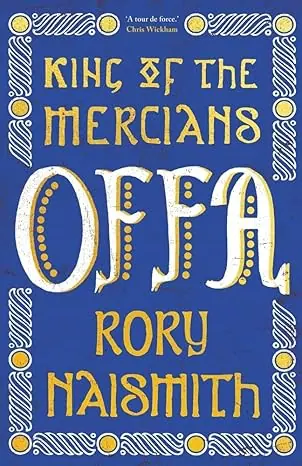
Rory Naismith’s Offa: King of the Mercians is not simply a life of a famous Anglo-Saxon ruler. It is a reconstruction of a kingdom, a court, a political culture, and a reputation built from fragmentary evidence: chronicles, Alcuin’s letters, charters, coins, archaeology, sculpture, and landscape. Naismith states in the preface that his aims are both synthetic and revisionist: to gather the totality of the evidence for Offa’s reign and to present “a new view of Offa,” and the book largely succeeds on both fronts. It brings together the scattered record of one of early medieval Britain’s most consequential rulers and argues persuasively that Offa should be understood less as a grim precursor to Alfred than as a major architect of large-scale kingship in England.
The concise verdict is straightforward: this is an outstanding book, authoritative, wide-ranging, and intellectually generous. It is especially strong where Naismith is strongest as a historian: in showing how coins, charters, and material remains can recover political reality where narrative sources fail. For readers willing to engage with evidence rather than rely on legend, this is close to a benchmark modern study of Offa. Its few limitations lie not in judgment but in density: some sections remain necessarily speculative, and the book can at times ask more concentration from general readers than a conventional royal biography would. Even so, it is a deeply rewarding achievement and a major addition to Yale’s English Monarchs series.
Genre: Non-Fiction
Age Range: Adult
Star Rating: 4.6 stars
Publication Date: May 19, 2026
This website uses affiliate links. If you purchase via these links, we might earn a commission that contributes to sustaining the HistoryMedieval.com platform.
OVERVIEW
Published by Yale University Press in the English Monarchs series, the volume runs to 384 pages and includes 33 black-and-white illustrations and 12 maps. Yale presents it as a major new biography that re-evaluates Offa’s place in Anglo-Saxon history, while also noting Naismith’s standing as a Cambridge professor and the author of prize-winning books on money, coinage, and early medieval England. Those credentials matter here because this is a book written by a scholar with long familiarity not just with Offa, but with the material systems that made Offa’s power visible.
The architecture of the book is one of its first strengths. After setting out the problems of evidence in the introduction, Naismith moves through Offa’s family, the making of Mercia, relations with neighbouring English polities, kingship and administration, royal image-making, wealth and coinage, Wales and Offa’s Dyke, Charlemagne and Rome, the end of the reign, and finally Offa’s posthumous legacy. The conclusion then steps back to ask what kind of ruler Offa was and what, if anything, he left behind. This is not a narrowly political chronicle. It is a study of rulership in the round.
Naismith is also admirably explicit about method. He warns early that a personal biography of Offa in the modern sense is impossible because the surviving evidence does not reveal a private self in any sustained way. What can be written instead, he says, is a study of “a king and his kingdom.” That choice proves wise. Rather than pretend intimacy where none is possible, the book turns lack of evidence into a historical problem and then shows how much can still be recovered when texts are read alongside coinage, charters, topography, and visual culture.
For anyone seeking to understand the power, ambition, and fragile political world of Anglo-Saxon Mercia, Rory Naismith’s Offa: King of the Mercians is essential and rewarding reading.
Enjoyed this article?
Join The Medieval Chronicle on Substack for weekly medieval discoveries, book notes, and behind-the-scenes commentary from HistoryMedieval.
CRITICAL EVALUATION
Contributions
The book’s greatest contribution is historiographical. For a long time, Offa has lived in the shadow of later West Saxon success. He tends to appear either as the man behind Offa’s Dyke, as a ruthless regional overlord, or as a failed, almost-king who did not unify England. Naismith pushes firmly against that teleology. He argues that Offa should be judged on Mercian, not retrospective English, terms. In the conclusion, he presents Offa as a ruler focused on Mercia but also as one who transformed a loose hegemony into a more articulated kingdom. That is a substantial reframing, and it is one of the book’s most convincing achievements.
This reframing works because the evidentiary base is so impressively handled. Naismith’s best pages are those where he turns coinage and charters into instruments of political interpretation. He shows how titles, minting patterns, witness lists, assembly locations, and distributions of finds reveal shifts in power, hierarchy, and royal ambition. The result is not antiquarian detail for its own sake. Instead, these sources become the scaffolding of a larger argument: that Offa consolidated rule, tightened royal oversight, and helped model forms of kingship that later rulers would inherit.
A second major strength is the treatment of the family and the court. The chapters on Cynethryth, Ecgfrith, and Offa’s daughters are among the most memorable in the book because they show power as a dynastic performance rather than a solitary male possession. Naismith’s reconstruction of Cynethryth’s prominence, through charters, coins, and household authority, is especially effective, and it gives the Mercian court a coherence that many earlier depictions of Offa lack. This makes Offa’s kingship feel institutional as well as personal. It also sharpens the tragedy of the succession crisis after 796, because the family project had looked unusually secure.
The broader geographical frame is another virtue. Offa is not confined to the Midlands here. He is set in relation to Kent, East Anglia, Sussex, Wessex, Northumbria, the Welsh kingdoms, Charlemagne’s Francia, and Rome. That wider horizon matters because the book insists, correctly, that Offa was a European ruler in an insular kingdom, not a merely provincial strongman. The chapters on Charlemagne and Rome are particularly valuable in showing how trade, diplomacy, ecclesiastical politics, and royal image crossed the Channel. This helps rescue eighth-century England from the old habit of being treated as detached from continental developments.
In stylistic terms, Naismith writes with more narrative grace than many books operating at this level of evidence density. He can be vivid without becoming theatrical. His opening chapter gives Offa historical scale; later chapters move fluidly between micro-detail and large interpretation. The prose is at its best when it slows to consider the social performance of rulership: what it meant for local elites to bring charters before the king, how assemblies tied regions to the Mercian centre, and how authority was made visible through ceremony, documents, coinage, and place.
The book is also strongly equipped as a usable scholarly volume. The illustrations and maps are not decorative additions but genuinely explanatory tools. The notes, abbreviations, index, and Further Reading section make the volume useful for both specialists and serious general readers. For a book aimed at readers beyond a narrow academic audience, that balance matters.
Limitations
The book’s main limitation is one it shares with its subject: Offa remains elusive. Naismith is admirably honest about the problem, but honesty does not remove the consequence. The first phase of the reign is comparatively dim, and Offa’s personal life remains almost impossible to recover. Readers looking for a conventional royal biography, rich in personality, dialogue, and dramatic scenes, may therefore find that this book offers something more demanding: a reconstruction of kingship rather than an intimate life of the king.
A second limitation is accessibility. Although the prose is generally clear, this remains a learned book, and at times the accumulation of charter references, numismatic detail, and historiographical positioning can slow the pace. These sections are valuable, but they require concentration. Naismith has chosen depth over simplification, and that is the right choice for a serious study of Offa; even so, it slightly narrows the circle of ideal readers.
A smaller reservation concerns presentation. The Geoffrey Hill-inspired chapter titles are elegant and often evocative, but they are not always immediately transparent for readers scanning the structure. The detailed contents pages help, yet plainer chapter titles might have made the argument easier to navigate. Likewise, while the Further Reading section is genuinely useful, a fully consolidated bibliography would have made the book even more convenient for advanced readers, reviewers, and students wanting a single panoramic view of the scholarship used.
Final Verdict
Even with these caveats, the balance of judgment remains overwhelmingly positive. Offa: King of the Mercians does not merely rehabilitate Offa. It explains why older pictures of him hardened in the first place, then demonstrates how a richer and more disciplined reconstruction can be made from difficult evidence. By the close, Naismith has not turned Offa into a saint, a proto-national hero, or a romantic myth. He has done something better: he has made him historically intelligible.
This is first-rate medieval history: rigorous without being dry, ambitious without being overstated, and attentive to both the limits and possibilities of the surviving evidence. For readers seeking to understand the power, ambition, and fragile political world of Anglo-Saxon Mercia, Rory Naismith’s Offa is essential and rewarding reading.

BOOK REVIEW METER
Editorial Assessment — HistoryMedieval.com
OVERALL SCORE 4.6/5
Rory Naismith’s Offa: King of the Mercians is a lucid and authoritative reassessment of one of Anglo-Saxon England’s most powerful rulers, with its greatest strength lying in its recovery of Mercia as a dynamic political world rather than a mere prelude to Wessex and Alfred.
AUTHOR: Rory Naismith

Rory Naismith is Professor of Early Medieval English History at the University of Cambridge and Fellow of Corpus Christi College. A specialist in Anglo-Saxon England, numismatics, monetary history, and material culture, he has written widely on early medieval economy, kingship, coinage, and documentary evidence. His books include Money and Power in Anglo-Saxon England, Citadel of the Saxons, Early Medieval Britain 500–1000, Making Money in the Early Middle Ages, and Offa: King of the Mercians.

LICENSE & COPYRIGHT
The copyright holder has published this content under the following license: Creative Commons Attribution-NonCommercial-ShareAlike. This license lets others remix, tweak, and build upon this content non-commercially, as long as they credit the author and license their new creations under the identical terms. When republishing on the web, a hyperlink back to the original content source URL must be included. Please note that content linked from this page may have different licensing terms.
If I have mistakenly misused any of your content, artwork, images, or videos, please contact me at historymedieval62@gmail.com, and I will take the necessary corrective action.
This website uses affiliate links. If you purchase via these links, we might earn a commission that contributes to sustaining the HistoryMedieval.com platform.

Luciano Anastasi
Luciano is the founder of the MedievalHistory platform and the LinkedIn History Enthusiasts Group, where he is dedicated to curating and sharing high-quality medieval history content. His goal is to engage scholars, teachers, students, and enthusiasts by fostering insightful discussions and promoting scholarly resources on topics from medieval warfare and religion to societal transformations and daily life in the Middle Ages.
Luciano is also an active book reviewer, focusing on academic publications related to medieval history. He recently collaborated with Yale University Press to review forthcoming medieval history titles, aiming to deepen educators' and researchers' understanding of the period. Alongside his history endeavors, he has over 40 years of experience in IT leadership roles across various industries, including the public sector, banking, insurance, airlines and consulting, and has contributed to United Nations projects.
With a Master of Arts in Business Process Management, Luciano combines his expertise in IT strategy and governance with his passion for medieval history. He leverages technology to bridge the academic community and the wider public, making historical scholarship more accessible through engaging online content.




