Robin Hood and More: Medieval Myths in Modern Culture
How Medieval Myths Have Shaped Today’s Popular Culture
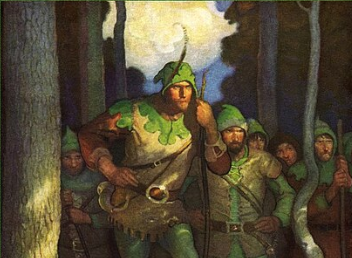
Robin Hood — N. C. Wyeth (1917)
There are perhaps few figures more famous than Robin Hood when it comes to British folklore; the outlaw hero is well known today for his ‘rob from the rich, give to the poor’ ethos, although this familiar portrayal has developed over the centuries. He has appeared in countless different iterations in modern culture. Across films, TV series, games, songs and more, he has been a highly influential presence, and he is not alone: many other medieval (and even older) figures have had a giant impact on today’s world, influencing what our media focuses on, what our games and stories explore, and what characteristics we admire and hold up as examples of good behaviour.
But where do these characters appear, and how has their influence spread? Let’s find out.
Mythical Figures Appearing in Games
Games are perhaps one of the biggest areas in which we see legendary figures like Robin Hood brought to life. Many changes have been made to traditional stories, bringing their characters into popular culture in ways that modern audiences can relate to and understand, but recognisable elements are still usually preserved. Both board games and video games frequently feature these characters to capture audiences’ imaginations.
Sticking with our Robin Hood example, a quick search will bring up all sorts of titles, including Robin Hood and the Merry Men, a semi-cooperative board game in which players seek to rescue Maid Marian and may compete to take Robin’s place as Nottingham’s protector. It’s a complex game, but one that has found an enthusiastic audience.
Robin Hood has also made his way into some surprisingly modern areas, including slot games at the casino. The appeal is obvious: he’s instantly recognisable, very fun, and has a strong association with money, which makes him an ideal pick for game designers in this world. A brief look at today’s crypto slots shows us immediately that Robin appears in at least three separate titles: Robin Hood, Robin of Loxley, and Archer Robin Hood. All call on famous characteristics from the character, bringing the lovable rogue to life on the screen.
And, of course, Robin is far from the only legendary figure to make his way into these games: searching for King Arthur will bring up titles such as Arthurian Legends, King Arthur, Arthur’s Fortune and Mighty Arthur. If we look beyond medieval British legend, few fictional figures are more famous than Count Dracula, the vampire introduced in Bram Stoker’s 1897 novel. The name has historical associations with the fifteenth-century ruler Vlad III of Wallachia, although the extent to which he inspired Stoker’s character remains disputed. A quick search reveals a tidal wave of game titles, including Dracula Riches, Guises of Dracula, Dracula the Hunt, Dracula’s Castle and many more.
That’s a quick demonstration of how influential legendary and literary figures have been in games. The same is true of film and television, where filmmakers and showrunners have adapted and reimagined these characters in a multitude of ways.
But that brings us to the next question: why do we reuse these figures, and what is the result?
Why Do We Reuse Popular Figures?
There are many reasons to reuse popular figures, but much of their appeal stems from recognition. Yes, we like novelty, but we also love the comfort of familiarity, and these games tap into that. Players may be more inclined to explore a game featuring a character they already know and love than one built around an unfamiliar figure; recognition provides the new story an immediate point of connection.
The same is true of films and television shows. Consider how often Greek gods and myths have been adapted, whether in the Percy Jackson series or Netflix’s Kaos; these works draw on an existing framework, giving audiences familiar characters and stories through which to approach a new interpretation.
That familiarity has another benefit: world-building can be richer when a framework already exists, because less explanation may be needed. In Kaos, for instance, many references immediately make sense to viewers who know the myths. Much has been changed, but the series need not explain at length that Orpheus is an extraordinary musician or that Cassandra is a prophetess: these established elements can be woven into a new setting without lengthy introductions.
And what’s the effect on us? The impact these figures have on today’s culture depends, to some extent, on the character in question: modern depictions of Robin Hood often celebrate social justice, while stories centred on Dracula tend to explore horror and fear. What is fascinating is that the appetite for such figures persists, with stories that captivated earlier generations continually retold and reimagined.
It’s also fascinating that, although these figures become part of particular cultures, they need not have originated in the cultures that embrace them today. Ancient Greek gods remain recognisable in modern adaptations, Robin Hood appeals to American audiences, and King Arthur has found readers and viewers far beyond Britain. Perhaps that is because these figures have come to embody themes that resonate across cultures, whether the fear of the unknown or the hope of justice in an unfair world. Either way, they are likely to continue weaving through popular culture, connecting the present with stories from the past.
History teaches everything, including the future – Alphonse de Lamartine, History of the French Revolution of 1848
Copyright, Licensing and Disclosure
© HistoryMedieval. All rights reserved.
This article may not be copied, republished, adapted, translated, distributed, scraped or otherwise reused without prior written permission, except where permitted by law. Unauthorised use for AI training, dataset creation, text and data mining or generative-AI systems is prohibited.
Third-party images and materials may be subject to separate copyright or licensing terms. For copyright concerns, contact info@historymedieval.com. We will review the matter and take any necessary corrective action.
This article may contain affiliate links. We may earn a commission from qualifying purchases at no additional cost to the buyer.
This article is a paid promotional feature published on HistoryMedieval.com. All content remains subject to our editorial standards.