
Rory Naismith on the World of King Offa
- Luciano Anastasi
- 19 August 2026
- 0 Comment
- 14 Min Read


Editorial Introduction
In this interview, Rory Naismith reflects on King of the Mercians: Offa, his study of one of the most powerful and intriguing rulers of early medieval England. Offa has long stood at the crossroads of history and legend: a king associated with conquest, statecraft, coinage, diplomacy, and the enduring shadow of Mercia’s political power. Yet he is also a figure whose life must be reconstructed from fragmentary and often difficult evidence.
Naismith discusses the challenge of writing about a ruler who is both famous and elusive, and explains how coins, charters, chronicles, and material culture can help recover the world in which Offa operated. The conversation also opens onto larger questions about kingship, authority, and the making of political power in early medieval Britain.
What emerges is not simply a portrait of Offa, but a wider exploration of how historians approach the early Middle Ages: carefully, critically, and always with an eye to the gap between later reputation and historical reality.
The Interview
Rory Naismith: That is a fair question. Of course, even if such a thing as the ‘Mercian recension’ of the Anglo-Saxon Chronicle existed, it probably would not give much more insight into Offa’s private mind, in the same way as the fuller Chronicle entries for Æthelred II and Edward the Confessor generally don’t. Offa is therefore an extreme version of a problem that bedevils all attempts at biography for early medieval kings. There is often good material for writing a history of how they fulfilled that role, but much less to tell you about the individual as such. All that said, I do think it is possible to draw some reasoned inferences about Offa as a person based on what we know about his kingship, especially from the last decade or so of his reign (which is the best-recorded part of it). We know that he was pious and prized his family, and that even his detractors recognised robust personal morals. This suggests a person who was not without warmth, but who was also perhaps rather rigid and protective. That comes across in some other pieces of information about him: that Offa was anxious about the loyalty of individuals and institutions, and kept a close eye on what Charlemagne was doing, as if the two of them were rivals.
Rory Naismith: Another very good question! My suspicion is that her role may have evolved over the reign. It is not known for sure what Cynethryth’s background was. Her name could fit with either the Mercian royal clan of the seventh century or the West Saxon royal kindred of the eighth (or indeed both). Either way would surely have been an important boost to Offa, especially in the early part of his reign when he must have married Cynethryth. She then springs into prominence in the charters at the time her children with Offa also appear. To me, this suggests that she rises because of her position in the dynastic scheme Offa was hatching. The coinage, at least visually, sends a similar message, since it was based closely on Roman coins in the names of empresses. It was indeed a demonstration of Cynethryth’s status but also, implicitly, a celebration of Offa’s dynastic ambitions. In other words, Cynethryth’s power starts out from her place at Offa’s side, but it evolves from there. Her coinage is big enough that it cannot be merely a token gesture, and it also circulates somewhat differently from Offa’s own coins. She seems to have taken advantage of the opportunities available to her to turn symbolic importance into tangible influence. Her position became less prominent in the last years of Offa’s reign: Cynethryth’s name no longer appeared in charter witness lists, and her coinage came to an end. It isn’t clear why this happened (she certainly didn’t die – she reappears after Offa’s death), but it is tempting to speculate that she fell out of favour, or that Offa’s priorities had evolved.
Continue the Story in Rory Naismith’s Books

Rory Naismith: You could see this as flattery and a wish to keep a potentially difficult neighbour on-side, though Charlemagne seems to have held more cards than Offa: he harboured exiles from England, his kingdom was the source of most of the silver used in England and English visitors to Rome (of which there were many) had to pass through his lands. The language of equality and fraternity is therefore something more than flattery. Probably it stems from a recognition, on both sides and despite disparities in overall size and wealth, that the English kingdoms and the Frankish lands were different spheres, and that neither was likely to be in a position to take over the other. It therefore made sense for the pre-eminent rulers in both areas to recognise and accept one another as far as possible, even if there was always simmering tension and rivalry between the two kings.
Enjoyed this Article?
Join The Medieval Chronicle on Substack for weekly medieval discoveries, book notes, and behind-the-scenes commentary from HistoryMedieval.
Rory Naismith: I don’t think Offa meant to govern the Welsh kingdoms in the same way as he meant to govern East Anglia and Kent, let alone the traditional Mercian territories likely to have first been under his control in 757. He wanted to keep the Welsh in their place, which to him meant at a safe distance. Offa’s Dyke is, in part, a sign of this: it signalled to his Welsh neighbours that he was superior, able to marshal much greater resources; and it established a clear – and very impressive – line of direct Mercian power. There is of course a question over how much of it was built by Offa, or whether he spliced together stretches of fortification that were there already. But if it was all built or connected by Offa, it represented a huge investment that probably was meant to combine several roles. Recent research has argued persuasively that the dyke was designed to be imposing to those on the west. It was at the same time meant to recall the great linear fortifications built by the Romans centuries earlier, and implicitly cast the Welsh as the barbarians. Neither of these roles would preclude a military function. The dyke on its own would be a significant obstacle to an invading army, and the intention may have been to back it up with patrols or subsidiary fortifications. Evidence for these is thin, so either the extra supporting systems were light, or they never existed in the first place (perhaps because work on this aspect of the dyke was never completed).
Rory Naismith: It is difficult to say for sure because – even more so than in other contexts – we know the story of Lichfield’s establishment at second hand, and it comes from sources with a strong vested interest in Canterbury being the sole archbishopric of southern England. They therefore also had a good reason to present the Lichfield project as a Machiavellian scheme designed only to further Offa’s personal ends and doomed to failure. It is important to treat these accounts with caution. Elevating bishoprics to archepiscopal status was by no means exceptional: York had been raised up in 735, and several Frankish bishoprics were elevated in the time of Charlemagne, sometimes on similar grounds to Lichfield. The fleeting references to Offa’s arguments for why the new archbishopric was necessary – which relate to his kingdom’s size and political dominance – only survive because they were quoted back to his successor, Coenwulf (796–821), in a letter from the pope. This suggests Offa was open about the reasons for his plan, even if we cannot know exactly how they were framed. It is likely that the archbishopric was pitched as a gain for Mercia rather than as a loss for Canterbury; it was probably also viewed through an ‘Anglian’ lens, thinking of the traditional cross-kingdom ethnic affiliations among the English as described by Bede. If later sources describing the jurisdiction of the archbishopric of Lichfield can be believed, then it included all the bishoprics north of the Thames save London, presumably because it was the seat of the bishop of the East Saxons; it was, therefore, an archbishopric of the southern Angles, leaving Canterbury as an archbishopric for the Saxon and Jutish kingdoms further south. In a way, then, this is a matter of royal authority and ecclesiastical structures working hand in hand. It was not a perfect match: most of the ‘Saxon’ territories that remained under Canterbury’s ecclesiastical jurisdiction were also politically subject to Offa. But the new archbishopric does reflect a wider pattern of Offa working closely with his bishops, especially those from the ‘Anglian’ territories; so much so that some continental observers expressed discomfort at the cosy relationship between the king and the bishops.
Rory Naismith: I think this project allowed me to see the big picture of Offa in a way I had not really been able to before. As you say, my earlier work tended to look at him through specific sources or other particular angles. But looking at the king himself and his reign in the round brought out new sides to the story. It was partly a matter of getting a clearer sense of the scholarship, and building on the gradual rehabilitation Offa has undergone in the historiography since the nineteenth century (after hundreds of years of being cast as a dastardly villain). Writing the book also brought out new connections between the many sources. I think I came to appreciate the importance of letting them speak for themselves, so that one might fill the gap left by others. The coins are very important in showing how Offa presented himself to his subjects, making comparisons to respected rulers of times gone by, and this chimes with hints at the cultural and religious fervour in Offa’s kingdom. In addition, looking at all the sources together emphasised his success in creating a new model for how big kingdoms forged from several pre-existing units could operate. This was founded on integration of subject territories into a single whole, with a common coinage and common meetings with a single king. Many of these practices, and also that of having his son raised up as co-king while the father was still ruling, were picked up by the West Saxons in the ninth century. In a way, then, Offa did lay many of the foundations for how Anglo-Saxon kingship would work in later times, despite his dynasty and eventually also his kingdom coming to an end.
About the Author

Rory Naismith is Professor of Early Medieval English History at the University of Cambridge and Fellow of Corpus Christi College. A specialist in Anglo-Saxon England, numismatics, monetary history, and material culture, he has written widely on early medieval economy, kingship, coinage, and documentary evidence. His books include Money and Power in Anglo-Saxon England, Citadel of the Saxons, Early Medieval Britain 500–1000, Making Money in the Early Middle Ages, and Offa: King of the Mercians.
Book Discussed in this Interview

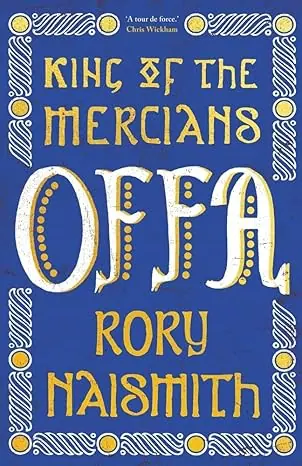
Offa: King of the Mercians by Rory Naismith
Rory Naismith’s Offa: King of the Mercians is not simply a life of a famous Anglo-Saxon ruler. It is a reconstruction of a kingdom, a court, a political culture, and a reputation built from fragmentary evidence: chronicles, Alcuin’s letters, charters, coins, archaeology, sculpture, and landscape. Naismith states in the preface that his aims are both synthetic and revisionist: to gather the totality of the evidence for Offa’s reign and to present “a new view of Offa,” and the book largely succeeds on both fronts. It brings together the scattered record of one of early medieval Britain’s most consequential rulers and argues persuasively that Offa should be understood less as a grim precursor to Alfred than as a major architect of large-scale kingship in England.
License & Copyright
© HistoryMedieval. All rights reserved. This article may not be reproduced, republished, adapted, commercially exploited or used for AI training or content generation without prior written permission. Brief quotations are permitted with proper attribution and a link to the original article.
Third-party images and materials may be subject to separate copyright terms. This article may contain affiliate links or clearly identified sponsored content.
If you believe that any text, artwork, photograph, video or other material published in this article infringes your copyright, please contact info@historymedieval.com, identifying the material concerned and the relevant article URL. We will investigate the matter and, where appropriate, take prompt corrective action.

Luciano Anastasi
Luciano is the founder of the MedievalHistory platform and the LinkedIn History Enthusiasts Group, where he is dedicated to curating and sharing high-quality medieval history content. His goal is to engage scholars, teachers, students, and enthusiasts by fostering insightful discussions and promoting scholarly resources on topics from medieval warfare and religion to societal transformations and daily life in the Middle Ages.
Luciano is also an active book reviewer, focusing on academic publications related to medieval history. He recently collaborated with Yale University Press to review forthcoming medieval history titles, aiming to deepen educators' and researchers' understanding of the period. Alongside his history endeavors, he has over 40 years of experience in IT leadership roles across various industries, including the public sector, banking, insurance, airlines and consulting, and has contributed to United Nations projects.
With a Master of Arts in Business Process Management, Luciano combines his expertise in IT strategy and governance with his passion for medieval history. He leverages technology to bridge the academic community and the wider public, making historical scholarship more accessible through engaging online content.




