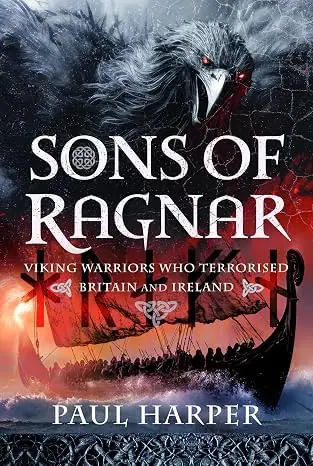
Sons of Ragnar
Authors
Paul Harper
Publisher
Pen & Sword Military
SYNOPSIS
Few figures in medieval history occupy such an uncertain position between legend and reality as Ragnar Lothbrok. The famous Viking warrior, supposedly executed in a pit of snakes by the Northumbrian king Ælla, became the subject of an extraordinary literary tradition. His sons, remembered as Ivar the Boneless, Bjorn Ironside, Ubbe, Halfdan and Sigurd Snake in the Eye, were said to have carried his legacy across Europe through conquest, vengeance and political ambition. Yet how much of this celebrated family history can be verified?
In Sons of Ragnar: Viking Warriors Who Terrorised Britain and Ireland, Paul Harper attempts to answer that question by examining the medieval chronicles, Old Norse sagas, archaeological discoveries and historical debates surrounding these formidable warriors. His investigation ranges from the Viking attacks on Francia and the Mediterranean to the establishment of Scandinavian power in Ireland and the conquest of Anglo-Saxon kingdoms.
The result is a lively, extensively researched and often compelling work of popular history. Harper succeeds particularly well when contrasting the dramatic narratives of later Scandinavian writers with the fragmentary testimony of contemporary sources. His enthusiasm for historical mysteries is infectious, although his determination to identify the real individuals behind the legends occasionally encourages conclusions that remain more speculative than the evidence permits.
Nevertheless, Sons of Ragnar makes a valuable contribution to accessible Viking Age history, offering readers an engaging examination of one of medieval Europe’s most enduring warrior traditions.
VERDICT: An engaging and thoroughly researched exploration of Ragnar Lothbrok’s legendary sons, blending historical sources, archaeology and compelling storytelling. Although some conclusions remain speculative, Paul Harper delivers an ambitious and rewarding account of the Viking Age.
GET YOUR COPY
Rated 4 out of 5
Genre: Viking Age |
Publication Date: 10 July 2026 |
ISBN: 978-1036105594 |
Extent: 277 pages |
Affiliate links may earn us a commission to support HistoryMedieval.com.
OVERVIEW
Paul Harper approaches the story of Ragnar’s sons as a historical investigation rather than a conventional collective biography. Across twenty chapters, he attempts to recover the events, personalities and political circumstances behind the legends while examining how the stories developed over the centuries.
The book begins by introducing the world from which the Viking expeditions emerged. Harper considers Scandinavian beliefs, social hierarchies, maritime technology and the development of warrior brotherhoods. Particularly interesting is his attention to the considerable resources required to equip Viking fleets, including the labour of women whose production of sailcloth, clothing and provisions made long-distance expeditions possible.
This background establishes an important context. Viking warfare was not simply the product of adventurous individuals seeking plunder. It depended upon established trading networks, political patronage, skilled craftsmanship and communities capable of supporting demanding maritime operations.
The narrative then moves into the ninth century, beginning with the Viking attack on Paris in 845, associated with a leader known in Frankish sources as Reginherus. Harper examines the possibility that this figure contributed to the later legend of Ragnar Lothbrok, setting the scene for his wider investigation.
Bjorn Ironside’s supposed exploits take the story into the Mediterranean, where Scandinavian raiders attacked territories controlled by Christian and Muslim rulers. The discussion of Iberian and Arabic sources is particularly welcome, broadening the narrative beyond the familiar Viking encounters with Anglo-Saxon England.
The book’s geographical scope subsequently expands to Ireland, where Harper considers the complex identities of Scandinavian groups described in Irish chronicles as the ‘fair foreigners’ and ‘dark foreigners’. Questions surrounding the identity of Ímar, his relationship with other Scandinavian rulers and the emergence of the powerful Uí Ímair dynasty occupy an important place in the investigation.
The arrival of the Great Heathen Army in England in 865 provides a central thread. Harper follows the campaigns associated with Ivar, Halfdan and Ubbe through Northumbria, East Anglia, Mercia and Wessex, exploring the destruction of established political structures and the emergence of new centres of Scandinavian power.
Several chapters take the reader beyond the battlefield. Discussions of the Viking winter camps, the archaeological discoveries at Repton, the fall of Alt Clut and the potential existence of female warriors introduce social, cultural and archaeological dimensions to the story. The concluding chapters return to Francia, examining the siege of Paris in 885–886 and the possibility that the Scandinavian leader Siegfried was connected with the legendary Sigurd Snake in the Eye.
By structuring the narrative around particular historical mysteries, Harper provides a broad account of the Viking Age while maintaining a personal focus on the warriors whose reputations inspired the book.
An enjoyable, ambitious and well-supported work of popular medieval history, recommended particularly for readers who want to move beyond the romanticised Ragnar legend while remaining open to the historical mysteries it continues to inspire.
Compare Prices & Get Your Copy
Enjoyed this Article?
Join The Medieval Chronicle on Substack for weekly medieval discoveries, book notes, and behind-the-scenes commentary from HistoryMedieval.
CRITICAL EVALUATION
Contributions
The book’s greatest strength lies in Harper’s willingness to investigate the relationship between history and legend rather than simply repeat familiar saga narratives. He recognises that much of what readers believe they know about Ragnar Lothbrok derives from texts composed centuries after the events they describe. The Icelandic sagas, Saxo Grammaticus’s Gesta Danorum and the poetic traditions surrounding Ragnar preserve valuable evidence of medieval storytelling, but they cannot automatically be treated as reliable accounts of ninth-century events.
Harper frequently compares these traditions with Frankish, Anglo-Saxon and Irish records, acknowledging the difficulties created by conflicting genealogies, uncertain chronology and the religious prejudices of Christian chroniclers. His examination of the ninth-century attack on Paris illustrates this approach particularly effectively. The historical account of Reginherus provides an intriguing starting point, but the connections between this leader and the legendary Ragnar remain uncertain.
Another important contribution is the integration of archaeological research. The chapters concerning Repton are particularly engaging, drawing on excavations and scientific investigations of the extraordinary burial complex associated with the Great Heathen Army. Harper explains how revised radiocarbon analysis, accounting for the effects of marine food consumption, helped reconcile previously troublesome dates with the army’s presence during the winter of 873–874.
This discussion demonstrates how archaeology can challenge or strengthen interpretations derived from written sources. Rather than relying exclusively upon accounts produced by the victims of Viking attacks, the reader encounters material evidence of burial practices, mobility, warfare and the composition of Scandinavian military communities.
Harper’s journalistic background also contributes positively to his method. He visits historical locations, considers the physical characteristics of disputed battlefields and incorporates the investigations of researchers working on local historical problems. His extensive discussion of the Battle of Cynuit in Devon, particularly Nick Arnold’s proposed identification of Castle Hill near Beaford, is among the book’s most distinctive sections.
The examination of rivers, defensive positions, landing places and possible lines of retreat encourages readers to think geographically about medieval warfare. Harper demonstrates that landscapes can preserve important clues even when the written record remains frustratingly incomplete.
His treatment of women in Viking society is another welcome feature. The chapter devoted to Lagertha considers both medieval literary traditions and archaeological discoveries involving women buried with weapons. It introduces readers to a significant historical debate without making the existence of the legendary Lagertha an established fact.
The book’s supporting material strengthens its value. Chapter-specific references, an index, a campaign map and numerous black-and-white illustrations, including photographs of archaeological sites and artefacts, encourage further exploration. Although the narrative primarily targets a general readership, it provides sufficient references for interested readers to pursue many of the underlying historical questions.
Limitations
The principal limitation concerns the distinction between a persuasive historical hypothesis and an identification that can be demonstrated with reasonable confidence.
Harper is generally aware of the problems surrounding the historical Ragnar and his supposed descendants. Nevertheless, his desire to recover a coherent family history occasionally gives speculative connections greater prominence than their evidential foundations justify.
The discussion of Ivar the Boneless provides an instructive example. Harper presents a compelling case for considering Repton as a possible burial place, drawing on the site’s importance, its association with the Great Heathen Army and the extraordinary treatment of its dead. Yet archaeological evidence establishing the presence of Viking military elites cannot, by itself, identify a particular individual. Without an inscription or other decisive evidence, the identification of Ivar remains a hypothesis rather than a proven historical conclusion.
Similar difficulties arise in the proposed connections between Sigurd Snake in the Eye and the Scandinavian leader Siegfried, associated with the siege of Paris in 885–886. The chronological circumstances and similarities between names are intriguing, but medieval names were widely repeated, while subsequent genealogical traditions frequently attached prominent ancestors to successful ruling families.
The uncertain relationship between the legendary Ragnar’s sons is itself fundamental to the historical problem. It is possible to establish the existence of several powerful Viking leaders without proving that they belonged to the same biological family or acted primarily to avenge a common father.
The investigation of the Battle of Cynuit likewise illustrates both the appeal and the limitations of Harper’s approach. The geographical arguments favouring Castle Hill near Beaford are interesting, and his first-hand consideration of the landscape brings considerable immediacy to the discussion. However, a location that corresponds well with medieval descriptions is not necessarily the correct battlefield. The proposed identification remains open to challenge until stronger archaeological or documentary evidence emerges.
At times, therefore, the narrative would benefit from more consistent distinctions between what is documented, what is reasonably inferred and what remains conjectural.
A secondary weakness concerns structure. The book’s extensive geographical range is admirable, but its movement between Scandinavian mythology, dynastic politics, archaeological investigations and individual military campaigns can occasionally feel digressive. Some background sections, while informative in themselves, delay the central discussion of Ragnar’s sons.
The narrative’s dramatic style also has mixed consequences. Harper writes vividly about warfare, ship voyages and the violent deaths of Viking leaders, qualities that make the book enjoyable and accessible. Yet occasional reconstructions of personal intentions, battlefield behaviour or imagined final experiences risk giving speculative episodes the atmosphere of documented events.
Readers may also find the complexity of recurring Scandinavian names and disputed family relationships challenging. A comparative chronology and genealogical diagrams distinguishing historically attested relationships from those preserved only in later traditions would have been particularly valuable.
These reservations do not undermine the broader achievement. Rather, they reflect the inherent difficulty of attempting to reconstruct individual lives from evidence that is incomplete, politically influenced and frequently separated from the events by several centuries.
OVERALL ASSESSMENT
Sons of Ragnar succeeds most convincingly as an investigation into the historical world from which the Ragnar legend emerged. Its strongest chapters demonstrate the value of combining written records, archaeological discoveries and careful attention to geography. They reveal a Scandinavian military culture that was considerably more complex than the familiar image of warriors descending upon defenceless monasteries.
Harper’s enthusiasm is evident throughout, and his ability to communicate demanding historical material without excessive academic language makes the book particularly attractive to general readers and Viking Age enthusiasts. Those interested in the Great Heathen Army, Scandinavian Ireland and the interaction between historical evidence and medieval storytelling will find much to appreciate.
The central historical uncertainty, however, remains unresolved. The existence of powerful Viking leaders associated with Ragnar’s legendary family does not establish the accuracy of the family relationships preserved in later Scandinavian literature. Harper makes a worthwhile case for exploring those connections, but readers should treat some of his conclusions as interpretations rather than established facts.
Ultimately, the book’s greatest value lies not in definitively identifying every son of Ragnar but in demonstrating how much can still be learned about their world through the patient examination of historical evidence.
Final verdict: An enjoyable, ambitious and well-supported work of popular medieval history, recommended particularly for readers who want to move beyond the romanticised Ragnar legend while remaining open to the historical mysteries it continues to inspire.

BOOK REVIEW METER
Editorial Assessment — HistoryMedieval.com
OVERALL SCORE 4.0/5
Contribution & Value: 4.5 / 5Broad, engaging investigation connecting the legendary family to historical developments
0
Scholarly & Visual Apparatus: 4.0 / 5Extensive references and illustrations; additional genealogical and chronological aids would help
0
Style & Readability: 4.5 / 5Vivid, accessible narrative, occasionally too dramatic in its reconstructions
0
Structure & Coherence: 3.5 / 5Ambitious geographical scope, though digressions occasionally interrupt the central argument
0
Content & Argument: 3.5/ 5Strong synthesis and source discussion, weakened by several speculative identifications
0
A compelling and richly researched exploration of the Viking Age, blending historical evidence, archaeology and vivid storytelling to uncover the remarkable lives, conquests and enduring legends of Ragnar Lothbrok’s sons.
AUTHOR: Paul Harper
Paul Harper is an experienced journalist who has been writing reports and investigations for more than a decade for British newspapers. He has worked for several top local and national news publications. Paul is now a press officer for a London-based university promoting academic research to the wider public. He has a passion for history, particularly the Anglo Saxon and Viking periods.
Copyright, Licensing and Disclosure
© HistoryMedieval. All rights reserved. This article may not be reproduced, republished, adapted, commercially exploited or used for AI training or content generation without prior written permission. Brief quotations are permitted with proper attribution and a link to the original article.
Third-party images and materials may be subject to separate copyright terms. This article may contain affiliate links or clearly identified sponsored content.
If you believe that any text, artwork, photograph, video or other material published in this article infringes your copyright, please contact info@historymedieval.com, identifying the material concerned and the relevant article URL. We will investigate the matter and, where appropriate, take prompt corrective action.