
The Mongol Tempest: The Fall of Central Asia’s Cities
- 3 February 2025
- 0 Comment
- 7 Min Read

A World on the Brink
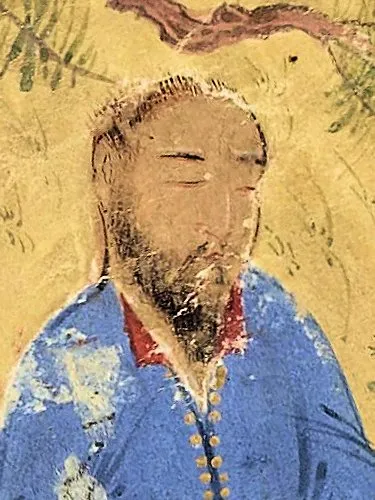
Depiction of Muhammad II in a 1430 manuscript of the Jami’ al-tawarikh by Rashid-al-Din Hamadani
Central Asia had been the jewel of the Islamic world for centuries, a cradle of intellectual brilliance where scholars debated philosophy, mathematicians devised new equations, and poets composed verses that still echo today. The cities of the region—Samarkand, Bukhara, and Nishapur—were as many learning centres as they were of commerce. Under the rule of the Khwarazmian dynasty, the region was wealthy, powerful, and utterly convinced of its superiority.
Yet beneath this veneer of strength, cracks had begun to appear. The Abbasid Caliphate, once the unifying force of the Islamic world, had been reduced to little more than a ceremonial institution. The great Seljuk Empire had collapsed, leaving a patchwork of squabbling rulers who spent more time plotting against one another than preparing for the next great invasion. The Khwarazm-Shah, Ala-ad-Din Muhammad II, saw himself as the supreme ruler of the east, but he underestimated the storm gathering beyond his borders.
An Empire Insulted
Genghis Khan, by contrast, was a man of singular vision. Born into hardship and raised in an unforgiving world, he had clawed his way to power, uniting the fractious Mongol tribes under a banner of discipline, loyalty, and unyielding conquest. By 1218, his empire stretched from the Yellow River in China to the Altai Mountains, and he was eager to expand his influence into the Muslim lands of Central Asia. But Genghis Khan was not just a conqueror—he was also a pragmatist. Before turning his armies south, he attempted diplomacy.
The Wrath of the Khan
In the autumn of 1219, the Mongol horde descended upon Central Asia with a fury never before witnessed. Moving with unprecedented speed, they divided into multiple columns, striking at different cities simultaneously. Otrar, the city that had sparked the war, was besieged for five months. When it fell, its inhabitants were slaughtered, and the governor was executed by having molten silver poured into his eyes.
A River of Blood and Ink
Bukhara, one of the most revered cities of the Islamic world, was next. Its walls, thought to be impregnable, crumbled under Mongol siege engines, their technology borrowed from Chinese engineers. When the city surrendered, Genghis Khan himself rode into its grand mosque and declared to the trembling congregation, “I am the punishment of God. If you had not committed great sins, God would not have sent a punishment like me upon you.”
Samarqand, the shining beacon of Central Asian civilization, fell within days. The Khwarazm Shah, instead of organizing a last stand, abandoned his people and fled. His son, Jalal al-Din, attempted to resist, but after a brief victory, he too was driven into exile. The once-mighty Khwarazmian Empire ceased to exist.
The Mongols’ Military Superiority
The Mongols did not simply conquer—they annihilated. In Nishapur, it was said that every man, woman, and child was put to the sword. In Merv, a city that had boasted one of the largest populations in the world, nearly a million people were slain in a single week. The Tigris River, which ran through Baghdad, was said to have turned red with blood and black with the ink of countless manuscripts thrown into its waters.
Yet, for all their destruction, the Mongols were not mindless barbarians. Their empire was built on order and administration. Those who submitted were spared and integrated into the Mongol system. Scholars, artisans, and engineers were often taken alive and relocated to serve the empire. Even as they razed cities, the Mongols built roads, encouraged trade, and established what became known as the Pax Mongolica—a period of stability that paradoxically allowed for the very intellectual and cultural exchange that the Khwarazm-Shah had failed to nurture.
A Legacy of Conquest
Though the Mongol invasion was a cataclysmic event for the Islamic world, it was not the end. The horror of their conquest eventually gave way to something unexpected: assimilation. Over time, the Mongols themselves adopted Islam, integrating into the very civilization they had once sought to destroy. The descendants of Genghis Khan, particularly those of the Ilkhanate and later the Mughal Empire, would become some of the most ardent patrons of Islamic art, science, and governance.
Historians like Ibn Khaldun would later describe the Mongols as part of a recurring cycle in history—where strong, nomadic warriors conquer decadent civilizations, only to be absorbed into them. What began as a tempest ended in transformation.
The Lesson of the Mongol Invasion
The fall of Central Asia to the Mongols was not merely the result of superior military tactics or ruthless ambition. It was, at its core, a failure of unity and leadership among the Muslim rulers of the time. The Khwarazm-Shah’s arrogance and incompetence played a role as much as Mongol cunning and brutality. It is a lesson that echoes through history: civilizations fall not only from external attacks but from internal decay.
And yet, from the ashes of destruction, new worlds emerge. The Mongols left behind a paradoxical legacy—one of devastation but also of connection. They reshaped the world not just through war but through the bridges they built between East and West. Their tempest was brief, but its echoes still shape the world today.
As we look back on this chapter of history, we are left to wonder: What other storms are brewing on the horizon? And more importantly—are we ready for them?


Luciano Anastasi
Luciano is the founder of the MedievalHistory platform and the LinkedIn History Enthusiasts Group, where he is dedicated to curating and sharing high-quality medieval history content. His goal is to engage scholars, teachers, students, and enthusiasts by fostering insightful discussions and promoting scholarly resources on topics from medieval warfare and religion to societal transformations and daily life in the Middle Ages.
Luciano is also an active book reviewer, focusing on academic publications related to medieval history. He recently collaborated with Yale University Press to review forthcoming medieval history titles, aiming to deepen educators' and researchers' understanding of the period. Alongside his history endeavors, he has over 40 years of experience in IT leadership roles across various industries, including the public sector, banking, insurance, airlines and consulting, and has contributed to United Nations projects.
With a Master of Arts in Business Process Management, Luciano combines his expertise in IT strategy and governance with his passion for medieval history. He leverages technology to bridge the academic community and the wider public, making historical scholarship more accessible through engaging online content.




