Thomas Smith on the Fifth Crusade’s War for Egypt

Editorial Introduction
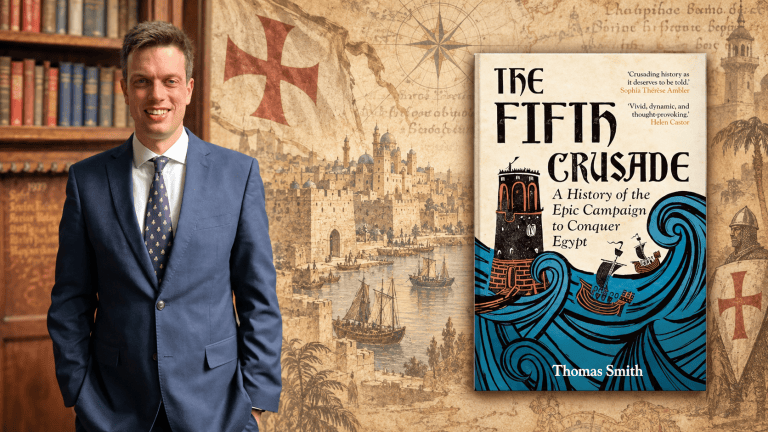
The Fifth Crusade rarely occupies the same place in popular memory as the capture of Jerusalem in 1099, Richard the Lionheart’s struggle with Saladin, or the extraordinary diversion of the Fourth Crusade to Constantinople. Yet for Thomas Smith, this relative obscurity hides a campaign of remarkable scale and ambition. Between 1217 and 1221, crusading armies turned away from the familiar battlefields of the Holy Land and attempted something far more audacious: the conquest of Egypt, the economic and political heart of Ayyūbid power. Smith describes it as a major conflict that has been largely forgotten outside academic circles.
At the heart of Smith’s new study, The Fifth Crusade: A History of the Epic Campaign to Conquer Egypt, is a reassessment of what the crusaders were trying to achieve and how close they came to achieving it. Their capture of Damietta in 1219 gave them an extraordinary foothold in the Nile Delta and opened the road to Cairo. Smith argues that the Egyptian strategy itself was far from irrational: controlling Egypt could have deprived the Ayyūbids of their principal source of wealth while strengthening the crusader states. Even in defeat, the expedition demonstrated how vulnerable Ayyūbid power could become when Egypt itself was threatened.
In this interview, Smith discusses why the Fifth Crusade deserves to be remembered, where the expedition’s fortunes began to unravel, and why its failure cannot simply be blamed on a single commander. He also explores the extraordinary influence of prophecy on crusader decision-making, the difficulties of working with partisan medieval sources, and his determination to recover the experiences of people beyond the political and military elite. The result is a conversation not only about a forgotten crusade but also about how historians reconstruct the ambitions, fears and assumptions of people living eight centuries ago.
The Interview
The Fifth Crusade is far less familiar to the general public than the First, Third or even Fourth Crusades, yet your book presents it as an extraordinarily ambitious campaign that came surprisingly close to changing the political map of the eastern Mediterranean. What first drew you to the Fifth Crusade, and why do you think its story deserves greater attention?
Thomas Smith: The short answer is the incredible, and seemingly incongruous, setting: crusaders fighting in the land of the pyramids. When I first encountered the crusade nearly twenty years ago, I found this utterly captivating, since one thinks primarily of crusades taking place in the Holy Land, rather than Egypt. The story deserves greater attention because it represents a major conflict and hugely disruptive event in world history that has been all but forgotten outside of academic circles. The Fifth Crusade and the invasion of Egypt was a riveting campaign on an epic scale that came breathtakingly close to toppling the Ayyubid regime, which affected the lives of well over a hundred thousand directly involved combatants and civilians, as well as all those who supported and wrote about the war.
One of the striking arguments in the book is that the crusade’s invasion of Egypt was not simply a disastrous adventure, but a strategically credible attempt to strike at the heart of Ayyūbid power. Looking back at the campaign, was there a particular moment when you believe the crusaders had their best opportunity to succeed, and where did that opportunity begin to unravel?
Thomas Smith: The great success of the Fifth Crusade was in the conquest of the port city of Damietta in 1219. This represented a glittering prize for the crusading movement, and the first major Muslim city in the Near East was captured by a western crusade since the time of the First Crusade in 1099. With the capture of Damietta (and Tinnis soon afterwards), the Europeans projected power and dominance in the Nile Delta. They had begun to carve out a new crusader state for the first time in well over a hundred years. There were several problems where things started to unravel – the carousel of arrivals and departures across the Mediterranean, which sapped the crusader host of experienced troops, and the failure of Emperor Frederick II to fulfil his crusade vow – but the decision which doomed the crusade was when the leaders decided to march south to besiege Cairo just as the River Nile was about to begin its annual flood. As I explain in the book, however, this was not a result of strategic stupidity but rather an intense belief in the power of prophecy, which the crusaders believed foretold their success despite the coming deluge.
Continue the Story in Thomas Smith’s Books

The failure of the Fifth Crusade has often been associated with poor leadership, particularly that of the papal legate Pelagius. Your account offers a more complicated picture, while also highlighting the damaging consequences of Frederick II’s repeated delays. Do you think historians have traditionally been too eager to identify a single person to blame for the crusade’s failure?
Thomas Smith: Like most historical events, a multi-causal explanation is usually the most compelling one, and in the case of the Fifth Crusade, there are several factors we can point to, including the period of stasis after the capture of Damietta, King John of Jerusalem’s decision to leave the crusade to pursue his dynastic ambitions in Cilician Armenia during the campaign, and personality clashes among the leaders at the highest level (usually the finger is pointed at Pelagius, though there is no contemporary evidence criticising him until after the crusade). After failures and disasters, it is human nature to look for a scapegoat on whom to pin the blame. Someone like Pelagius, a churchman representing the papacy, was an easy target, since there was a current of thought in medieval society that clerics should not be involved in warfare. But ultimately I think that we need to put all the factors together – the Nile flood, Frederick II’s absence, King John’s adventure in Armenia, and, most importantly, the crusaders’ belief in prophecies which foretold their success, in order to explain what happened on the marshy banks of the Nile in summer 1221, when the expedition collapsed.
Your book draws heavily on vivid contemporary voices such as Oliver of Cologne and Jacques de Vitry, while also incorporating Muslim perspectives and attempting to recover the experiences of people beyond the great political and military leaders. What are the particular challenges of turning sources that are partisan, religiously charged and sometimes contradictory into a narrative that is both historically rigorous and accessible to a modern reader?
Thomas Smith: I think ultimately it boils down to the historian’s selection and interpretation of the sources. Picking out the salient points, interpreting them for one’s audience, and making sense of them in the historical context in a sensitive way. We are blessed with a really rich set of sources for the campaign, especially on the crusader side, and if we ask the right questions of them, I think it is possible to close the gap between those authors writing 800 years ago and modern audiences. I always try to draw out the humanity in the material and – I hope, at least – to make connections with the people who fought on the crusade (on both sides) and the ordinary people – men, women, and children – who were affected by the war.
Stepping away from the Fifth Crusade itself, what originally drew you towards medieval history and the history of the crusades as a professional historian? And after years of researching the period, which part of the historian’s work do you still find the most rewarding: archival research, teaching, writing, or the discovery of an unexpected source?
Thomas Smith: I always loved medieval history more than any other period as a child. Trips with my parents to Bodiam Castle in East Sussex, a fascination with Robin Hood (both Disney and Costner versions), and Lego knights all played a role. It was while I was studying for my A Levels that my interest in the Middle Ages began to centre on the crusades. Thomas Asbridge’s brilliant book on the First Crusade came out, which I loved, along with associated articles and documentaries on the BBC, and this was around the same time that the film Kingdom of Heaven was released in cinemas. From that point on, I was hooked! I still love all aspects of involvement with history: I find researching and writing greatly fulfilling, archival research and discoveries are utterly thrilling (I have been fortunate to identify some new crusades manuscripts in my previous academic research), and teaching is enormous fun. I think those things all inform and reinforce each other.
Historians inevitably spend much of their lives reading for research, but what do you choose to read when you are reading purely for pleasure? Are there particular historians, works of historical writing, or historical novels that have influenced the way you think about telling the past, and is there a book you have read recently that you would especially recommend?
Thomas Smith: I mostly prefer to read historical non-fiction, interspersed with the occasional work of fiction. In terms of the latter, I love Ken Follett’s works and those of the late C. J. Sansom. There are so many superb historical non-fiction books. The most recent ones I have enjoyed have been Dan Jones’ Henry V, Helen Castor’s The Eagle and the Hart, Helen Carr’s Sceptred Isle, and Steve Tibble’s Assassins and Templars, among others. One thing that unites these works is that they manage to reconstruct the lost worlds of their subjects in a captivating way – they close the gap between the reader and the Middle Ages in a way that is spellbinding. That is something very difficult to achieve.
About the Author

Dr Thomas Smith is a prize-winning author, public historian, and leading specialist on the Crusades, known for bringing the medieval world to life through vivid, character-driven narrative. A Fellow of both the Royal Historical Society and the Royal Asiatic Society, he received his PhD from Royal Holloway, University of London, in 2013. He is Keeper of the Scholars at Rugby School and holds honorary research positions at Royal Holloway and the University of Kent.
His books include The Fifth Crusade: A History of the Epic Campaign to Conquer Egypt (Yale University Press, 2026), Rewriting the First Crusade (2024), and Curia and Crusade (2017). Rewriting the First Crusade was joint winner of the 2026 SSCLE Best Book Prize, while Curia and Crusade received a Highly Commended award in the British Records Association’s Janette Harley Prize. He is also co-author, with Susan Edgington, of The Deeds of the Franks Who Conquered Jerusalem, published by Oxford University Press.
Beyond his books, Smith has contributed more than forty articles and book chapters, served as a historical consultant for the television series Vikings, and appeared on history podcasts including Gone Medieval and History Extra. He is also an experienced international speaker, having delivered talks across Europe, North America, Asia, and Australia.
Book Discussed in this Interview
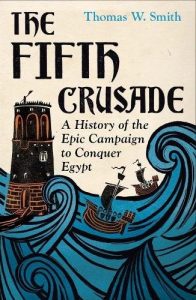
The Fifth Crusade: A History of the Epic Campaign to Conquer Egypt
by Thomas Smith
In The Fifth Crusade: A History of the Epic Campaign to Conquer Egypt, historian Thomas Smith reconstructs one of the most ambitious yet comparatively neglected campaigns of the crusading era. Rather than treating the expedition simply as a disastrous failure, Smith explains the strategic logic behind the invasion of Egypt, the gruelling struggle for Damietta and the crusaders’ eventual advance towards Cairo. The campaign came remarkably close to destabilising Ayyūbid power and reshaping the eastern Mediterranean.
Written for a general audience, the book combines a vivid narrative with contemporary Christian and Muslim sources while looking beyond kings and commanders to the wider communities caught up in the conflict.
Copyright, Licensing and Disclosure
© HistoryMedieval. All rights reserved.
This article may not be copied, republished, adapted, translated, distributed, scraped or otherwise reused without prior written permission, except where permitted by law. Unauthorised use for AI training, dataset creation, text and data mining or generative-AI systems is prohibited.
Third-party images and materials may be subject to separate copyright or licensing terms. For copyright concerns, contact info@historymedieval.com. We will review the matter and take any necessary corrective action.
This article may contain affiliate links. We may earn a commission from qualifying purchases at no additional cost to the buyer.