
Viking Silver Found in a Norwegian Farm Field
- Luciano Anastasi
- 18 May 2026
- 0 Comment
- 12 Min Read

Overview
In April 2026, metal detectorists discovered the Mørstad Hoard near Rena, Østerdalen, Norway’s largest Viking Age coin hoard ever found. With over 4,700 silver coins, and counting, spanning the 980s to the 1040s, it offers an extraordinary window into Viking-era trade, wealth, and monetary history.
Cite This Work
Norway’s Greatest Viking Treasure: The Mørstad Hoard of Rena
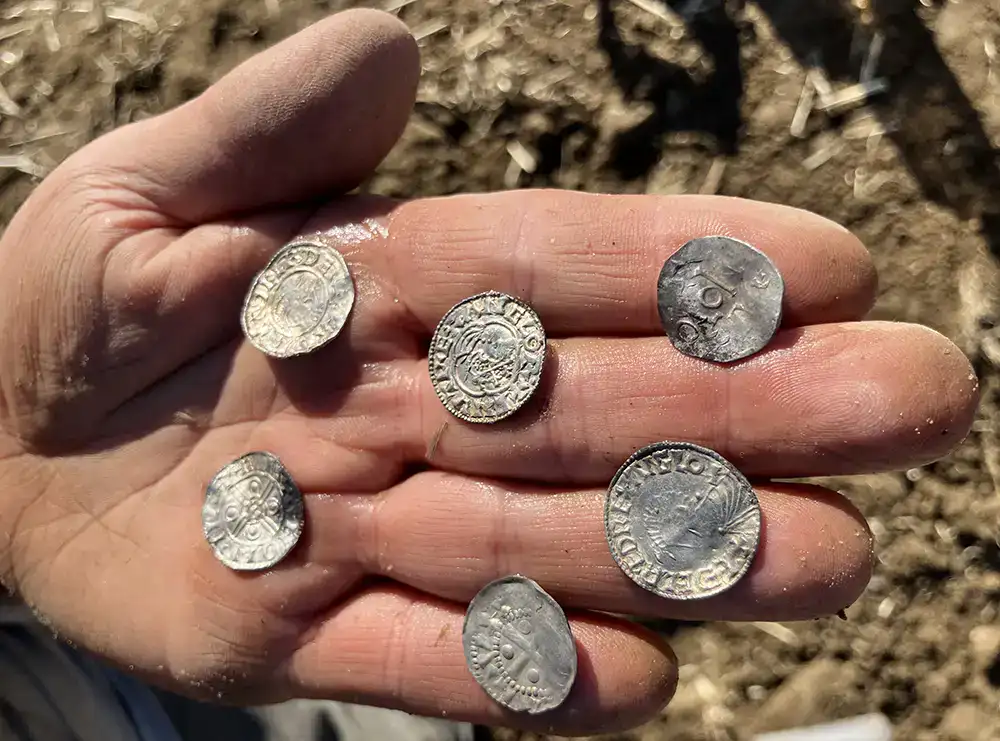
Largest coin hoard in Norwegian history. Credit – Innlandet County Authority
The Detectorists Who Stopped at the Right Moment
On a bright Friday in April 2026, two metal detectorists named Vegard Sørlie and Rune Sætre walked out onto a farm field near Rena in the Østerdalen valley of eastern Norway, equipment in hand, hoping for a gentle start to the season. The field had never been searched before. Within hours, their detectors were producing signals they could barely believe. They had found 19 silver coins — ancient, beautifully preserved, and clearly part of something much larger.
What Sørlie and Sætre did next is as important as what they found. They stopped. They secured the site and immediately contacted archaeologists at Innlandet County Authority. That act of responsible citizenship set in motion one of the most significant archaeological discoveries in Norwegian history: the unearthing of the Mørstad Hoard, the largest Viking Age coin hoard ever recorded in Norway.
A Discovery That Kept Growing
The full scale of the find only became apparent over days and weeks of meticulous fieldwork. After the initial 19 coins were recovered, archaeologists joined the detectorists, and the count climbed to 70. Archaeologist May-Tove Smiseth, responsible for metal detector finds at Innlandet County Municipality, reportedly joked that it would be nice to find enough to make the discovery even bigger. The detectors never stopped beeping. By late April, the hoard had surpassed 2,970 silver coins. By mid-May 2026, after the latest round of fieldwork concluded on 13 May, the count had reached 4,772, and experts anticipated that the final total could exceed 5,000 once a further excavation is carried out later in the year.
To put this in context: the previous record for a Viking Age coin hoard in Norway had stood since 1950, when a comparable find was made in Trondheim. The Mørstad Hoard is now larger than the next four biggest Viking Age coin hoards discovered in Norway combined. “This is a historic find. The fact that it is also from the Viking Age makes it even more spectacular,” said Andreas Bjelland Eriksen, Norway’s minister of climate and environment, in a statement reported by multiple news outlets.
For Smiseth, who has spent her career studying finds of this type, the experience was unlike anything she had encountered before. “It has been absolutely unbelievable to stand there and watch these coins be lifted out of the ground,” she told Science Norway. “And to see the quality of the coins. They are so beautiful. They have been preserved so well that they almost look newly minted.”
What the Coins Tell Us: A Numismatic Portrait of the Late Viking Age
Coin experts at the Museum of Cultural History in Oslo, having examined the hoard, report that the collection spans roughly the 980s to the 1040s. The majority of the coins are English, Anglo-Saxon and German in origin, with smaller numbers of Danish and Norwegian examples also present. Among the most historically notable are coins minted under four major rulers of the era: Æthelred II of England, Cnut the Great, who ruled both England and Denmark; Otto III of the Holy Roman Empire; and Harald Hardrada of Norway.
Professor Svein Harald Gullbekk, a specialist in medieval numismatics at the Museum of Cultural History, described the find in the most emphatic terms. “We have previously found Viking Age coin hoards containing around 2,000 coins, but never more than 3,000. They have broken a barrier here. This is truly exceptional. “Truly exceptional,” he told Science Norway. Gullbekk noted that, compared with similar discoveries in Denmark, Sweden, and England, the Mørstad Hoard holds up impressively well.
The composition of the hoard is itself a story about the economics of the Viking world. The predominance of English and German coins is not coincidental. As Gullbekk explained, these currencies functioned as the international monetary standard of northern Europe in this period — much like the euro or the dollar today. Norway at this time did not yet have a robust national coinage. Foreign silver circulated widely, facilitating trade, tribute, and payment across vast distances. The Mørstad Hoard is a physical record of that interconnected economy.
What makes the Norwegian coins in the hoard particularly significant is their rarity and their timing. According to Professor Gullbekk, it was Harald Hardrada who established Norway’s first national minting system after returning from Byzantium around 1045. The Norwegian coins in the Mørstad Hoard must, therefore, have been freshly minted when the hoard was buried — they represent the very dawn of Norwegian coinage. Experts have estimated that the hoard was deposited in the ground around 1047, right at the cusp of this momentous monetary transition.
Harald Hardrada and the End of an Era
The presence of coins from Harald Hardrada’s earliest reign places the Mørstad hoard at one of the most dramatic turning points in Viking Age history. Harald Sigurdsson — known to history as Harald Hardrada, or Harald the Ruthless — ruled Norway from 1046 to 1066 and is widely regarded as the last great Viking king. His reign marked the close of the Viking Age in Scandinavia and ended with his death at the Battle of Stamford Bridge in September 1066, just weeks before the Norman Conquest of England.
The coins provide what researchers describe as a monetary snapshot of his earliest years in power. Notably, the newest coins appear to date from the very beginning of Harald’s reign, suggesting that the hoard was assembled and concealed at precisely the moment when his authority was being consolidated, and the old, foreign-dominated monetary system was beginning to give way to a Norwegian national one. Hanna Geiran, Director General of the Directorate for Cultural Heritage, publicly mused about the implications: ‘Could Harald Hardråde himself have something to do with this? Perhaps archaeologists can now give us more answers.”
The Iron Valley: Why Rena?
One of the most compelling questions raised by the discovery is geographical: why here? Rena is not a coastal trading hub. It sits inland in the Østerdalen valley, far from the ports and markets one might associate with Viking Age wealth. The answer, archaeologists believe, lies underground — not in silver but in iron.
Archaeologist Jostein Bergstøl from the Museum of Cultural History, who is leading further excavation of the site, has pointed to the region’s remarkable industrial history. Archaeological work carried out in Østerdalen and the surrounding parts of inland Norway has revealed extensive iron-production sites from the Viking Age. From roughly the 900s until the late 1200s, the region was engaged in iron production on what researchers now believe was an industrial scale. Iron ore was extracted from the bogs, smelted, and the processed metal exported to markets across Europe.
“The Mørstad Hoard provides a striking picture of the wealth that iron production created,” said researcher Knut Loftsgarden, as reported by medievalists.net. In this light, the hoard is not mysterious at all — it is the logical consequence of a prosperous inland industry. Someone in this valley had accumulated significant wealth through the iron trade, and they buried it here for safekeeping.
Scattered by the Plough, Preserved by the Soil
The physical condition of the coins has astonished specialists. The soil at the Mørstad site contains very little stone, which appears to have created an unusually gentle burial environment. Many of the coins are so well preserved that they retain fine detail in their engravings — royal portraits, inscriptions, crosses — as though they were struck recently rather than nearly a thousand years ago.
Archaeologists believe the coins were originally buried in a leather pouch or some other organic container. As that material decayed over the centuries, the plough gradually scattered the coins across the field, which is why no single concentrated deposit was found, but rather a broad distribution of silver across a wide area. This also explains why they had gone unnoticed by the farmers who work the land. As Smiseth observed, people no longer walk their fields; they sit in machines elevated above the ground. The coins were invisible to modern agriculture, preserved only by the chance that no metal detectorist had ever thought to survey this particular field before.
Why Was It Never Recovered?
A hoard of this size, buried with such evident deliberateness, raises an immediate historical question: why did the owner never return to retrieve it? This is a question that applies to Viking Age hoards across northern Europe, and it has no single answer.
Professor Gullbekk reflected on the possibilities. The coins could have been an offering to the gods — a religious act of sacrifice rather than mere safekeeping. Alternatively, the owner may have hidden them to protect them from theft or the violence of war and simply never returned, whether through death, displacement, or misfortune. “We are probably talking about either a person or a family who stored part of their wealth in the ground here,” Gullbekk told Science Norway. He ventured that, based on land purchase records from the 1200s and 1300s, the sum may have been sufficient to buy an entire farm.
The Icelandic sagas, which Gullbekk referenced, contain numerous accounts of treasures buried in specific locations that have never been found. The Mørstad Hoard is a reminder that those stories are not merely literary conventions — they reflect a real practice and real consequences when the person who buried the treasure did not come back.
A Model of Responsible Discovery
The circumstances of the hoard’s discovery are worth pausing on, not only for their archaeological significance but also for what they say about best practices in heritage recovery. Sørlie and Sætre did everything right. They asked the landowner for permission before searching. When they realised the scale of what they had found, they immediately stopped and contacted county archaeologists. They did not attempt to excavate further on their own, and they cooperated fully with officials throughout the subsequent investigation.
“This is a discovery that all of Norway deserves to experience,” said Minister Eriksen in his official statement. For the Museum of Cultural History and the Directorate for Cultural Heritage, the case represents exactly the kind of collaboration between amateur detectorists and professional archaeologists that yields the best outcomes — both for knowledge and for preservation. The Norwegian Ministry of Cultural Heritage responded by announcing funding of 1.2 million kroner, approximately US$130,000, for continued research on the site, including ground-penetrating radar surveys to better understand the extent of the deposit.
Ongoing Excavation and Future Prospects
The investigation of the Mørstad site is far from over. Ground-penetrating radar surveys have been conducted, but, as of the time of writing, no underground architectural structures have been identified near the find location. The absence of evidence is not evidence of absence, however, and Bergstøl and his colleagues are preparing for a further season of excavation.
Gullbekk estimates that the field and its surroundings will continue to yield results over several seasons. Turning the soil often brings more objects to the surface, and the possibility of associated structural remains — a farmstead, a storehouse, any built feature that might explain why this particular spot was chosen — remains open. The coins themselves will be subjected to detailed numismatic analysis, which may resolve outstanding questions about their precise dating, their mint origins, and the sequence in which they were assembled.
Smiseth, for her part, summed up the significance of the find with characteristic directness: “This is the kind of discovery one might experience only once in a lifetime.” For historians and archaeologists working in Viking Age studies, the Mørstad Hoard promises to be a reference point for decades.
Sources
- Bergstrøm, I. I. (2026, April 29). Norway’s largest Viking Age coin hoard has been discovered: “Truly exceptional”. Science Norway.
https://www.sciencenorway.no/archaeology-culture-the-viking-age/norways-largest-viking-age-coin-hoard-has-been-discovered-truly-exceptional/2656877 - Milligan, M. (2026, April 29). Norway’s largest Viking-Age coin hoard unearthed in Østerdalen. HeritageDaily.
https://www.heritagedaily.com/2026/04/norways-largest-viking-age-coin-hoard-unearthed-in-osterdalen/157932 - Medievalists.net. (2026, May 3). Huge medieval coin hoard discovered in Norway.
https://www.medievalists.net/2026/05/huge-medieval-coin-hoard-discovered-in-norway/ - Medievalists.net. (2026, May 15). More medieval coins discovered, adding to Norway’s largest-ever hoard.
https://www.medievalists.net/2026/05/more-medieval-coins-discovered-adding-to-norways-largest-ever-hoard/ - Museum of Cultural History, University of Oslo. (2026, April 29). Enormous Viking Age coin hoard discovered.
https://www.khm.uio.no/english/news/enormous-viking-age-coin-hoard.html

License & Copyright
The copyright holder has published this content under the following license: Creative Commons Attribution-NonCommercial-ShareAlike. This license lets others remix, tweak, and build upon this content non-commercially, as long as they credit the author and license their new creations under identical terms. When republishing on the web, a hyperlink back to the original content source URL must be included. Please note that content linked from this page may have different licensing terms.
If I have mistakenly misused any of your content, artwork, images, or videos, please contact me at historymedieval62@gmail.com and I will take the necessary corrective action.
This website uses affiliate links. If you purchase via these links, we might earn a commission that contributes to sustaining the HistoryMedieval.com platform.

Luciano Anastasi
Luciano is the founder of the MedievalHistory platform and the LinkedIn History Enthusiasts Group, where he is dedicated to curating and sharing high-quality medieval history content. His goal is to engage scholars, teachers, students, and enthusiasts by fostering insightful discussions and promoting scholarly resources on topics from medieval warfare and religion to societal transformations and daily life in the Middle Ages.
Luciano is also an active book reviewer, focusing on academic publications related to medieval history. He recently collaborated with Yale University Press to review forthcoming medieval history titles, aiming to deepen educators' and researchers' understanding of the period. Alongside his history endeavors, he has over 40 years of experience in IT leadership roles across various industries, including the public sector, banking, insurance, airlines and consulting, and has contributed to United Nations projects.
With a Master of Arts in Business Process Management, Luciano combines his expertise in IT strategy and governance with his passion for medieval history. He leverages technology to bridge the academic community and the wider public, making historical scholarship more accessible through engaging online content.




