1066: The Norman Conquest and the End of Anglo-Saxon England
Overview
The Norman Conquest of 1066 ended Anglo-Saxon royal rule and transformed England’s political, social and economic landscape. From Cnut’s Scandinavian empire to the Domesday survey of 1086, this article examines the competing claims, military confrontations, resistance and enduring Anglo-Saxon institutions that shaped a conquered kingdom.
Cite This Work
Anastasi, L. (2026, November 26). 1066: The Norman Conquest and the End of Anglo-Saxon England. Medieval History – Yesterday in a Nutshell. https://historymedieval.com/1066-the-norman-conquest-and-the-end-of-anglo-saxon-england/
The Kingdom That Fell in 1066
On 14 October 1066, King Harold Godwinson lost his life at the Battle of Hastings, bringing to an end one of the most remarkable chapters in English history. The victory of William, Duke of Normandy, marked the downfall of an aristocratic and political order whose origins stretched back to the Anglo-Saxon kingdoms that had emerged following the collapse of Roman Britain.
Over the preceding centuries, rulers such as Alfred the Great, Edward the Elder and Æthelstan had transformed a collection of competing kingdoms into a relatively unified and prosperous English state. By the eleventh century, England possessed an efficient system of taxation, an established monetary economy, sophisticated administrative institutions and extensive commercial connections with northern Europe. These achievements, however, also made the English crown an attractive prize for ambitious rulers beyond its shores.
Although 1066 is conventionally regarded as the end of Anglo-Saxon England, the transformation that followed Hastings was neither immediate nor complete. To understand the Norman Conquest and its consequences, we must return fifty years to another foreign conquest, examine the political rivalries that undermined the kingdom and consider what remained of Anglo-Saxon England when William ordered his great survey of 1086.
Cnut and the Scandinavian Kings of England (1016–1042)
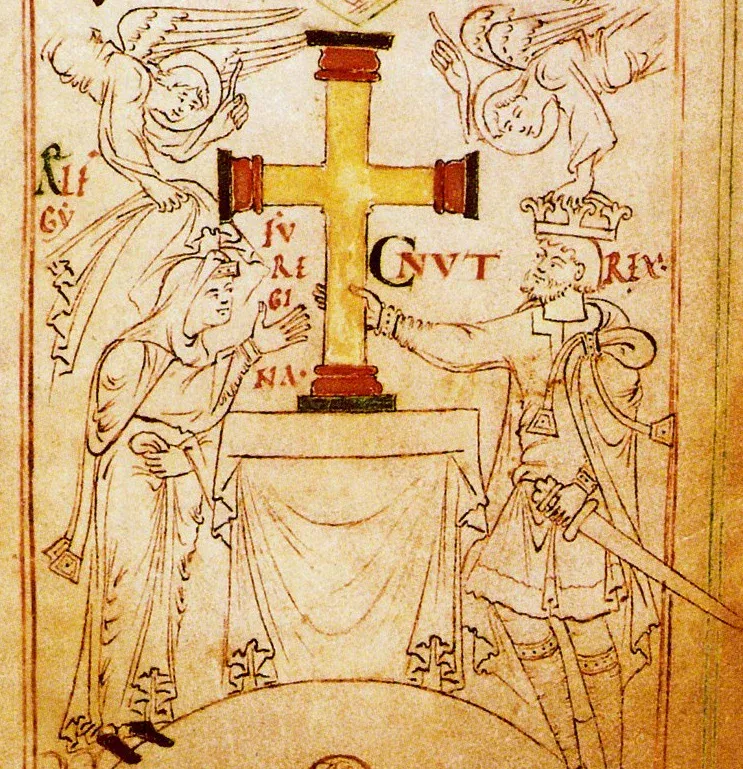
King Cnut and Queen Emma present a golden cross to the New Minster at Winchester, illustrating the Christian character of Cnut’s kingship. Credit: Unknown eleventh-century artist, British Library, Stowe MS 944, fol. 6r / Wikimedia Commons.
The Norman Conquest was not the first occasion on which England had fallen under the authority of a foreign ruler. In 1016, following years of Scandinavian attacks and political instability during the reign of Æthelred II, the Danish prince Cnut secured control of the English kingdom.
After Æthelred’s death in April 1016, his son Edmund Ironside continued the struggle against Cnut. Edmund’s defeat at the Battle of Assandun in October resulted in an agreement dividing England between the two rulers. When Edmund died the following month, Cnut became the undisputed king of England.
Cnut subsequently acquired the crowns of Denmark and Norway, creating what historians often describe as the North Sea empire. England became part of a wider maritime political network that connected the British Isles with Scandinavia, rather than an isolated kingdom on the western edge of Europe.
Despite his origins as a conqueror, Cnut did not attempt to dismantle the English state. Although some members of the existing nobility were removed, he retained much of the kingdom’s administrative structure, supported the Christian Church and governed through powerful regional earls. Among those who prospered under his rule was Godwin, Earl of Wessex, whose family would eventually dominate English politics.
Cnut’s marriage in 1017 to Emma of Normandy, the widow of Æthelred, further strengthened his dynastic position. Emma was already the mother of Edward, the future Confessor, and her marriage to Cnut produced another future English king, Harthacnut. The arrangement illustrates the extraordinary complexity of the dynastic relationships connecting England, Scandinavia and Normandy.
Following Cnut’s death in 1035, his sons Harold Harefoot and Harthacnut successfully ruled England. Harthacnut died childless in 1042, allowing his half-brother Edward to inherit the throne and restore the West Saxon royal dynasty. The Scandinavian interlude had ended, but the international rivalries and aristocratic alliances created during those years would continue to influence English politics. (Musgrove & Lewis, 2026, pp. 13–20; English Heritage, n.d.-a.)
Edward the Confessor and the Rise of the Godwin Family (1042–1065)
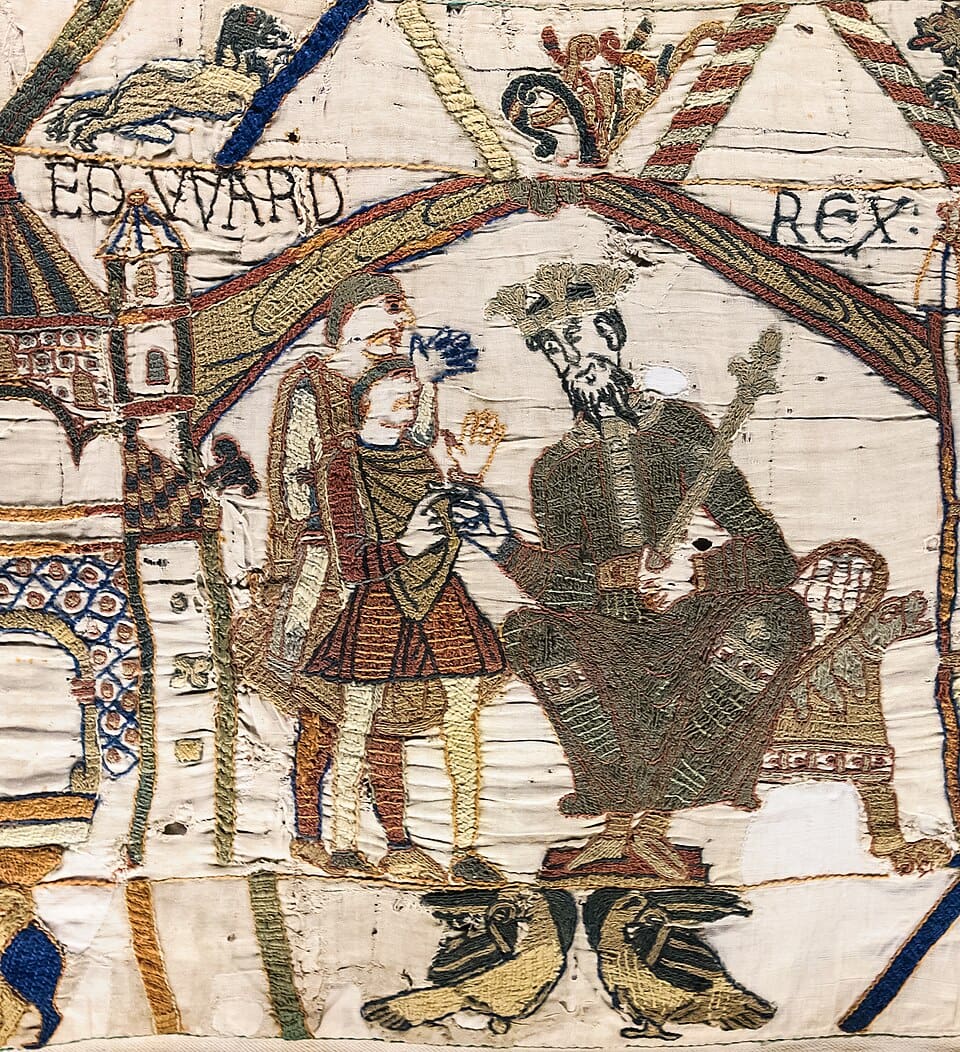
Edward the Confessor, enthroned, opening scene of the Bayeux Tapestry
Edward the Confessor returned to England after spending much of his earlier life in exile in Normandy. His continental upbringing, Norman family connections and preference for certain foreign advisers contributed to tensions with members of the established English aristocracy, particularly the powerful Godwin family.
Godwin had supported Edward’s accession despite the troubled history between the two men. Edward’s younger brother Alfred had been captured and fatally mistreated after returning to England in 1036, an episode in which Godwin was implicated, although the precise extent of his responsibility remains disputed.
In 1045, Edward married Godwin’s daughter Edith, strengthening the relationship between the royal household and England’s most powerful noble family. Nevertheless, the marriage produced no children, leaving the future succession uncertain and making the relationship between the king and his earls increasingly important.
The political crisis of 1051
Relations between Edward and Godwin deteriorated dramatically in 1051 following a violent confrontation in Dover involving the entourage of Eustace II, Count of Boulogne, and the townspeople. Godwin refused to carry out Edward’s demands against the inhabitants, provoking a confrontation that brought England dangerously close to civil war.
The Godwin family was outlawed and forced into exile, but its absence proved short-lived. Returning with substantial support in 1052, Godwin recovered his estates and titles, while Edward was compelled to dismiss several of his continental associates. The crisis demonstrated that royal authority depended heavily upon cooperation with the kingdom’s leading aristocrats.
When Godwin died in 1053, his son Harold succeeded him as Earl of Wessex. Harold gradually established himself as an influential political and military figure, strengthening his reputation through campaigns against the Welsh ruler Gruffudd ap Llywelyn. His brothers also held important positions, giving the family considerable influence across the kingdom.
The rebellion against Tostig
The apparent unity of the Godwin family concealed serious internal tensions. In 1065, a rebellion erupted in Northumbria against Harold’s brother Tostig, whose government had provoked accusations of excessive taxation, injustice and the mistreatment of local nobles.
The rebels rejected Tostig and selected Morcar, a member of the rival Mercian aristocratic family descended from Earl Leofric. Harold accepted the political settlement that resulted in his brother’s removal, while Tostig went into exile and subsequently sought foreign assistance.
Historian Tom Licence, in Harold: Warrior King (2026), offers a more critical interpretation of Harold’s conduct than traditional accounts. Drawing upon narrative sources and evidence of landholding preserved in the Domesday Book, Licence argues that Harold may have actively exploited the rebellion to weaken Tostig and strengthen his own political position.
Whether Harold deliberately encouraged the crisis remains open to debate, but the episode exposed the fragility of England’s political alliances. When Edward’s health deteriorated towards the end of 1065, the kingdom was already experiencing a serious breakdown in relations between its most powerful families. (Licence, 2026, chs. 8–9; Musgrove & Lewis, 2026, ch. 1.)
Four Claimants and a Crown: The Succession Crisis of 1066
Edward the Confessor died on 5 January 1066, only days after the consecration of his newly rebuilt Westminster Abbey. His death brought an end to a twenty-four-year reign and exposed the fundamental problem that had overshadowed much of his kingship: the absence of a direct heir.
Anglo-Saxon royal succession was not governed by the strict principle of primogeniture, whereby the eldest son automatically inherited the throne. Royal ancestry carried considerable importance, but political influence, military capability, royal designation and recognition by the leading members of the kingdom also mattered. In January 1066, these considerations produced several competing claims.
Harold Godwinson: England’s chosen king
As Earl of Wessex, Harold possessed enormous wealth, extensive political connections and considerable military experience. English sources indicate that Edward entrusted the kingdom to Harold shortly before his death, and Harold was recognised as king by the leading members of the English aristocracy. He was crowned on 6 January 1066.
The precise meaning of Edward’s deathbed instructions, however, remains disputed. Tom Licence argues that Edward may have intended for Harold to act as protector of the kingdom rather than succeed him as monarch, with Queen Edith retaining an important position and Edgar Ætheling remaining the intended dynastic heir.
This interpretation challenges the traditional understanding of Harold’s accession, although his recognition and coronation established him as the reigning king of England. The distinction between possessing the crown and having an undisputed right to inherit it would become fundamental to the events of 1066. (Licence, 2026, chs. 9–10.)
William of Normandy: A disputed promise
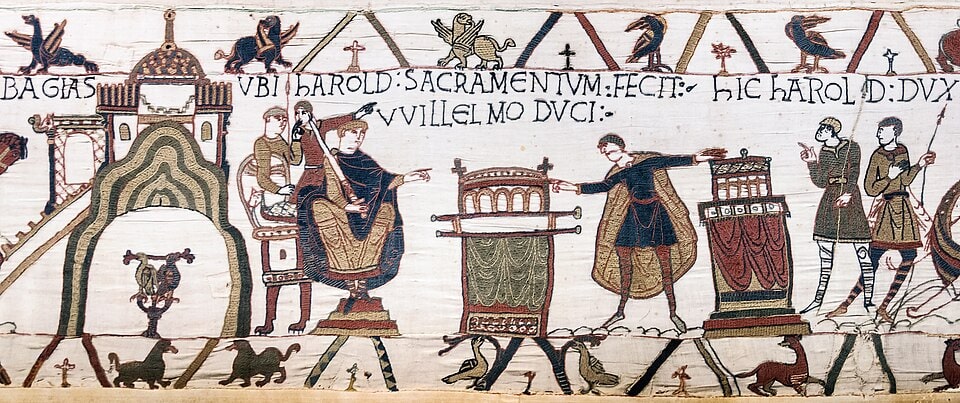
Harold Godwinson swears a sacred oath to Duke William. The embroidery does not specify the precise terms of the oath.
Across the English Channel, William of Normandy maintained that Edward had promised him the English throne, possibly during the political crisis of 1051. Norman chroniclers also claimed that Harold had subsequently sworn an oath recognising William’s right to succeed Edward.
The famous scene in the Bayeux Tapestry depicting Harold touching sacred reliquaries appears to support the existence of an oath. Its accompanying Latin inscription reads:
UBI HAROLD SACRAMENTUM FECIT WILLELMO DUCI.
— Bayeux Tapestry, Scene 23 (Where Harold swore a sacred oath to Duke William).
Yet the inscription does not reveal the terms of the oath. As David Musgrove and Michael Lewis explain in The Story of the Bayeux Tapestry: Unravelling the Norman Conquest, Harold may have sworn more than one oath during his time in Normandy, and the exact relationship between these promises and the English succession remains uncertain.
Norman writers such as William of Poitiers presented Harold’s accession as an act of perjury, providing a moral justification for William’s invasion. The English chroniclers, however, offer a different perspective, and no surviving contemporary agreement independently establishes that Edward had irrevocably promised William the crown. (Musgrove & Lewis, 2026, pp. 118–124.)
Harald Hardrada: The Scandinavian claim
The Norwegian king Harald Hardrada advanced a claim rooted in the earlier Scandinavian kingship of England. According to tradition, Magnus the Good of Norway and Harthacnut had agreed that, should either die without an heir, the survivor would inherit the other’s kingdom.
Harald, who succeeded Magnus as king of Norway, subsequently asserted a claim to England based on this arrangement. Although the agreement and its application to the English crown remain open to question, Harald’s ambitions became considerably more dangerous when he secured the cooperation of Harold Godwinson’s exiled brother Tostig.
The Norwegian challenge demonstrated that the political legacy of Cnut’s North Sea empire had not disappeared with the restoration of the West Saxon dynasty in 1042.
Edgar Ætheling: The overlooked royal heir
Often overshadowed by the three military contenders, Edgar Ætheling possessed arguably the strongest hereditary claim to the English throne through the male line of the West Saxon dynasty. He was the grandson of Edmund Ironside and the son of Edward the Exile, who had returned to England in 1057 but died shortly afterwards.
Edgar was still an adolescent in 1066, and England’s leading aristocrats may have considered an experienced military ruler preferable in the face of foreign threats. Nevertheless, youth did not automatically exclude a prince from medieval kingship, as contemporary examples elsewhere in Europe demonstrate.
His exclusion from the succession therefore reflected political circumstances rather than an absence of dynastic legitimacy. By choosing Harold, the English aristocracy had secured an experienced king, but it had not eliminated the competing claims that threatened the kingdom. (Musgrove & Lewis, 2026, pp. 18–20; Licence, 2026, chs. 9–10.)
The Northern Invasion: Fulford and Stamford Bridge
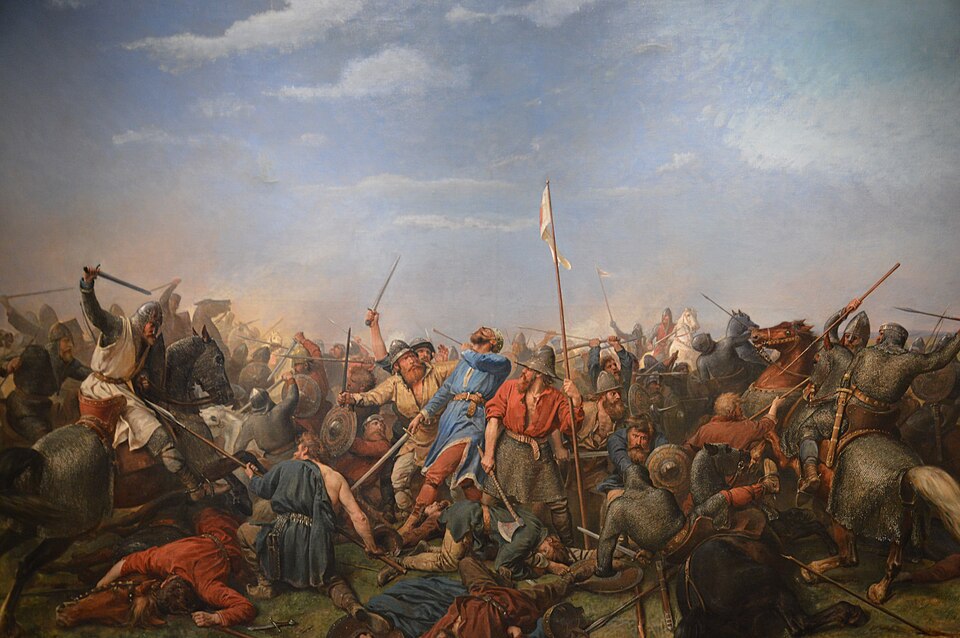
The Battle of Stamford Bridge by Peter Nicolai Arbo, 1870.
Throughout much of 1066, Harold faced the possibility of invasion from both Scandinavia and Normandy. His military difficulties were compounded by the seasonal limitations of the English military system, which made it difficult to maintain large forces indefinitely while awaiting an enemy whose arrival remained uncertain.
In September, Harald Hardrada and Tostig launched their invasion of northern England. On 20 September 1066, they defeated the forces of Edwin, Earl of Mercia, and Morcar, Earl of Northumbria, at the Battle of Fulford, near York. The victory exposed northern England to Norwegian occupation and presented Harold with an immediate challenge to his authority.
Five days later, on 25 September, Harold defeated the Norwegian invaders at the Battle of Stamford Bridge. Both Harald Hardrada and Tostig were killed, effectively destroying the immediate Scandinavian challenge to the English throne.
The victory was a considerable achievement and demonstrated Harold’s ability to mobilise the resources of his kingdom in response to a major military emergency. Stamford Bridge is frequently described as the end of the Viking Age, although Scandinavian intervention in English affairs continued after 1066, making such a definitive chronological division somewhat misleading.
The surviving accounts of the northern battles also present difficulties for historians. The Anglo-Saxon Chronicle provides relatively early evidence, whereas some of the more dramatic stories associated with Stamford Bridge derive from Scandinavian sagas composed considerably later.
Harold’s triumph in Yorkshire nevertheless came at a particularly unfortunate moment. Only three days after Stamford Bridge, William of Normandy arrived in southern England, confronting the English king with another invasion before the political and military consequences of the first had been fully resolved. (English Heritage, n.d.-b; Licence, 2026, ch. 13.)
The Battle of Hastings: The Fall of Anglo-Saxon Kingship
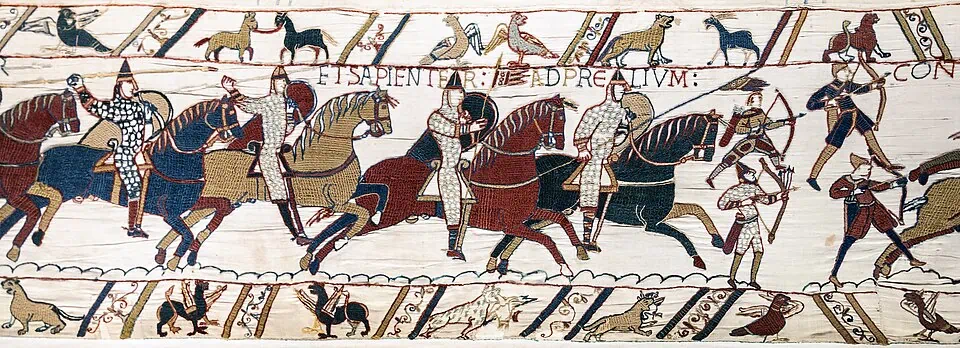
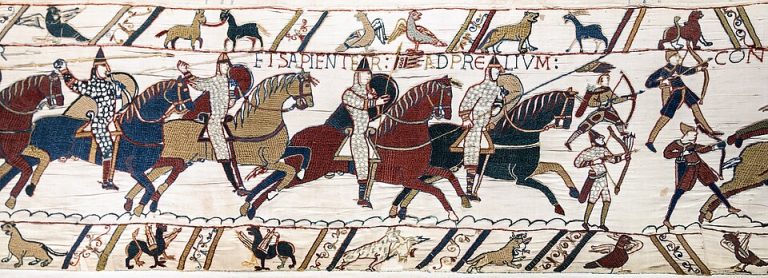
Tapisserie de Bayeux – Scène 51 (partielle) : la bataille d’Hastings, avec des chevaliers et des archers normands.
William’s invasion represented an enormous political and military undertaking. The Norman duke had assembled a coalition that included not only Normans but also men from Brittany, Flanders and other continental territories. Their motivations ranged from loyalty to William and support for his dynastic claim to the prospect of acquiring wealth and landed estates in England.
On 14 October 1066, Harold and William confronted one another at the Battle of Hastings. The battle brought together different military traditions, with the English army relying predominantly on infantry and the invading force incorporating infantry, mounted warriors and archers.
The struggle was fiercely contested, and William’s victory should not be regarded as inevitable. Although Harold’s recent northern campaign undoubtedly complicated his preparations, historians cannot establish precisely how many of the men who fought at Stamford Bridge subsequently participated at Hastings, nor the extent to which exhaustion determined the outcome.
Harold’s defeat culminated in his death and those of his brothers Gyrth and Leofwine. The loss of several leading members of the Godwin family in a single battle deprived England of much of its established political and military leadership, creating circumstances that William could exploit in the months that followed.
Did an arrow really kill King Harold?

Harold’s death depicted in the Bayeux Tapestry
The apparent depiction of Harold receiving an arrow in his eye is one of the most recognisable images from mediaeval history. The inscription above the scene states:
HIC HAROLD REX INTERFECTUS EST.
— Bayeux Tapestry, Scene 57 (Here King Harold is killed).
The embroidery, however, does not establish beyond doubt which of the figures represents Harold or precisely how he died. One figure appears to have a projectile near his face, while another is being struck down by a mounted warrior.
Musgrove and Lewis draw particular attention to the evidence of earlier illustrations of the Bayeux Tapestry. Antoine Benoît’s engraving of 1729 and Charles Stothard’s nineteenth-century drawing depict differences in the object associated with the standing figure. Subsequent restoration work may have altered the embroidery to reinforce the familiar story of Harold’s death.
The authors’ comparison of these representations, reproduced in Plates 16 and 17 of their book, illustrates why the surviving embroidery must be examined as a historical artefact with its history of damage, repair and interpretation. Harold certainly died at Hastings, but the precise circumstances of his death remain unresolved. (Musgrove & Lewis, 2026, pp. 198–201.)
What can archaeology tell us about Hastings?
The traditional battlefield at Battle, East Sussex, is closely associated with the abbey that William subsequently founded. Historical evidence strongly supports identifying this location, although archaeologists have not recovered any securely identified archaeological artefacts from the battle itself there.
The absence of such discoveries does not demonstrate that the battle occurred elsewhere. Medieval battlefields could extensively clear valuable equipment, while agricultural activity, construction, and natural processes over subsequent centuries can obscure surviving evidence.
Archaeological investigations have nevertheless revealed substantial remains of the later monastic complex, helping historians understand how the Normans commemorated their victory. Battle Abbey became both a religious foundation associated with the bloodshed of 1066 and a permanent monument to William’s conquest. (English Heritage, n.d.-c, n.d.-d.)
Winning the Crown Was Not Enough: Conquest and Resistance (1066–1075)
The death of Harold did not immediately bring England under Norman control. Surviving members of the English aristocracy initially rallied around Edgar Ætheling, who was proclaimed king but never crowned. Their inability to organise an effective response ultimately allowed William to secure the submission of the leading English nobles.
On Christmas Day 1066, William was crowned king of England at Westminster Abbey. The ceremony took place within the religious foundation that Edward the Confessor had rebuilt, providing William with a powerful connection to the preceding English monarchy. His coronation, however, established a claim to authority that still needed to be enforced throughout the kingdom.
English resistance and the Harrying of the North
Rebellions broke out in several regions during the following years. Exeter resisted William in 1068, while opposition in northern England became particularly threatening in 1069, when Danish intervention offered renewed support to English resistance.
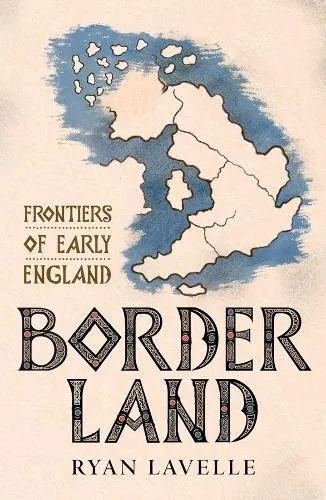
The difficulties William encountered in the north had much deeper roots in a longer history of regional independence and contested authority. As Ryan Lavelle emphasises in Border Land: Frontiers of Early England, English kings had already exercised varying degrees of control over Northumbria before the Norman Conquest. The rebellion against Tostig in 1065 demonstrated the continuing strength of regional political identities and interests.
William responded to northern resistance with a campaign of devastation during the winter of 1069–1070, remembered as the Harrying of the North. The destruction of settlements, crops and livestock inflicted severe hardship upon local communities, with starvation and displacement among its consequences.
Medieval chroniclers provide disturbing accounts of the suffering, although historians continue to debate its geographical extent and the reliability of later descriptions. Domesday Book records extensive areas of reduced or absent economic value in parts of Yorkshire, but not every estate described as waste can automatically be attributed to a single destructive campaign.
Resistance also continued elsewhere. In East Anglia, Hereward the Wake became associated with opposition centred on the Isle of Ely in 1070–1071. Although later stories transformed Hereward into a legendary English hero, the historical resistance in the region demonstrates that opposition to Norman rule persisted long after Hastings.
The Revolt of the Earls in 1075, which involved both Norman and English nobles, showed that William’s power could be questioned by people who had first accepted or benefited from the new government. The conquest was a continuing struggle to establish control rather than a political transformation completed in a single year.
Castles: The archaeology of Norman authority
The construction of castles was among the most visible physical consequences of the Norman Conquest. Although castles existed in England before 1066, William and his followers introduced them on an unprecedented scale, transforming both urban and rural landscapes.
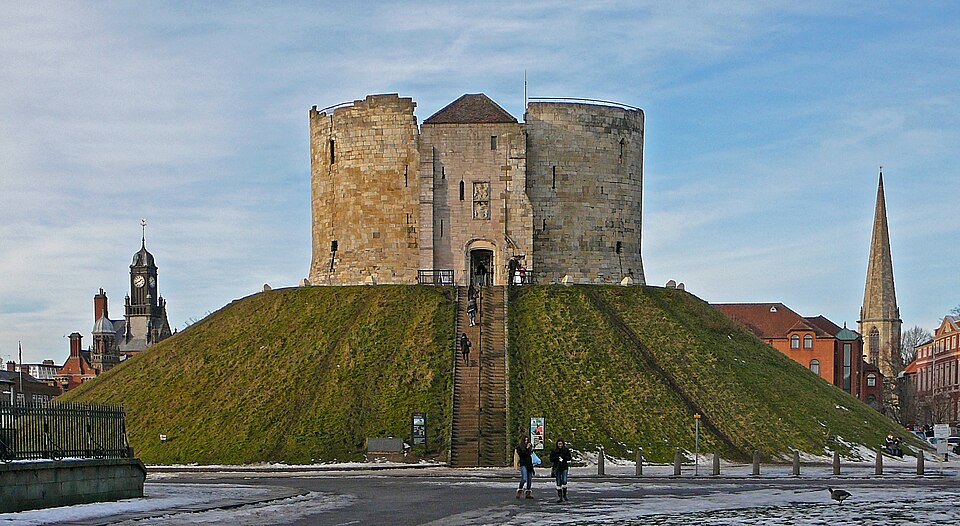
In York, William established a castle in 1068 on the site now occupied by Clifford’s Tower. Its elevated earthwork preserves a connection with the original Norman fortress, although the surviving stone tower is the product of later medieval rebuilding.
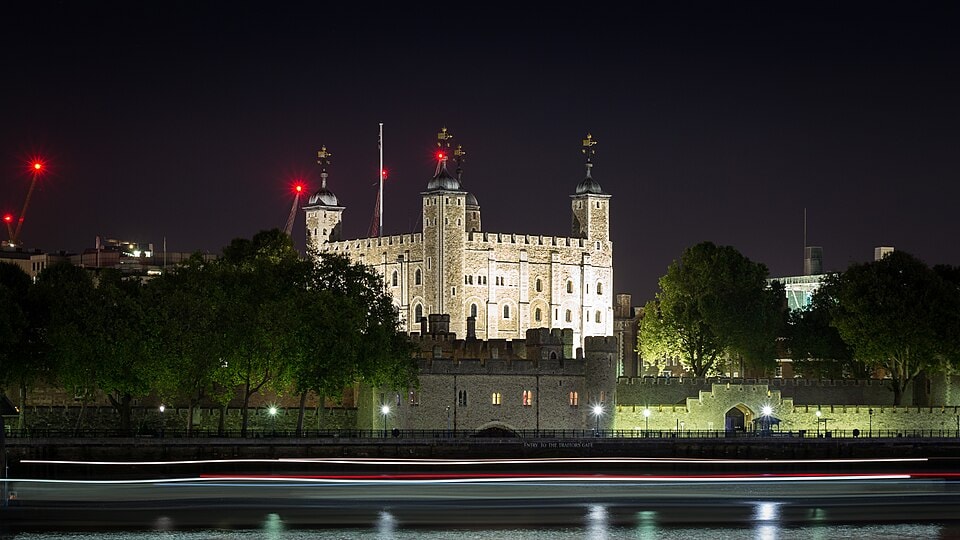
In London, the White Tower, begun during William’s reign, demonstrated the ambition and permanence of Norman royal architecture. Its monumental construction contrasted with the earlier timber fortifications established during the initial stages of conquest.
At Norwich, archaeological investigations and historical records reveal the displacement of late Anglo-Saxon settlement areas as land was appropriated for the castle and cathedral precincts. Such evidence reminds us that the Norman transformation of England involved the disruption of existing communities as well as the construction of imposing new monuments.
These fortifications were not simply defensive buildings. They became centres of lordship, administration and political authority, providing the new ruling elite with a permanent presence within the conquered kingdom. (English Heritage, n.d.-e; Historic Royal Palaces, n.d.; Norfolk Historic Environment Record, n.d.)
A Conquered Kingdom: What Changed and What Survived?
By the 1080s, England had undergone a profound redistribution of wealth and political authority. The replacement of its ruling elite was particularly extensive, yet many of the institutions through which the Anglo-Saxon kings had governed remained essential to the Norman monarchy.
The disappearance of the Anglo-Saxon aristocracy
One of the most dramatic consequences of the conquest was the dispossession of the English landed aristocracy. Some nobles died fighting against William, others forfeited their estates following rebellions, and many gradually lost their positions as land was transferred to the king’s continental followers.
The process was neither instantaneous nor uniform. English nobles such as Waltheof initially retained important positions under William, while members of the former royal family, including Edgar Ætheling, survived and eventually reached accommodations with the Norman ruler. Nevertheless, Waltheof’s execution in 1076 following his involvement in the Revolt of the Earls illustrates the increasingly precarious position of the surviving English political elite.
Changes also affected the Church. In 1070, Stigand was removed as Archbishop of Canterbury and replaced by Lanfranc, formerly abbot of Saint-Étienne at Caen. Over time, continental churchmen acquired many of the most influential ecclesiastical positions, while cathedrals and monasteries underwent extensive architectural and institutional transformation.
England also became increasingly integrated into an Anglo-Norman political world, with powerful aristocratic families holding estates on both sides of the English Channel. This fundamentally altered the political character of England’s continental connections.
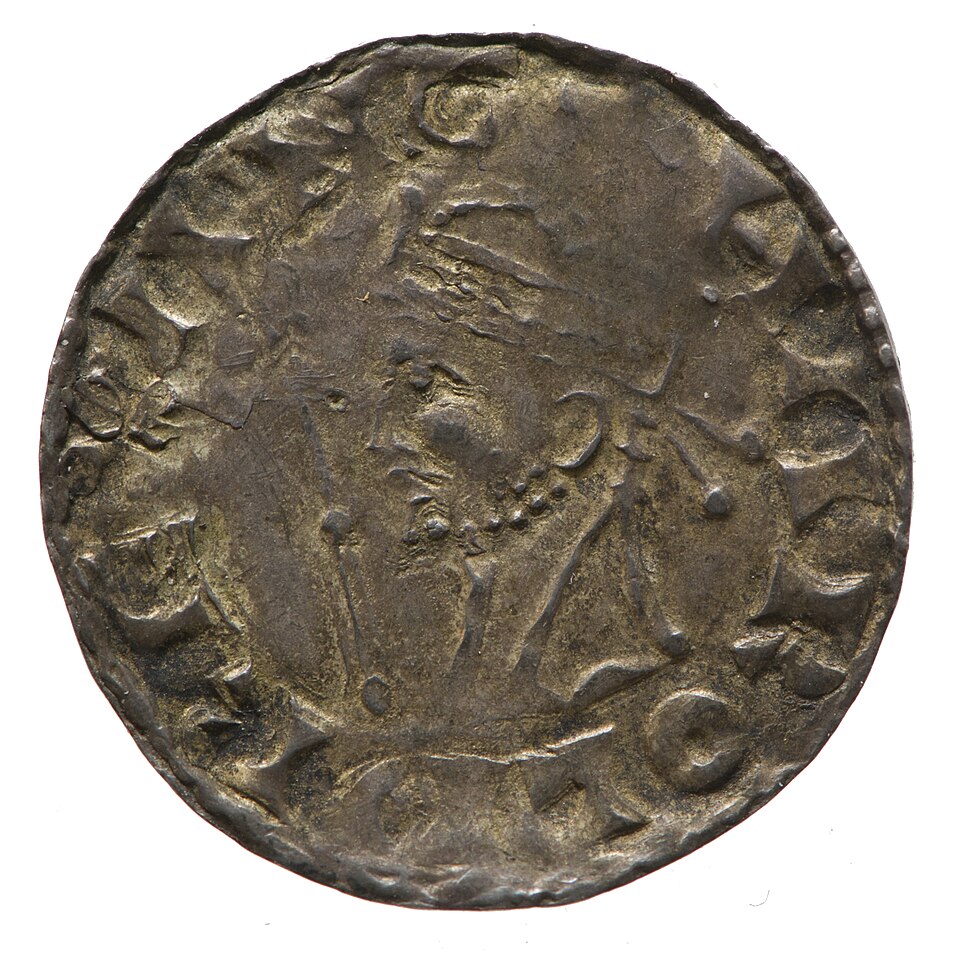
Silver penny of Harold II, obverse
The Chew Valley Hoard: Two kings and one monetary system
One of the most remarkable archaeological discoveries associated with the Norman Conquest was made in Somerset in January 2019, when metal detectorists uncovered the Chew Valley Hoard.
Containing 2,584 silver coins dating from around 1066–1068, the hoard includes substantial numbers of pennies issued under both Harold II and William I. Its discovery significantly increased the number of surviving examples of Harold’s coinage and William’s earliest English issues, providing numismatists with valuable new material for understanding the monetary economy during the conquest.
The burial of such a considerable quantity of wealth may reflect the insecurity of the period, although the identity of its owner and the precise circumstances in which it was concealed remain unknown.
Perhaps the most significant feature of the discovery is what it reveals about continuity. Although the royal portrait and inscriptions changed to reflect the authority of a new king, William inherited an established English system of coin production and circulation. The conqueror had little reason to abandon an institution that already served the economic and fiscal needs of the monarchy.
The Chew Valley Hoard therefore provides a tangible illustration of the conquest’s central paradox: the identity of the ruler changed dramatically, but important economic institutions continued to function. (South West Heritage Trust, n.d.)
Domesday Book: The evidence of a conquered England
In December 1085, William ordered a comprehensive survey of the land and resources of his English kingdom. Undertaken during the following year, the investigation produced the records collectively known as the Domesday Book, one of the most extraordinary surviving administrative documents of medieval Europe.
The survey recorded landholders, agricultural resources, settlements, livestock, mills and the economic value of estates. In many instances, it also identified the individuals who had held the land during Edward the Confessor’s reign, allowing historians to investigate the extent of the redistribution that followed the Norman Conquest.
By 1086, much of the landed wealth previously controlled by English aristocratic families had passed into the possession of the king, his continental followers and major ecclesiastical institutions. The concentration of landownership represented a fundamental restructuring of English society.
Yet the Domesday Book also demonstrates the administrative sophistication of the kingdom William had inherited. Its compilation depended upon established territorial divisions, local knowledge, systems of assessment and administrative practices with deep roots in Anglo-Saxon England.
The survey also reflects renewed Scandinavian threats. Lavelle connects its political and financial background to the anticipated Danish invasion of 1085, for which William had undertaken extensive defensive preparations. England’s vulnerability to developments across the North Sea had therefore not ended with Hardrada’s defeat twenty years earlier.
The survival of Anglo-Saxon England
Despite the scale of the political transformation, numerous features of Anglo-Saxon society endured. Shires, hundreds, sheriffs, royal writs and established taxation practices continued to provide the foundations of English government, although they were adapted to serve Norman interests.
The English language remained the principal language of much of the population, even as French became prominent among the aristocracy and Latin retained its importance in ecclesiastical and administrative writing. Old English manuscript production also continued after the conquest, preserving important elements of earlier religious, legal and literary traditions.
Architectural evidence provides another reminder that cultural change did not begin abruptly in 1066. Edward the Confessor’s Westminster Abbey, dedicated in December 1065, had already incorporated continental Romanesque architectural influences. Parts of the eleventh-century complex survive in the Pyx Chamber and Undercroft, demonstrating that artistic and architectural exchanges between England and Normandy preceded William’s invasion.
For much of the population, life continued to revolve around farming, local communities, religious observance and obligations to landowners. The identities of those exercising authority might have changed, sometimes with devastating consequences, but the English population and its accumulated cultural traditions did not simply disappear.
The End of an Age, but Not of England
The Norman Conquest brought to an end the political dominance of the Anglo-Saxon aristocracy and inaugurated a new period in English history. Its consequences extended far beyond the Battle of Hastings, encompassing years of resistance, the redistribution of landed wealth, ecclesiastical reform and the creation of a powerful cross-Channel aristocratic society.
The contrast between 1016 and 1066 is particularly revealing. Both Cnut and William conquered an existing English kingdom, and both relied upon institutions developed by earlier English rulers. William’s conquest, however, resulted in a far more extensive replacement of the established landed and political elite, giving the transformation an enduring social and cultural significance.
As we conclude this series on the making of Anglo-Saxon England, it is worth recalling the extraordinary distance travelled since the fragmented political landscape of fifth-century Britain. From the emergence of the first Anglo-Saxon kingdoms to the achievements of Alfred the Great and Æthelstan, successive generations had constructed a kingdom capable of surviving even the destruction of its ruling dynasty.
Domesday Book stands as evidence both of William’s triumph and of the enduring achievements of the society he conquered. The Anglo-Saxon political age had ended, but much of the England created during those centuries survived, providing essential foundations upon which the medieval English kingdom would continue to develop.
Frequently Asked Questions
What caused the Norman Conquest of England in 1066?
The Norman Conquest resulted from the succession crisis following Edward the Confessor’s death without a direct heir. Harold Godwinson became king, but William of Normandy and Harald Hardrada of Norway advanced competing claims, resulting in two major foreign invasions of England.
Who had the strongest claim to the English throne in 1066?
Edgar Ætheling possessed arguably the strongest hereditary claim through the male line of the West Saxon royal dynasty. However, Harold Godwinson secured recognition from England’s leading aristocrats, while William and Hardrada based their claims on alleged earlier promises and dynastic agreements.
Why did Harold Godwinson lose the Battle of Hastings?
William commanded a diverse military force that successfully overcame the English army’s resistance. Harold’s recent campaign against Harald Hardrada may have contributed to his difficulties, although historians disagree about the relative importance of exhaustion, leadership, military organisation and battlefield circumstances.
Was Harold Godwinson killed by an arrow in his eye?
The Bayeux Tapestry appears to depict a figure receiving an arrow near his eye, but the identification of that figure and the effects of later restoration remain disputed. The surviving written sources do not establish conclusively how Harold died.
Did the Norman Conquest end in 1066?
Although William won the Battle of Hastings and was crowned in 1066, resistance continued for several years. Major challenges included the northern rebellions, Danish intervention, resistance at Ely and the Revolt of the Earls in 1075.
What survived from Anglo-Saxon England after the Norman Conquest?
Many Anglo-Saxon institutions survived, including shires, hundreds, sheriffs, monetary systems and established taxation practices. The English language, agricultural communities and numerous religious and cultural traditions also endured despite the extensive replacement of the ruling aristocracy.
Recommended Reading
This website uses affiliate links. If you purchase via these links, we might earn a commission that contributes to sustaining the HistoryMedieval.com platform.



Related Articles
 1066: The Norman Conquest and the End of Anglo-Saxon England
 The Birth of England: From Alfred the Great to Æthelstan
 The Great Heathen Army: How England Was Transformed
 Women Who Shaped Anglo-Saxon England: Faith and Power
 The Christian Conversion of Anglo-Saxon England
 The First Anglo-Saxon Kings: How England’s Kingdoms Emerged
 Angles, Saxons and Jutes: A New History of Migration
 The End of Roman Britain: What Happened After Rome Withdrew?
Sources & References
- The Anglo-Saxon Chronicle (M. Swanton, Ed. & Trans.). (1996). J. M. Dent.
- Ashbee, J. (n.d.). History of Clifford’s Tower. English Heritage. https://www.english-heritage.org.uk/visit/places/cliffords-tower-york/history-and-stories/history
- Bates, D. (2016). William the Conqueror. Yale University Press.
- Baxter, S. (2007). The earls of Mercia: Lordship and power in late Anglo-Saxon England. Oxford University Press.
- Bolton, T. (2017). Cnut the Great. Yale University Press.
- Brown, R. A. (1995). The Norman Conquest of England: Sources and documents. Boydell Press.
- Douglas, D. C., & Greenaway, G. W. (Eds.). (1981). English historical documents, 1042–1189 (2nd ed., Vol. 2). Eyre Methuen.
- English Heritage. (n.d.-a). 1066 and the Norman Conquest. https://www.english-heritage.org.uk/1066/
- English Heritage. (n.d.-b). Research on Battle Abbey and battlefield. https://www.english-heritage.org.uk/visit/places/1066-battle-of-hastings-abbey-and-battlefield/history-and-stories/history/research/
- English Heritage. (n.d.-c). Sources for Battle Abbey and battlefield. https://www.english-heritage.org.uk/visit/places/1066-battle-of-hastings-abbey-and-battlefield/history-and-stories/history/sources/
- Historic Royal Palaces. (n.d.). William I (the Conqueror): England’s first Norman king. https://www.hrp.org.uk/tower-of-london/history-and-stories/william-the-conqueror/
- John of Worcester. (1998). The chronicle of John of Worcester: Vol. 3. The annals from 1067 to 1140 with the Gloucester interpolations and the continuation to 1141 (P. McGurk, Ed. & Trans.). Clarendon Press.
- Lavelle, R. (2026). Border land: Frontiers of early England. Yale University Press.
- Lewis, C. P. (2023). William the Conqueror’s Harrying of the North, 1069–1070: What, if not genocide? In B. Kiernan, T. M. Lemos, & T. S. Taylor (Eds.), The Cambridge world history of genocide (Vol. 1, pp. 403–424). Cambridge University Press. https://doi.org/10.1017/9781108655989.018
- Licence, T. (2020). Edward the Confessor: Last of the royal blood. Yale University Press.
- Licence, T. (2026). Harold: Warrior king. Yale University Press.
- The life of King Edward who rests at Westminster (F. Barlow, Ed. & Trans.). (1992). Clarendon Press.
- Morris, M. (2012). The Norman Conquest. Hutchinson.
- Musgrove, D., & Lewis, M. (2026). The story of the Bayeux Tapestry: Unravelling the Norman Conquest (Rev. ed.). Thames & Hudson.
- Norfolk Heritage Explorer. (n.d.). Parish summary: Norwich (medieval period). https://www.heritage.norfolk.gov.uk/record-details?uid=TNF1545
- Orderic Vitalis. (1969–1980). The ecclesiastical history of Orderic Vitalis (M. Chibnall, Ed. & Trans.; Vols. 1–6). Clarendon Press.
- Porter, R. (n.d.-a). Fulford and Stamford Bridge: The northern battles of 1066. English Heritage. https://www.english-heritage.org.uk/learn/histories/1066-and-the-norman-conquest/northern-battles-1066/
- Porter, R. (n.d.-b). What happened at the Battle of Hastings? English Heritage. https://www.english-heritage.org.uk/visit/places/1066-battle-of-hastings-abbey-and-battlefield/history-and-stories/what-happened-battle-hastings/
- Porter, R. (n.d.-c). Where did the Battle of Hastings happen? English Heritage. https://www.english-heritage.org.uk/visit/places/1066-battle-of-hastings-abbey-and-battlefield/history-and-stories/battle-of-hastings-location/
- South West Heritage Trust. (n.d.). Chew Valley Hoard. https://swheritage.org.uk/museum-of-somerset/chew-valley-hoard/
- Sullivan, T. (2023). The early Anglo-Saxon kings. Pen & Sword History.
- The National Archives. (n.d.-a). Domesday. https://www.nationalarchives.gov.uk/explore-the-collection/explore-by-time-period/medieval/domesday/
- The National Archives. (n.d.-b). Domesday Book. https://www.nationalarchives.gov.uk/help-with-your-research/research-guides/domesday-book/
- The National Archives. (n.d.-c). What does Domesday Book tell us? https://www.nationalarchives.gov.uk/education/teaching-resources/what-does-domesday-book-tell-us/
- Westminster Abbey. (n.d.). Architecture. https://www.westminster-abbey.org/history/explore-our-history/architecture
- William of Poitiers. (1998). The Gesta Guillelmi of William of Poitiers (R. H. C. Davis & M. Chibnall, Eds. & Trans.). Clarendon Press.
- Williams, A. (1995). The English and the Norman Conquest. Boydell Press.
Copyright, Licensing and Disclosure
© HistoryMedieval. This article is licensed under the Creative Commons Attribution–NonCommercial–NoDerivatives 4.0 International licence (CC BY-NC-ND 4.0).
You may share this article unchanged for non-commercial purposes, provided that full credit is given to the author and HistoryMedieval, a link to the licence is included, and online republication links back to the original article on HistoryMedieval.com. Adaptation, translation, abridgement or commercial reuse requires prior written permission.
Third-party images and materials may be subject to separate copyright or licensing terms. For copyright concerns, contact info@historymedieval.com. We will review the matter and take any necessary corrective action.
This article may contain affiliate links. We may earn a commission from qualifying purchases at no additional cost to the buyer.