The Great Heathen Army: How England Was Transformed
Overview
From the attack on Lindisfarne in 793 to Alfred the Great’s resistance, discover how Viking raids developed into territorial conquest, settlement and political transformation, reshaping Anglo-Saxon England and laying the foundations for a new kingdom.
Cite This Work
Anastasi, L. (2026, November 19). The Great Heathen Army: How England Was Transformed. Medieval History – Yesterday in a Nutshell. https://historymedieval.com/the-great-heathen-army-how-england-was-transformed/
Lindisfarne: The Raid That Changed Everything

Viking Raider Doomsday Stone; Kloster Lindisfarne, Holy Island
On 8 June 793, Scandinavian raiders attacked the monastery of Lindisfarne, one of the most important centres of Christianity in Anglo-Saxon England. Established in 635 by the Irish monk Aidan under the patronage of King Oswald of Northumbria, the monastery had become an influential centre of religious learning, scholarship and manuscript production. It was also the resting place of St Cuthbert, whose reputation extended far beyond the shores of Northumbria.
The attack provoked outrage throughout the Christian world. Alcuin of York, a Northumbrian scholar serving at the court of Charlemagne, expressed his horror in letters to religious and political leaders. The Anglo-Saxon Chronicle, compiled towards the end of the ninth century, associated the disaster with extraordinary supernatural occurrences, including whirlwinds, flashes of light and terrifying apparitions.
Fiery dragons were seen flying in the air.
— Anglo-Saxon Chronicle, entry for 793.
Such language reveals how Christian writers understood catastrophe. The attack was not simply a military or economic disaster but an event that appeared to challenge the spiritual security of Christian society. Alcuin questioned whether the suffering inflicted upon Lindisfarne reflected divine punishment for the moral shortcomings of the Northumbrian people.
Lindisfarne was not necessarily England’s first encounter with Scandinavian violence. As examined in our earlier article, Before Lindisfarne: Was England’s First Viking Raid in 789?, a violent encounter at Portland in Dorset probably occurred several years earlier. What distinguished Lindisfarne was the nature of the attack, the religious importance of its target and the extraordinary contemporary reaction it generated.
Over the following century, Scandinavian expeditions would develop from relatively small-scale raids into coordinated military campaigns that overthrew established kingdoms, redistributed land and permanently transformed the political landscape of England.
From Coastal Raids to Sustained Warfare
Why Did the Vikings Target England?
The emergence of Viking activity in the late eighth century cannot be attributed to a single cause. Political competition within Scandinavia, opportunities to accumulate wealth, access to slaves and the prestige associated with successful military expeditions all contributed to overseas expansion. Advances in shipbuilding allowed Scandinavian crews to navigate open seas, penetrate river systems and approach settlements with considerable speed.
Monasteries presented particularly attractive targets. They possessed precious religious objects, accumulated agricultural wealth and often occupied accessible coastal or riverside locations. Their religious importance offered little protection against attackers who did not share the Christian beliefs of their inhabitants.
Nevertheless, Scandinavians did not necessarily acquire their knowledge of Britain through raiding. Commercial and cultural connections across the North Sea existed long before 793, and these contacts may have provided valuable information about sailing routes, wealthy settlements and opportunities for exploitation.
From Raiding Parties to Winter Encampments
By the middle of the ninth century, the scale of Scandinavian operations had increased considerably. Viking armies confronted West Saxon forces at Carhampton in 836 and again in 843, while in 851 a major expedition attacked Canterbury and London before advancing into Wessex. King Æthelwulf and his son Æthelbald eventually defeated the invading force at Aclea, although its precise location remains uncertain.
An important development was the establishment of winter encampments. Rather than returning overseas at the end of each campaigning season, Scandinavian forces increasingly remained in England, allowing them to replenish supplies, repair equipment and plan further operations.
The Anglo-Saxon kingdoms were no longer dealing exclusively with temporary coastal incursions. They faced opponents capable of maintaining a prolonged military presence and exploiting the political divisions of their adversaries.

The Arrival of the Great Heathen Army
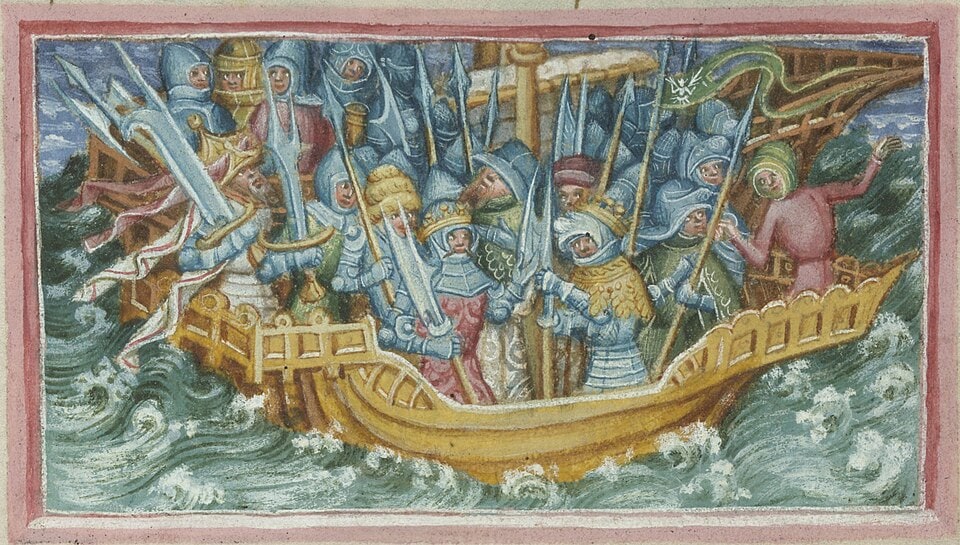
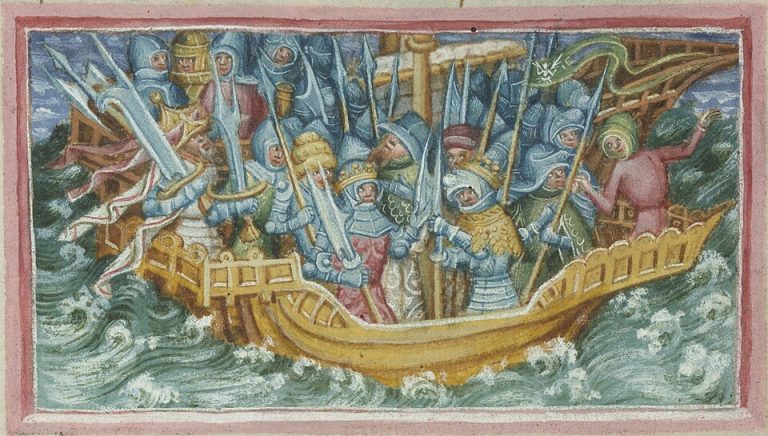
Hinguar and Hubba set out to avenge their father, Lothbrok. Excerpt from folio 47v of Harley MS 2278.
An Army Rather Than a Raiding Party
The decisive turning point came in 865, when a substantial Scandinavian force arrived in East Anglia. The Anglo-Saxon Chronicle described it as the micel hæþen here, the Great Heathen Army, a name that reflected both its considerable military strength and the religious perspective of the Christian chroniclers who recorded its activities.
The army established winter quarters in East Anglia, where it secured horses and reached an agreement with the local population. The acquisition of horses was particularly important because it enabled Scandinavian warriors to operate far beyond navigable rivers and coastal settlements. Although they generally fought on foot, mounted movement gave them a considerable advantage in conducting extensive inland campaigns.
The Great Army was probably a collection of military formations rather than a single, permanently unified one. Rather, it consisted of cooperating warbands led by powerful individuals whose interests were sometimes shared and sometimes divergent. Reinforcements arrived during subsequent campaigns, while other contingents eventually separated to pursue their objectives.
Historians have long debated its size, with earlier interpretations suggesting that it may have numbered only several hundred warriors. Recent archaeological research has challenged these estimates, indicating that the army and its accompanying population could have numbered several thousand people.
The Sons of Ragnar: History and Legend
Among the Scandinavian leaders associated with the campaigns were Ivar, traditionally known as Ivar the Boneless, Halfdan and Ubba. Their adventures later became part of the story of Ragnar Lothbrok, a famous character in medieval Scandinavian literature.
According to later saga traditions, King Ælla of Northumbria captured Ragnar and executed him in a pit of snakes. His sons supposedly invaded England to avenge his death, eventually capturing Ælla and subjecting him to the notorious execution known as the blood eagle.
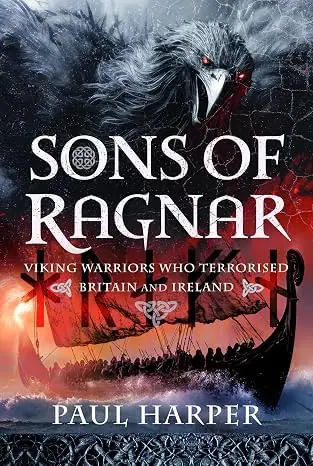
These narratives, however, were recorded centuries after the events they describe. As Paul Harper discusses in Sons of Ragnar (2026), he shows how historical individuals and traditions became entangled with legendary deeds, questionable genealogies and literary embellishments. Contemporary evidence does not establish Ragnar’s death in Northumbria or vengeance as the principal motive for the invasion.
The army’s subsequent actions suggest that its ambitions extended considerably beyond family vengeance. Wealth, political authority and control over territory increasingly shaped its campaigns, transforming the nature of Scandinavian activity in England.
The Fall of the Anglo-Saxon Kingdoms

A map of the routes taken by the Great Heathen Army from 865 to 886
Northumbria and the Capture of York
Northumbria became the first major Anglo-Saxon kingdom to succumb to the Great Army. Once a dominant political and cultural power in Britain, it had experienced considerable instability during the ninth century, with rival dynasties competing for control of the throne.
In 866, the Scandinavian army advanced northwards from East Anglia and captured York, traditionally associated with All Saints’ Day. At the time, Northumbria was divided between King Ælla and his rival Osberht, and their struggle for power had weakened the kingdom’s capacity to organise an effective defence.
Recognising the seriousness of the Scandinavian threat, the two kings temporarily abandoned their differences and attempted to recover York in March 867. Their forces penetrated the city’s defences but suffered a catastrophic defeat in which both kings were killed.
The Scandinavians subsequently exercised authority through a subordinate Northumbrian ruler, although Anglo-Saxon political authority survived in parts of the kingdom, particularly in the north. York would gradually emerge as the centre of a Scandinavian kingdom with extensive commercial and political connections across the British Isles and the North Sea.
The Death of King Edmund and the Conquest of East Anglia
Following campaigns in Northumbria and Mercia, the Great Army returned to East Anglia, establishing winter quarters at Thetford in 869. King Edmund confronted the invading forces but was defeated and killed, bringing an end to independent Anglo-Saxon royal rule in the kingdom.
The circumstances surrounding Edmund’s death became the subject of an enduring religious tradition. Writing towards the end of the tenth century, Abbo of Fleury portrayed Edmund as a Christian king who refused to abandon his faith and was subsequently tortured, shot with arrows and beheaded.
Although historians have established Edmund’s death at the hands of the Scandinavians, later Christian martyrdom traditions shaped the details of his execution. Abbo’s account was intended to celebrate the sanctity of Edmund rather than provide an impartial reconstruction of the Great Army’s campaign.
Edmund subsequently became one of medieval England’s most important saints, demonstrating how the experiences of Viking conquest continued to shape English religious identity long after the original events.
Mercia: Between Resistance and Accommodation
Mercia initially proved more resilient, having dominated much of Anglo-Saxon England during the eighth century. When the Great Army occupied Nottingham in 867–868, King Burgred sought military assistance from Wessex. Despite their combined efforts, the Mercians eventually negotiated peace with the Scandinavians.
The situation deteriorated during the winter of 873–874, when the Great Army established itself at Repton, an important Mercian royal and religious centre. Burgred was driven into exile and eventually travelled to Rome, while Ceolwulf II assumed the Mercian throne under an arrangement with the Scandinavians.
The Anglo-Saxon Chronicle portrayed Ceolwulf as an insignificant ruler dependent upon Viking support. Archaeological evidence, however, has complicated this interpretation considerably.
The Watlington Hoard, discovered in Oxfordshire in 2015, contains more than 200 silver pennies alongside jewellery, ingots and other precious metal objects. Particularly significant are coins issued in the names of both Alfred of Wessex and Ceolwulf of Mercia, including examples carrying closely related royal imagery.
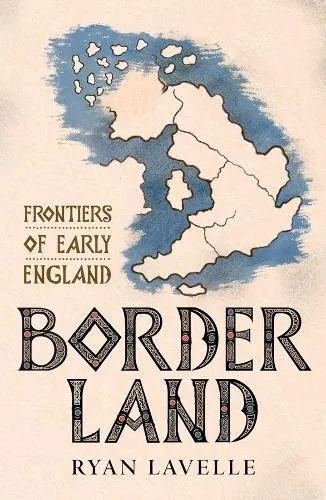
These discoveries suggest a degree of monetary and political cooperation between the two kings that is largely absent from the written accounts. As historian Ryan Lavelle argues in Border Land: Frontiers of Early England (2026), the West Saxon portrayal of Ceolwulf may reflect subsequent political developments rather than his actual importance during the 870s.
Mercia’s experience demonstrates that the relationship between Scandinavian invaders and Anglo-Saxon rulers involved negotiation, collaboration and accommodation as well as military confrontation.
Enjoyed this Article?
Join The Medieval Chronicle on Substack for weekly medieval discoveries, book notes, and behind-the-scenes commentary from HistoryMedieval.
What Archaeology Reveals About the Great Heathen Army
The written sources understandably concentrate on battles, royal deaths and political upheaval. Archaeology, however, has revealed aspects of Scandinavian activity that received relatively little attention from contemporary chroniclers, particularly the organisation, economic activities and social composition of the Great Army.
Torksey: A Mobile Community
During the winter of 872–873, the Great Army established an extensive encampment at Torksey in Lincolnshire, occupying elevated ground beside the River Trent. Archaeological investigations led by Dawn Hadley and Julian Richards identified an area of approximately 55 hectares, which is considerably larger than previously recognised Viking encampments in England.
The discoveries include fragments of Islamic silver dirhams, Anglo-Saxon coins, silver ingots, trading weights, jewellery, metalworking debris and numerous lead gaming pieces. Together, they suggest that the encampment functioned as a temporary centre of production, exchange and social activity.
The presence of textile-working equipment and other domestic objects also raises the possibility that women and children accompanied the army. Although archaeologists cannot establish the demographic composition of the community with certainty, the findings challenge the assumption that it consisted exclusively of male warriors.
Trade within such communities should not, however, be confused with peaceful commercial activity alone. Some of the wealth processed at Torksey would probably have been acquired through plunder, tribute and coercion, reflecting the close relationship between warfare and economic activity in the Viking world.
Hadley and Richards argue that the population of the camp probably numbered in the thousands, although this figure does not establish how many were active combatants.
Repton: The Dead of the Great Army
Archaeological investigations near St Wystan’s Church in Repton uncovered defensive earthworks, Scandinavian-style furnished burials and a remarkable collective deposit containing the remains of at least 264 individuals.
Initial radiocarbon dating produced apparently contradictory results, with some remains appearing to predate the Great Army’s occupation. This raised doubts about whether the deposit belonged to the Scandinavian forces recorded at Repton.
In 2018, a study led by archaeologist Cat Jarman reassessed the dating evidence, accounting for the consumption of marine foods, which can make human remains appear older in radiocarbon analysis. The revised results were consistent with a single late ninth-century deposition, considerably strengthening the association with the Great Army.
Although the precise circumstances of their deaths remain uncertain, the Repton burials provide exceptional physical evidence of the people involved in the Scandinavian campaigns that transformed Anglo-Saxon England.
Heath Wood: Crossing the North Sea with Animals
Further evidence has emerged from the Scandinavian cremation cemetery at Heath Wood, Derbyshire. In 2023, researchers published an analysis of strontium isotopes preserved in cremated human and animal remains from the cemetery.
The results suggest that at least one individual and several animals, including a horse and a dog, had probably originated in Scandinavia rather than Britain. This indicates that some members of the invading forces brought animals across the North Sea, challenging the assumption that they depended entirely upon acquiring them after landing.
Such discoveries reveal the sophisticated logistical arrangements required to transport people, equipment and animals over considerable maritime distances. They also suggest that Scandinavian expeditions could involve individuals preparing for extended periods overseas rather than short, opportunistic raids.
Alfred the Great and the Survival of Wessex

Portrait of Alfred the Great by Samuel Woodforde
A Kingdom on the Brink of Defeat
In early 871, Scandinavian forces established themselves at Reading, bringing the Great Army into the heart of the West Saxon kingdom. King Æthelred I and his younger brother Alfred confronted the invaders in a series of engagements that exposed both the military strength of the Scandinavians and the vulnerability of Wessex.
The Battle of Ashdown in January 871 resulted in an important West Saxon victory, but subsequent defeats demonstrated that the Scandinavian threat remained formidable. Following Æthelred’s death later that year, Alfred inherited a kingdom exhausted by repeated military confrontations.
Alfred initially relied upon negotiated agreements to secure periods of peace. These arrangements provided temporary relief but failed to remove the danger presented by the Scandinavian armies operating elsewhere in England.
The situation reached its most critical point in January 878, when Guthrum launched a surprise attack on Chippenham, an important West Saxon royal estate. Much of Wessex fell under Scandinavian control, while Alfred withdrew with a relatively small group of followers into the marshlands of Somerset.
Athelney and the Battle of Edington
Alfred established a fortified base at Athelney, from which he maintained resistance and gradually rebuilt his forces. The surrounding marshlands offered natural protection while allowing the king to remain in contact with loyal communities.
In the spring of 878, Alfred assembled forces from Somerset, Wiltshire and Hampshire before confronting Guthrum at Edington in Wiltshire. His biographer, the Welsh monk Asser, describes Alfred’s actions as follows:
Fought bravely and perseveringly by means of a close shield-wall.
— Asser, Life of King Alfred, written in 893.
The West Saxons defeated Guthrum’s army and pursued the survivors to their stronghold, where a siege lasting approximately two weeks compelled them to negotiate their surrender.
The resulting settlement included an agreement that Guthrum would receive Christian baptism. Alfred acted as his sponsor during the ceremony at Aller, and Guthrum adopted the Christian name Æthelstan.
The conversion was politically significant. By accepting baptism, Guthrum established a new religious relationship with Alfred and acquired a means of legitimising his authority over a predominantly Christian population.
Edington secured the survival of Wessex, but it neither expelled the Scandinavians from England nor ended their political dominance elsewhere.
Alfred’s Military and Political Reorganisation
Alfred recognised that the survival of Wessex required more than occasional battlefield victories. His reign consequently witnessed the development of a more systematic military and defensive organisation designed to respond to the mobility of Scandinavian forces.
Central to this approach was the establishment and strengthening of fortified settlements known as burhs. These provided refuges for local populations, defensive garrisons and strategically positioned centres from which military operations could be conducted. Some also developed into important commercial and administrative settlements.
The Burghal Hidage, a document generally associated with the late Alfredian or early tenth-century defensive system, records the resources assigned to maintaining a network of fortifications. It demonstrates the connection between military defence, landholding and royal administration.
Alfred also reorganised military service, allowing troops to be maintained in the field while others remained responsible for agriculture and local defence. His investment in naval capabilities represented a further attempt to restrict the freedom with which Scandinavian forces operated along the English coastline.
The effectiveness of these arrangements was tested during renewed Viking campaigns between 892 and 896. Although the Scandinavians continued to threaten Wessex, they were unable to repeat the political and military successes that the Great Army had achieved during the previous decades.
From Conquest to Settlement: The Making of the Danelaw
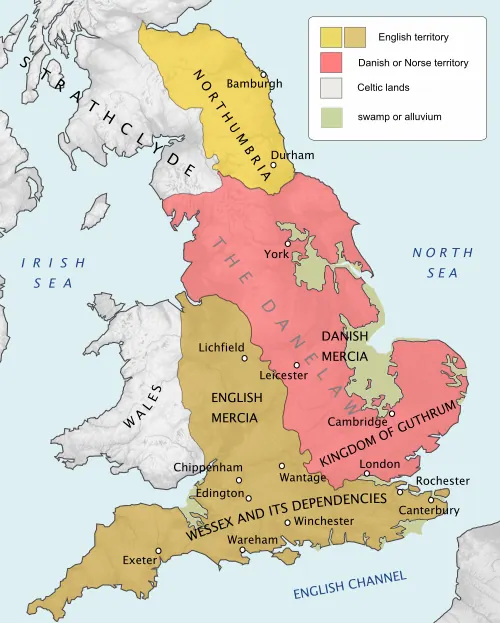
England and Wales at the time of the Treaty of Chippenham (AD 878)
Dividing the Land
Even before Alfred’s victory at Edington, elements of the Great Army had begun transitioning from military campaigning to territorial settlement.
In 876, Halfdan distributed land among his followers in Northumbria. Scandinavian forces subsequently divided part of Mercia in 877, while Guthrum’s army settled in East Anglia in 880.
These developments represented a fundamental change in Scandinavian ambitions. Control over agricultural estates and existing communities provided opportunities for taxation, permanent residence and the establishment of political authority. Former raiders increasingly became landholders and rulers, although military activity continued.
The surviving Treaty of Alfred and Guthrum offers remarkable evidence of the process through which Scandinavian and Anglo-Saxon rulers negotiated their coexistence.
Often incorrectly associated directly with the aftermath of Edington, the written treaty was probably concluded several years later. It established a frontier following the Thames, the River Lea and the River Great Ouse towards Watling Street, while also addressing compensation for killings, legal disputes and cross-border commercial transactions.
As Ryan Lavelle emphasises, the treaty reflected the particular political circumstances of the period rather than the creation of a permanent boundary separating two culturally homogeneous populations. Furthermore, the region subsequently known as the Danelaw consisted of territories under different Scandinavian authorities rather than a single unified Viking kingdom.
The Emergence of an Anglo-Scandinavian Society
Scandinavian settlement gradually transformed the cultural and economic character of northern and eastern England. Its legacy remains particularly visible in place names incorporating Old Norse elements such as ‘-by’, indicating a farm or settlement, and ‘-thorpe’, often associated with a secondary settlement.
Archaeological research at Cottam in Yorkshire provides evidence of how these transformations may have occurred. Julian Richards and David Haldenby identified patterns of material culture consistent with an initial episode of Viking military activity followed by the development of a community combining Anglo-Saxon and Scandinavian characteristics.
The evidence suggests that settlement frequently involved the adaptation and reorganisation of existing landscapes rather than the wholesale replacement of their inhabitants. The precise scale of Scandinavian migration varied considerably between regions and remains the subject of historical debate.
Religious identities also evolved. Guthrum’s coinage, issued under his baptismal name Æthelstan, provides material evidence of the adoption of Christian kingship by Scandinavian rulers.
York subsequently developed into a flourishing commercial centre, connecting England with Scandinavian territories, Ireland and continental Europe. Its growing prosperity demonstrated that the Scandinavian presence could generate economic development alongside the destruction and displacement associated with earlier campaigns.
The Making of a Different England
When Scandinavian raiders attacked Lindisfarne in 793, few could have anticipated the extent to which their successors would transform Anglo-Saxon England. Within a century, the kingdoms of Northumbria and East Anglia had lost their independent Anglo-Saxon rulers, Mercia had been divided, and Wessex had narrowly escaped a similar fate.
The Scandinavian invasions inflicted considerable suffering upon local populations, destroying religious institutions, disrupting established political structures and facilitating the seizure of wealth, land and slaves. Yet we cannot understand the historical significance of the Vikings exclusively through their military achievements.
Archaeological discoveries increasingly reveal communities characterised by mobility, craftsmanship, commerce and complex social relationships. Settlement brought Scandinavian newcomers into prolonged contact with Anglo-Saxon populations, producing new cultural identities and forms of political organisation.
By the time Alfred died in 899, England remained divided. Nevertheless, the defensive institutions, political alliances and administrative arrangements developed during his reign provided his successors with the foundations upon which they would build a more extensive kingdom.
The Scandinavian conquest of much of Anglo-Saxon England had nearly extinguished its established political order. Paradoxically, it also helped create the conditions under which a unified English kingdom would emerge during the tenth century.
Frequently Asked Questions
Was Lindisfarne the first Viking raid on England?
Not necessarily. An earlier violent encounter occurred at Portland in Dorset, traditionally dated to 789. Lindisfarne in 793 remains the earliest securely dated major Viking raid on England.
What was the Great Heathen Army?
The Great Heathen Army was a coalition of Scandinavian military forces that arrived in England in 865. Unlike many earlier raiders, it conducted sustained campaigns, overthrew Anglo-Saxon rulers and established permanent political control over extensive territories.
Who led the Great Heathen Army?
Several Scandinavian leaders commanded its different contingents, including Ivar, Halfdan and, later, Guthrum. The traditional association of these leaders with Ragnar Lothbrok derives partly from much later Scandinavian literary sources.
Which Anglo-Saxon kingdoms fell to the Vikings?
Scandinavian forces overthrew the native royal dynasties of Northumbria and East Anglia and occupied substantial areas of Mercia. Wessex retained its independence under Alfred the Great.
How did Alfred the Great defeat the Vikings?
Alfred defeated Guthrum at Edington in 878 and subsequently strengthened Wessex through fortified settlements, military reorganisation, diplomacy and improved defensive capabilities. His victory secured Wessex but did not end Scandinavian rule elsewhere.
What was the Danelaw?
The Danelaw was the geographical and legal region of England historically associated with Scandinavian settlement and authority. It developed gradually and consisted of several political territories rather than a single unified Viking kingdom.
Recommended Reading
This website uses affiliate links. If you purchase via these links, we might earn a commission that contributes to sustaining the HistoryMedieval.com platform.


Related Articles
 The Great Heathen Army: How England Was Transformed
 Women Who Shaped Anglo-Saxon England: Faith and Power
 The Christian Conversion of Anglo-Saxon England
 The First Anglo-Saxon Kings: How England’s Kingdoms Emerged
 Angles, Saxons and Jutes: A New History of Migration
 The End of Roman Britain: What Happened After Rome Withdrew?
 Æthelflæd: The Mercian Queen Who Helped Forge England
 Daily Life in the Viking Great Army Camps
Sources & References
Primary Sources
- Ælfric of Eynsham. (1998). The martyrdom of St. Edmund, King of East Anglia (K. Cutler, Trans.; adapted from Abbo of Fleury). Internet Medieval Sourcebook, Fordham University. https://sourcebooks.web.fordham.edu/source/870abbo-edmund.asp
- Alcuin. (1974). Alcuin of York, c. A.D. 732 to 804: His life and letters (S. Allott, Ed. & Trans.). William Sessions.
- Asser. (1906). Asser’s life of King Alfred (A. S. Cook, Trans.). Ginn & Company. (Original work written c. 893). https://www.gutenberg.org/ebooks/63384
- The Anglo-Saxon Chronicle: Eighth century. (n.d.). The Avalon Project, Yale Law School. https://avalon.law.yale.edu/medieval/ang08.asp
- The Anglo-Saxon Chronicle: Ninth century. (n.d.). The Avalon Project, Yale Law School. https://avalon.law.yale.edu/medieval/ang09.asp
- Alfred and Guthrum’s peace. (n.d.). Internet Medieval Sourcebook, Fordham University. https://sourcebooks.fordham.edu/source/guthrum.asp
Books and Academic Studies
- Downham, C. (2017). The earliest Viking activity in England? The English Historical Review, 132(554), 1–12. https://doi.org/10.1093/ehr/cex066
- Hadley, D. M., & Richards, J. D. (2016). The winter camp of the Viking Great Army, AD 872–3, Torksey, Lincolnshire. The Antiquaries Journal, 96, 23–67. https://doi.org/10.1017/S0003581516000718
- Hadley, D. M., & Richards, J. D. (2021). The Viking Great Army and the making of England. Thames & Hudson.
- Harper, P. (2026). Sons of Ragnar: Viking warriors who terrorised Britain and Ireland. Pen & Sword Military. https://www.pen-and-sword.co.uk/Sons-of-Ragnar/p/61528
- Jarman, C. L., Biddle, M., Higham, T., & Bronk Ramsey, C. (2018). The Viking Great Army in England: New dates from the Repton charnel. Antiquity, 92(361), 183–199. https://doi.org/10.15184/aqy.2017.196
- Lavelle, R. (2026). Border land: Frontiers of early England. Yale University Press. https://yalebooks.co.uk/book/9780300259582/border-land/
- Löffelmann, T., Snoeck, C., Richards, J. D., Johnson, L. J., Claeys, P., & Montgomery, J. (2023). Sr analyses from only known Scandinavian cremation cemetery in Britain illuminate early Viking journey with horse and dog across the North Sea. PLOS ONE, 18(2), e0280589. https://doi.org/10.1371/journal.pone.0280589
- Naylor, J., & Standley, E. (Eds.). (2022). The Watlington Hoard: Coinage, kings and the Viking Great Army in Oxfordshire, AD875–880. Archaeopress. https://doi.org/10.2307/jj.15136018
- Richards, J. D., & Haldenby, D. (2018). The scale and impact of Viking settlement in Northumbria. Medieval Archaeology, 62(2), 322–350. https://doi.org/10.1080/00766097.2018.1535382
Online and Institutional Sources
- Anastasi, L. (2026, September 1). Before Lindisfarne: Was England’s first Viking raid in 789? HistoryMedieval. https://historymedieval.com/before-lindisfarne-was-englands-first-viking-raid-in-789/
- Durham University. (n.d.). Lindisfarne. https://dur.ac.uk/departments/academic/archaeology/research/archaeology-research-projects/lindisfarne/
- English Heritage. (n.d.). History of Lindisfarne Priory. https://www.english-heritage.org.uk/visit/places/lindisfarne-priory/history/
- English Heritage. (n.d.). The history of the Vikings in England. https://www.english-heritage.org.uk/visit/inspire-me/the-history-of-vikings-in-england/
- English Heritage. (n.d.). The Viking raid on Lindisfarne. https://www.english-heritage.org.uk/visit/places/lindisfarne-priory/history/viking-raid/
Copyright, Licensing and Disclosure
© HistoryMedieval. This article is licensed under the Creative Commons Attribution–NonCommercial–NoDerivatives 4.0 International licence (CC BY-NC-ND 4.0).
You may share this article unchanged for non-commercial purposes, provided that full credit is given to the author and HistoryMedieval, a link to the licence is included, and online republication links back to the original article on HistoryMedieval.com. Adaptation, translation, abridgement or commercial reuse requires prior written permission.
Third-party images and materials may be subject to separate copyright or licensing terms. For copyright concerns, contact info@historymedieval.com. We will review the matter and take any necessary corrective action.
This article may contain affiliate links. We may earn a commission from qualifying purchases at no additional cost to the buyer.