The Birth of England: From Alfred the Great to Æthelstan
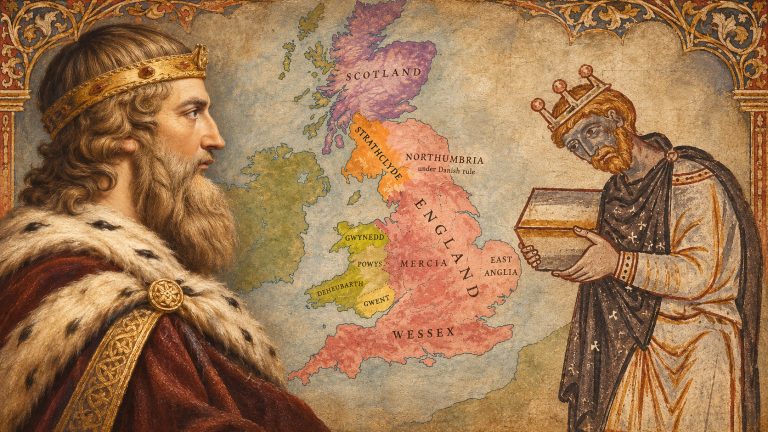
Overview
Explore how England emerged from competing Anglo-Saxon kingdoms through Alfred the Great’s reforms, the territorial expansion of Edward the Elder and Æthelflæd, and Æthelstan’s establishment of an English monarchy. Discover why unification remained fragile and how the resulting kingdom survived until the Norman Conquest.
Cite This Work
Anastasi, L. (2026, November 24). The Birth of England: From Alfred the Great to Æthelstan. Medieval History – Yesterday in a Nutshell. https://historymedieval.com/the-birth-of-england-from-alfred-the-great-to-aethelstan/
When Did England Become England?
When Alfred the Great ascended the throne of Wessex in AD 871, England did not exist as a unified political entity. Britain contained rival Anglo-Saxon kingdoms, Scandinavian-controlled territories and independent British kingdoms, each with its own political traditions, regional loyalties and ambitions. The emergence of a single English monarchy was far from inevitable, particularly as Scandinavian armies threatened to extinguish the remaining centres of independent Anglo-Saxon power.
Yet within little more than half a century, the political landscape had undergone a remarkable transformation. In 927, Alfred’s grandson Æthelstan acquired the kingdom of York, bringing the principal territories of what would become England under a single monarch. His achievements earned him recognition among historians as the first king of England, although the unity he established proved vulnerable to renewed conflict following his death.
The birth of England was therefore not the achievement of one extraordinary ruler or the consequence of a single decisive battle. It was a gradual and sometimes reversible process involving military conquest, diplomatic negotiation, administrative innovation and the cooperation—or submission—of regional elites. Archaeological discoveries, particularly coin hoards and the remains of fortified settlements, reveal a considerably more complex story than the surviving royal chronicles sometimes suggest.
Alfred the Great and the Survival of Wessex

A map of the routes taken by the Great Heathen Army from 865 to 886
A Kingdom on the Brink of Collapse
The arrival of the Great Heathen Army in 865 fundamentally altered the political balance of Anglo-Saxon Britain. Within a decade, Scandinavian armies had overthrown the kingdoms of East Anglia and Northumbria and severely weakened Mercia. Wessex remained the most substantial independent Anglo-Saxon kingdom, but its survival was increasingly uncertain.
Alfred inherited the throne following the death of his brother Æthelred in 871. Although the West Saxons had achieved a victory at Ashdown earlier that year, the military situation remained precarious. Alfred was compelled to negotiate peace while attempting to preserve his kingdom against renewed Scandinavian offensives.
The crisis reached its height in January 878, when the Scandinavian leader Guthrum launched a surprise attack on Chippenham. Alfred withdrew into the Somerset marshes, establishing a stronghold at Athelney from which he maintained resistance and eventually mobilised his supporters. His victory at the Battle of Edington later that year forced Guthrum to submit and accept baptism, with Alfred acting as his godfather.
Although subsequent generations celebrated Edington as a defining moment in English history, Alfred had secured the survival of Wessex rather than the independence of a united England. Much of northern and eastern England remained under Scandinavian authority, and Mercia’s political future remained far from settled.
Negotiating Peace and Defining England
The later Treaty of Alfred and Guthrum, probably concluded during the 880s, provides valuable insight into the changing political landscape. Rather than simply ending hostilities, it established an agreed territorial boundary and regulated relations between the populations governed by the two rulers.
The treaty described a frontier extending along rivers and established routes:
Up the Thames, and then up the Lea
The boundary continued towards Bedford, the River Great Ouse and Watling Street. Historian Ryan Lavelle argues in Border Land: Frontiers of Early England that the agreement represents an important development in the expression of royal authority through written territorial boundaries. Its provisions concerning compensation for offences also demonstrate that peaceful coexistence required practical arrangements between neighbouring societies.
Nevertheless, the agreement was not a permanent national frontier, nor did it encompass every Scandinavian-controlled territory. The political circumstances of the late ninth century shaped it, and the expansion of West Saxon and Mercian authority would subsequently overtake it.
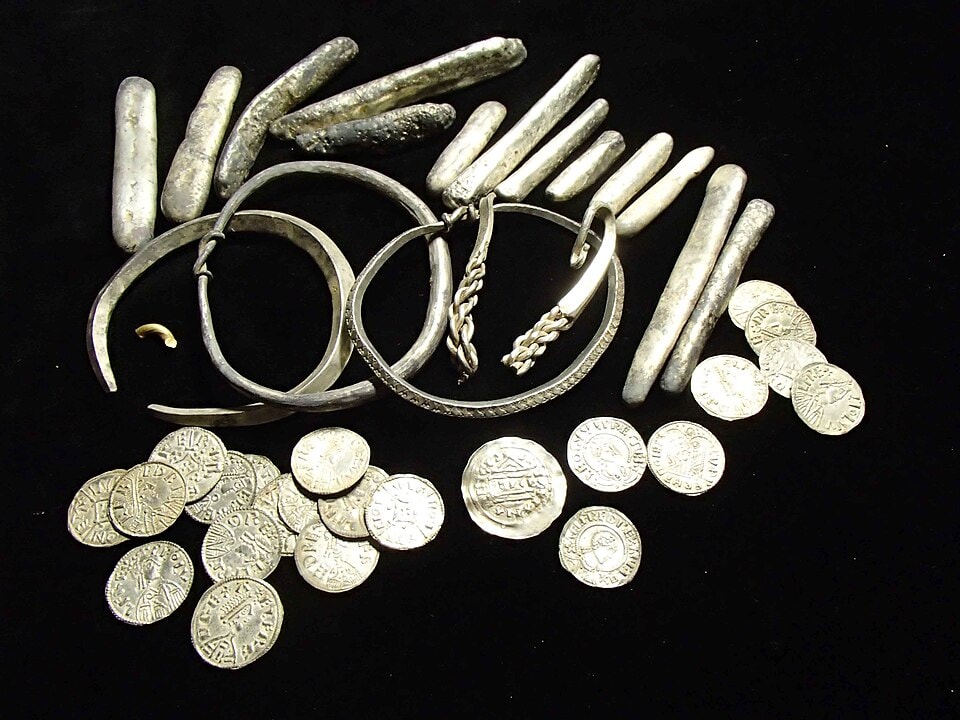
The Watlington Hoard: Rewriting Alfred’s Relationship with Mercia
Late ninth century, Ashmolean Museum, Oxford
More than 200 silver pennies offer important evidence of political and economic cooperation between Wessex and Mercia.
The discovery of the Watlington Hoard in Oxfordshire in 2015 challenged established interpretations of Alfred’s relationship with Ceolwulf II, the last independent king of Mercia. The hoard contains coins issued by both rulers, including rare examples bearing shared designs that suggest a degree of cooperation between their kingdoms.
The Anglo-Saxon Chronicle, compiled within the West Saxon political environment, portrays Ceolwulf as dependent upon the Scandinavian conquerors. The archaeological evidence suggests that his position may have been considerably more complex. Although the precise nature of his relationship with Alfred remains uncertain, the coins indicate that the emergence of West Saxon supremacy should not be accepted uncritically from accounts produced by its beneficiaries.

Building the Foundations of an English Kingdom
Alfred’s Fortified Towns
Alfred recognised that military victories alone could not guarantee the security of his kingdom. The Scandinavian armies had considerable mobility, enabling them to exploit weaknesses in local defences and threaten communities before traditional military levies could respond effectively.
His government developed an extensive network of fortified settlements known as burhs. Some occupied existing Roman towns or earlier defensive sites, while others were newly established or substantially reorganised. These settlements provided places of refuge, protected important routes and river crossings, and enabled royal forces to respond more effectively to enemy incursions.
The Burghal Hidage, a document generally associated with the late Alfredian or early tenth-century defensive system, records the resources allocated to a network of fortified centres. Land assessments helped determine the obligations necessary to defend and maintain these fortifications, thereby linking local communities more closely to the royal military organisation.
Alfred also reorganised military service so that forces could remain available without permanently removing agricultural workers from their livelihoods. His naval initiatives were less consistently successful, but they demonstrate an awareness of the need to counter Scandinavian threats at sea as well as on land.
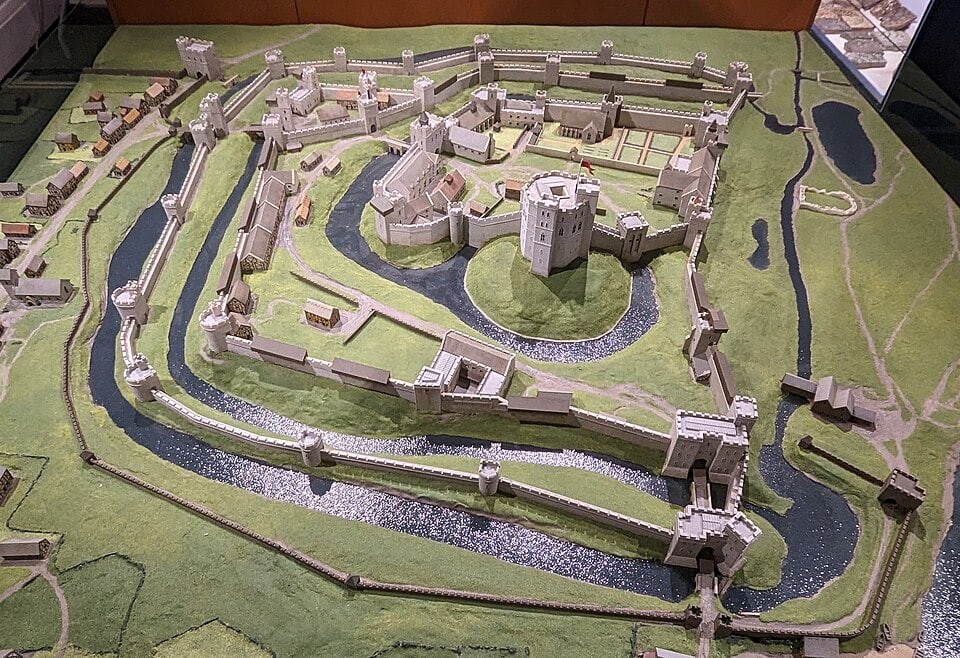
Wallingford’s Anglo-Saxon defences
Oxfordshire, England
Archaeological investigations reveal the defensive and administrative importance of this late Anglo-Saxon settlement.
Archaeological investigations at Wallingford illustrate the lasting significance of Alfred’s defensive programme. Its substantial earthen ramparts, planned settlement and mint demonstrate how fortified centres could develop into important commercial and administrative towns. Comparable settlements helped establish the urban infrastructure upon which Alfred’s successors would build their expanding kingdom.
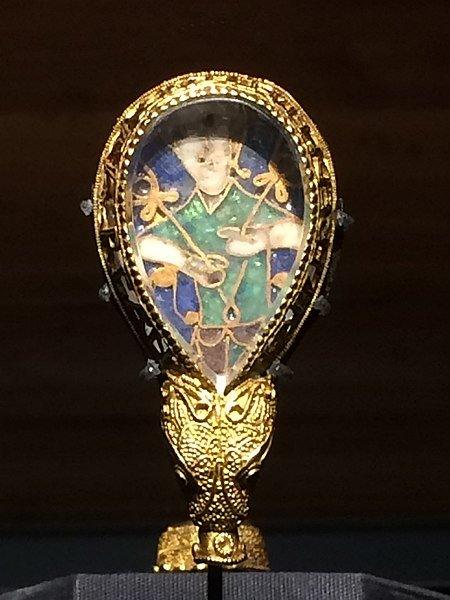
Alfred Jewel found at the Ashmolean, Oxford, UK
Law, Learning and English Identity
Alfred’s ambitions extended beyond military security. His law code drew on earlier Anglo-Saxon legislation and Christian principles, while his educational programme sought to revive learning and make important religious and philosophical works accessible in Old English.
The celebrated Alfred Jewel, discovered near Athelney in 1693, provides a remarkable material connection to this cultural revival. Its inscription identifies Alfred as the person who commissioned it, and scholars generally interpret the object as the decorative terminal of a reading pointer, although its precise function remains uncertain.
Alfred’s increasing use of a royal title identifying him as king of the Anglo-Saxons, rather than simply king of the West Saxons, reflected the widening geographical and political reach of his authority. His acquisition of London in 886 and his relationship with the Mercian leadership further strengthened the foundations of a monarchy that extended beyond the traditional kingdom of Wessex.
Although an English identity had existed long before Alfred’s reign, notably in the writings of Bede, the circumstances of the Viking Age gave this identity a new political significance. The defence of Christian Anglo-Saxon communities against Scandinavian armies helped provide a common purpose that increasingly transcended older political divisions.
Edward the Elder and Æthelflæd: Conquering the Danelaw
Edward the Elder and the Expansion of Wessex
When Alfred died in 899, his son Edward inherited a kingdom considerably stronger than the one his father had received almost three decades earlier. Nevertheless, Edward’s succession was challenged by his cousin Æthelwold, whose claim to the throne attracted Scandinavian support and demonstrated the continuing instability of Anglo-Saxon royal succession.
Following Æthelwold’s death in 902, Edward gradually strengthened his authority. In 910, West Saxon and Mercian forces defeated a Northumbrian Scandinavian army at Tettenhall, significantly weakening the ability of northern rulers to threaten southern England.
Edward subsequently pursued an increasingly ambitious programme of territorial expansion, establishing fortified settlements at strategically important locations and extending his authority into eastern England. By the end of 917, much of East Anglia had submitted to his rule, while further campaigns brought substantial areas of the Midlands under his control.
Edward’s achievements were made possible not only by the foundations established during Alfred’s reign but also by his partnership with one of the most remarkable political figures of early medieval England: his sister Æthelflæd.
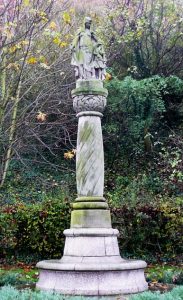
Æthelflæd, Lady of the Mercians
Commemorative statue at Tamworth
Her military leadership and political authority were instrumental in the expansion of Anglo-Saxon rule during the early tenth century.
Æthelflæd had married Æthelred, Lord of the Mercians, strengthening the political relationship between Mercia and Wessex. Following her husband’s death in 911, she assumed leadership of Mercia in her own right, an exceptional position for a woman within the political culture of the period.
Her achievements included the establishment and restoration of fortified settlements at locations such as Bridgnorth, Tamworth and Stafford. Archaeological investigations at Tamworth have identified evidence of its Anglo-Saxon defences, which support the documentary accounts of Mercia’s extensive fortification programme.
In 917, Æthelflæd captured Derby, one of the five principal Scandinavian-controlled boroughs of the Midlands. Leicester submitted to her authority the following year, while negotiations with the people of York appeared to offer the possibility of further territorial expansion.
Her death in June 918, however, brought these developments to an abrupt conclusion. Although her daughter Ælfwynn briefly succeeded her, Edward subsequently removed his niece from power and brought Mercia under his direct authority.
This episode reveals an important contradiction within the story of English unification. The expansion of a common English monarchy involved not only the defeat of Scandinavian rulers but also the dismantling of established Anglo-Saxon political structures. For the Mercians, greater political unity came at the expense of their remaining independence.
Æthelstan and the Birth of an English Monarchy
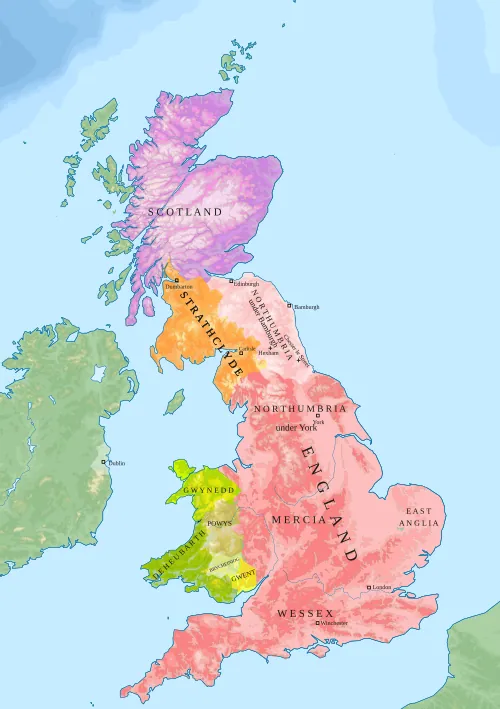
Map of the kingdoms of Britain in 927, under King Athelstan
From Mercian Prince to English King
Edward the Elder’s death in 924 initiated another uncertain royal succession. His son Æthelstan, who appears to have spent much of his formative life in Mercia, enjoyed considerable support there, although his acceptance in Wessex was apparently less immediate.
Following the death of his half-brother Ælfweard shortly after Edward, Æthelstan eventually secured the throne and was crowned at Kingston upon Thames in September 925. He inherited extensive territories encompassing Wessex, Mercia and East Anglia, but the Scandinavian kingdom centred on York remained beyond his direct authority.
In 926, Æthelstan arranged the marriage of one of his sisters to Sihtric, the ruler of York, establishing a dynastic alliance that temporarily secured relations between the two kingdoms. When Sihtric died in 927, however, Æthelstan took control of York and prevented rival Scandinavian claimants from establishing lasting authority there.
For the first time, a single monarch governed the principal kingdoms and territories traditionally associated with the English people. It is this achievement that has led historians, including Sarah Foot, to recognise Æthelstan as the first king of England.
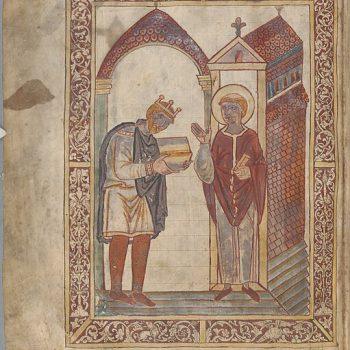
Æthelstan presenting a book to St Cuthbert
Tenth-century manuscript, Corpus Christi College, Cambridge, MS 183, fol. 1v
One of the earliest surviving contemporary representations of an English monarch.
Æthelstan’s ambitions extended considerably beyond the territories he governed directly. Following his acquisition of York, he secured recognition of his supremacy from several neighbouring rulers at a meeting traditionally associated with Eamont Bridge, near present-day Penrith.
Those acknowledging his authority included Constantine II of Scotland, Welsh rulers and the ruler of Bamburgh. The meeting represented an extraordinary demonstration of Æthelstan’s political standing, although it did not establish permanent national boundaries or bring all Britain under English administration.
As Ryan Lavelle explains in Border Land, the meeting at Eamont illustrates the difficulties of identifying definitive moments in the formation of England’s northern frontier. Political authority remained subject to negotiation, and powerful regional and neighbouring rulers continued to pursue their own interests.
Æthelstan’s coinage provides further evidence of his ambitions. Certain silver pennies carried the abbreviated Latin title:
Rex Totius Britanniae — King of All Britain.
Such titles communicated a powerful message about royal authority. Nevertheless, they represented claims to supremacy rather than proof that Æthelstan directly governed Scotland, Wales or every territory within Britain. His position depended upon a combination of military strength, diplomatic relationships and recognition from other rulers.
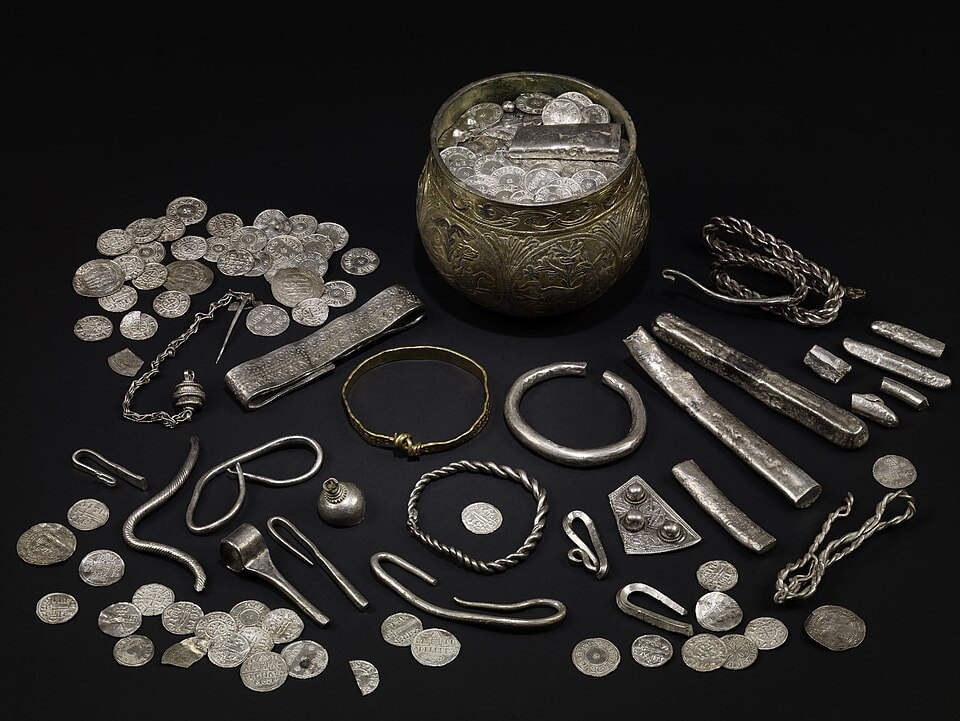
The Vale of York Hoard
Early tenth century, discovered in 2007
The collection contains coins, precious metalwork and silver originating from an extensive international trading network.
The discovery of the Vale of York Hoard near Harrogate in 2007 offers a remarkable archaeological perspective on the political transformation of northern England. Its contents include coins associated with Scandinavian York, Anglo-Saxon royal coinage, silver ingots and objects reflecting commercial connections extending far beyond Britain.
The presence of Æthelstan’s coinage places the burial of the treasure around the period following his acquisition of York. Although the identity and motives of its owner remain unknown, the hoard may reflect the political uncertainty accompanying the transition from Scandinavian to English royal authority.
Equally important is what the discovery reveals about the territory Æthelstan had acquired. Northern England was not an isolated frontier populated exclusively by warriors and farmers but part of an extensive commercial world linking Britain with Ireland, Scandinavia and more distant markets.
The Battle of Brunanburh, 937
Æthelstan’s claims to supremacy inevitably generated resistance. In 937, Constantine II of Scotland, Olaf Guthfrithson of Dublin and forces associated with the kingdom of Strathclyde formed a coalition against him. Their challenge threatened both Æthelstan’s wider political ambitions and his authority over northern England.
Æthelstan and his brother Edmund defeated the coalition at Brunanburh, a victory celebrated in an Old English poem preserved within several manuscripts of the Anglo-Saxon Chronicle. The poem presents the triumph as an achievement of considerable historical significance for the English people, linking the victory to their ancestral arrival in Britain.
Despite its prominence in medieval sources, the precise location of Brunanburh remains disputed, with several proposed sites continuing to attract historical and archaeological investigation.
The victory preserved Æthelstan’s monarchy during his lifetime and reinforced his reputation as a formidable ruler. However, the events following his death would demonstrate that military success had not eliminated the underlying political divisions of his kingdom.
One Kingdom, Many Peoples
The Machinery of English Government
The acquisition of territory was only one aspect of establishing an English monarchy. Governing communities with different legal traditions, political loyalties and economic interests posed challenges that military power alone could not resolve.
Æthelstan developed existing systems of royal administration, issuing law codes, granting charters and convening assemblies attended by ecclesiastical leaders, regional magnates and royal officials. These gatherings helped integrate influential individuals from different parts of his kingdom into a broader political community.
The developing network of shires, fortified settlements and royal mints provided mechanisms through which the monarchy could exercise authority. Royal legislation increasingly addressed matters such as theft, commercial transactions and the regulation of coinage, although the enforcement of these provisions inevitably depended upon cooperation at a local level.
Æthelstan’s legislation concerning currency illustrates the growing ambition of English kingship. By asserting greater control over the production and circulation of money, the monarchy sought to strengthen its authority over economic activity, although regional variations in coin design and minting practices persisted.
The Church also played an essential role in this process. Bishops and monasteries possessed extensive estates, administrative experience and networks of communication that connected otherwise distinct regions. Royal patronage of religious institutions helped strengthen political relationships while presenting English kingship as part of a wider Christian order.
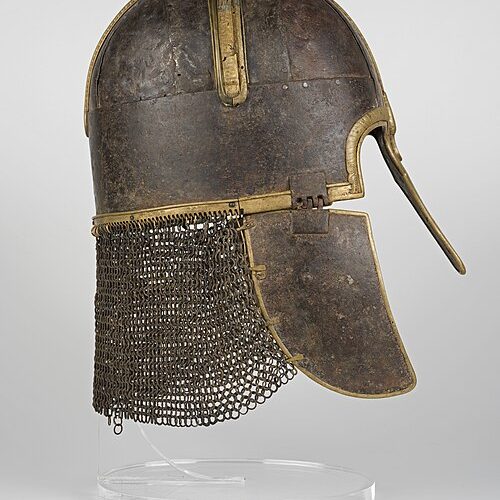
The Coppergate excavations
York, 1976–1981
Archaeological discoveries reveal the sophisticated urban society that developed under Scandinavian and subsequent English rule.
Political unification did not erase the cultural identities that had developed over preceding centuries. Mercian, Northumbrian and West Saxon loyalties remained influential, while communities throughout the former Danelaw retained distinctive Scandinavian cultural, linguistic and legal traditions.
The Coppergate excavations conducted in York between 1976 and 1981 provide particularly compelling evidence of this diversity. Archaeologists uncovered remarkably well-preserved remains of buildings, workshops, clothing, jewellery and everyday objects, revealing a thriving urban community whose inhabitants participated in extensive trading networks.
Such discoveries challenge any interpretation of English unification as a straightforward replacement of Scandinavian culture with Anglo-Saxon traditions. The emerging kingdom incorporated communities whose experiences, customs and economic relationships differed substantially from those of its southern political heartland.
Indeed, the Scandinavian contribution became an enduring element of English society. Place names, vocabulary, commercial practices and regional customs preserved aspects of this heritage long after independent Scandinavian kingship had disappeared.
The Fragility of English Unity
Æthelstan’s death in October 939 exposed the limitations of his achievements. Scandinavian rulers quickly re-established their authority in York, while Olaf Guthfrithson extended his influence into parts of the Midlands. Consequently, Æthelstan’s successor Edmund inherited a kingdom that already faced threats to its political unity.
Edmund recovered the Five Boroughs of Derby, Leicester, Lincoln, Nottingham and Stamford in 942 and regained control of York in 944. Nevertheless, Scandinavian kingship subsequently returned to Northumbria, demonstrating the continuing attraction of alternative political arrangements among sections of the northern population.
It was not until 954, during the reign of Eadred, that the expulsion of Eric Bloodaxe brought independent Scandinavian kingship at York to a definitive conclusion. Northumbria subsequently remained within the English kingdom, although its regional aristocracy continued to exercise considerable influence.
The significance of 954 is frequently overshadowed by Æthelstan’s achievements in 927. However, if the earlier date represents the first establishment of a unified English monarchy, the later date represents an important milestone in its lasting consolidation. England’s emergence was a prolonged historical process rather than the consequence of a single founding event.
From English Unification to the Norman Conquest
A Kingdom That Survived Changes of Dynasty
During the second half of the tenth century, particularly under King Edgar, the English monarchy underwent further administrative and institutional consolidation. Nevertheless, renewed Scandinavian invasions during the reign of Æthelred II exposed the kingdom’s continuing vulnerability to external threats and internal political rivalries.
In 1016, Cnut established himself as king of England, subsequently incorporating the kingdom into a wider North Sea empire that included Denmark and Norway. Significantly, the Scandinavian conquest did not lead to the dissolution of England into its former independent kingdoms. Cnut instead governed an established political entity, adopting and adapting institutions developed under his Anglo-Saxon predecessors.
The accession of Edward the Confessor in 1042 restored the traditional West Saxon royal dynasty, but regional aristocratic power remained a significant challenge to royal authority. The Northumbrian rebellion against Earl Tostig in 1065 demonstrated the enduring strength of northern political loyalties.
In Harold: Warrior King, historian Tom Licence argues that the unresolved divisions exposed by this rebellion were central to understanding Harold Godwinson’s accession in January 1066. His interpretation challenges the conventional emphasis on external invasion alone, suggesting that Harold’s supporters also regarded him as someone capable of restoring unity to a divided kingdom.
William of Normandy‘s victory at Hastings on 14 October 1066 brought an end to Anglo-Saxon royal government and initiated profound changes in landownership, aristocratic society, military architecture and ecclesiastical leadership. Nevertheless, the Normans inherited a kingdom possessing established administrative structures, taxation systems, royal mints and a developed conception of English kingship.
The compilation of the Domesday Book in 1086 would demonstrate the remarkable administrative resources available to the new monarchy, many of which had their origins in the centuries before the Norman Conquest. William had conquered England, but he had not created it.
England Was Made, Not Founded
The emergence of England cannot be attributed exclusively to Alfred the Great or Æthelstan, despite the extraordinary achievements of both monarchs. Alfred ensured the survival of Wessex and established essential military, cultural and administrative foundations, while Edward the Elder and Æthelflæd transformed the political geography of southern and central England. Æthelstan subsequently brought the principal territories of England under a single monarchy, although his successors were required to defend and consolidate his achievement.
Archaeological discoveries such as the Watlington Hoard, the Vale of York Hoard and the remains of fortified settlements reveal that this transformation involved considerably more than the military successes celebrated in contemporary chronicles. England emerged through cooperation and coercion, commercial integration, cultural interaction and the gradual development of institutions capable of governing diverse communities.
The kingdom that William took over in 1066 was the result of years of political experimentation, military conflict, and administrative growth. Although the Norman Conquest transformed its ruling elite and political culture, the English kingdom itself survived, preserving a substantial part of the institutional legacy established during the Anglo-Saxon centuries.
Frequently Asked Questions
Who was the first king of England?
Æthelstan is generally recognised as the first king of England. In 927, following his acquisition of the Scandinavian kingdom of York, he became the first monarch to govern the principal territories of England under a single crown.
Why is Alfred the Great not considered the first king of England?
Alfred ruled Wessex and extended his authority over other Anglo-Saxon territories, but he never governed all England. His military reforms, administrative achievements and cultural initiatives established the foundations upon which his successors built a more unified monarchy.
What role did Æthelflæd play in the unification of England?
Æthelflæd governed Mercia from 911 to 918, establishing fortified settlements, defeating Scandinavian rulers and recovering important territories. Her partnership with Edward the Elder significantly contributed to the expansion of Anglo-Saxon political authority.
When was England permanently united?
Although 927 is traditionally regarded as the foundation date of the Kingdom of England, Scandinavian kings subsequently regained control of York. The expulsion of Eric Bloodaxe in 954 marked the lasting incorporation of Northumbria into the English monarchy.
What was the importance of the Battle of Brunanburh?
The Battle of Brunanburh in 937 preserved Æthelstan’s authority against a coalition of Scottish, Scandinavian and British forces. His victory strengthened the recently established English monarchy, although it did not permanently resolve its regional political divisions.
Did the Norman Conquest create England?
No. By 1066, England had existed as a recognisable kingdom for more than a century. The Norman Conquest transformed its ruling aristocracy, landownership and political culture while retaining and adapting many established Anglo-Saxon institutions.
Recommended Reading
This website uses affiliate links. If you purchase via these links, we might earn a commission that contributes to sustaining the HistoryMedieval.com platform.


Related Articles
 The Birth of England: From Alfred the Great to Æthelstan
 The Great Heathen Army: How England Was Transformed
 Women Who Shaped Anglo-Saxon England: Faith and Power
 The Christian Conversion of Anglo-Saxon England
 The First Anglo-Saxon Kings: How England’s Kingdoms Emerged
 Angles, Saxons and Jutes: A New History of Migration
 The End of Roman Britain: What Happened After Rome Withdrew?
 Æthelflæd: The Mercian Queen Who Helped Forge England
Sources & References
Primary sources
- Asser. (1983). Alfred the Great: Asser’s Life of King Alfred and other contemporary sources (S. Keynes & M. Lapidge, Trans.). Penguin Books.
- The Anglo-Saxon chronicle (M. Swanton, Ed. & Trans.). (1996). J. M. Dent.
- Fordham University. (n.d.). Medieval sourcebook: The Anglo-Saxon Chronicle on Alfred the Great. Internet Medieval Sourcebook. https://sourcebooks.web.fordham.edu/source/angsax-chron1.asp
Historical books and academic studies
- Abels, R. (1998). Alfred the Great: War, kingship and culture in Anglo-Saxon England. Longman.
- Christie, N., Creighton, O., Edgeworth, M., & Hamerow, H. (2013). Transforming townscapes: From burh to borough: The archaeology of Wallingford, AD 800–1400. Society for Medieval Archaeology. https://www.routledge.com/Transforming-Townscapes/Christie-Creighton-Edgeworth-Hamerow/p/book/9781909662094
- Foot, S. (2011). Æthelstan: The first king of England. Yale University Press. https://yalebooks.yale.edu/book/9780300187717/aethelstan/
- Lavelle, R. (2026). Border land: Frontiers of early England. Yale University Press. https://yalebooks.co.uk/book/9780300259582/border-land/
- Licence, T. (2026). Harold: Warrior king. Yale University Press. https://yalebooks.co.uk/book/9780300252958/harold/
- Naylor, J., & Standley, E. (Eds.). (2022). The Watlington hoard: Coinage, kings and the Viking Great Army in Oxfordshire, AD 875–880. Archaeopress. https://www.jstor.org/stable/jj.15136018
- Sullivan, T. (2023). The early Anglo-Saxon kings. Pen & Sword History. https://www.penandswordbooks.com/9781399084215/the-early-anglo-saxon-kings/
Online historical and archaeological sources
- Ashmolean Museum. (n.d.). Alfred Jewel. University of Oxford. https://www.ashmolean.org/alfred-jewel
- English Heritage. (n.d.-a). An introduction to early medieval England (c. 410–1066). https://www.english-heritage.org.uk/learn/story-of-england/early-medieval/introduction/
- English Heritage. (n.d.-b). Early medieval: Power and politics. https://www.english-heritage.org.uk/learn/story-of-england/early-medieval/power-and-politics/
- Foot, S. (2004). Æthelstan [Athelstan] (893/4–939), king of England. In Oxford dictionary of national biography. Oxford University Press. https://academic.oup.com/oxford-dictionary-of-national-biography/reference/63486/reference-article/579417113
- JORVIK Viking Centre. (n.d.). 1976–1981: Coppergate dig. https://www.jorvikvikingcentre.co.uk/about/jorvik-story/coppergate-dig/
- Staffordshire Historic Environment Record. (n.d.). Tamworth burh (Record MST1151). Heritage Gateway. https://historicengland.org.uk/listing/heritage-gateway/results/record/327e063c-c604-4fab-b973-b2566fb68559/MST1151
- Woods, A. (n.d.). Beyond Jorvik: The Vale of York Viking hoard. York Museums Trust. https://www.yorkmuseumstrust.org.uk/blog/beyond-jorvik-the-vale-of-york-viking-hoard-andrew-woods/
Copyright, Licensing and Disclosure
© HistoryMedieval. This article is licensed under the Creative Commons Attribution–NonCommercial–NoDerivatives 4.0 International licence (CC BY-NC-ND 4.0).
You may share this article unchanged for non-commercial purposes, provided that full credit is given to the author and HistoryMedieval, a link to the licence is included, and online republication links back to the original article on HistoryMedieval.com. Adaptation, translation, abridgement or commercial reuse requires prior written permission.
Third-party images and materials may be subject to separate copyright or licensing terms. For copyright concerns, contact info@historymedieval.com. We will review the matter and take any necessary corrective action.
This article may contain affiliate links. We may earn a commission from qualifying purchases at no additional cost to the buyer.