
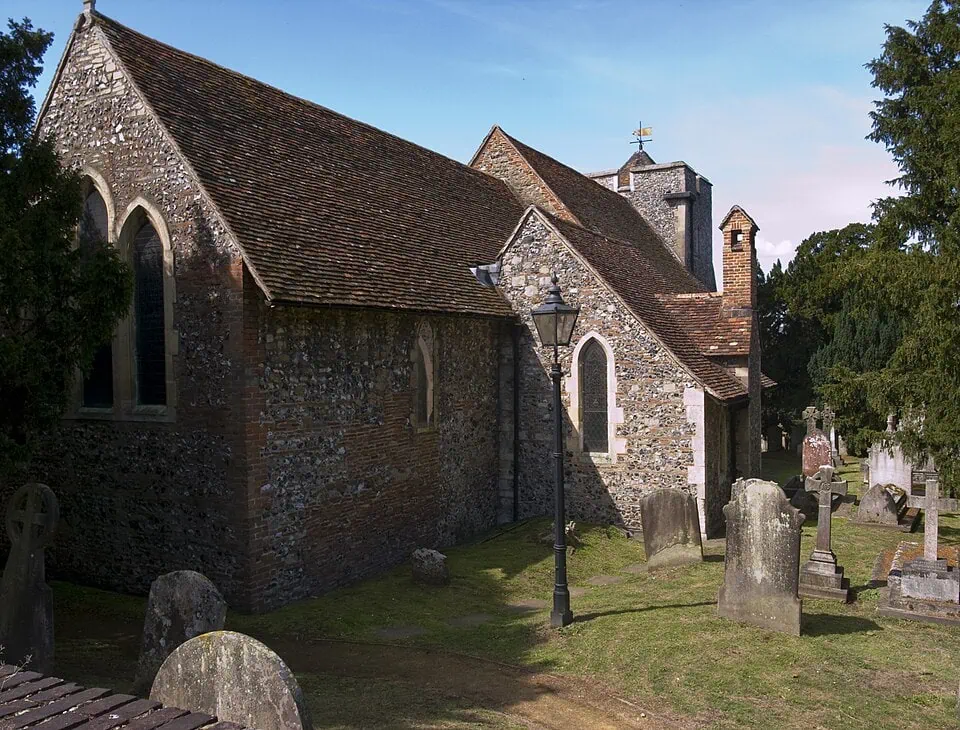
St Martin’s Church, Canterbury, England
Long before England became a united kingdom, the rulers of Kent maintained important commercial and diplomatic connections with continental Europe. Situated close to the Frankish territories across the English Channel, Kent was particularly well placed to participate in the political and cultural networks of the Merovingian world. It was against this background that Æthelberht, King of Kent, married Bertha, the Christian daughter of the Frankish king Charibert I.
The precise date of their marriage is uncertain, but its religious implications were significant. According to Bede, writing in the eighth century, Bertha was permitted to retain her Christian faith and was accompanied to Kent by Bishop Liudhard. At Canterbury, she worshipped at St Martin’s Church, a building associated with Britain’s earlier Christian traditions. Her household consequently provided a Christian presence at the Kentish royal court before Augustine arrived from Rome in 597.
Bertha’s influence should not, however, be reduced to the familiar story of a Christian wife persuading her pagan husband to convert. In a letter addressed to her in 601, Pope Gregory the Great praised her faith but also encouraged her to do more to advance Christianity among her subjects. The letter suggests that Rome recognised the political importance of royal women in religious conversion while also expecting them to fulfil particular responsibilities.
Historian Ryan Lavelle places Bertha’s marriage within a broader pattern of Frankish interests in southern Britain. Her union with Æthelberht may have helped strengthen diplomatic and ecclesiastical connections across the Channel, although the extent of Frankish political influence over Kent remains debated (Lavelle, 2026, pp. 224–225).
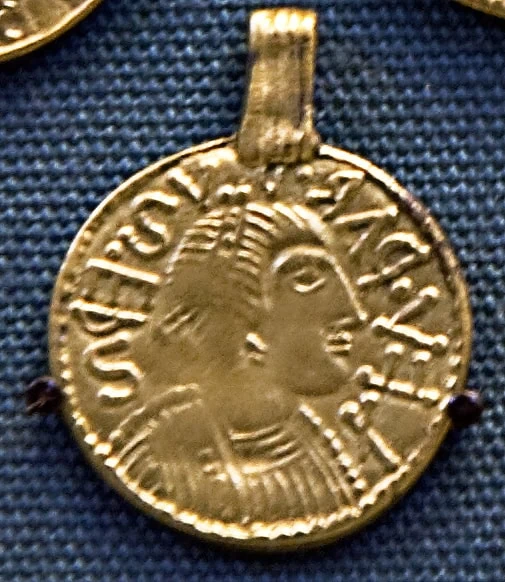
The Luidhard Medalet
Material evidence reinforces these connections. The Liudhard Medalet, discovered near St Martin’s Church in Canterbury, bears the bishop’s name and Christian imagery. Its adaptation for suspension suggests that it may have been worn as a visible expression of religious identity. Although it cannot tell us precisely how Bertha influenced her husband, it provides an exceptionally rare archaeological connection with the Christian world surrounding her.
Bertha’s historical importance lies in the intersection of marriage, diplomacy and religion. As a Frankish princess and Kentish queen, she helped establish the conditions in which Christianity could gain acceptance at one of the most influential royal courts of early Anglo-Saxon England.

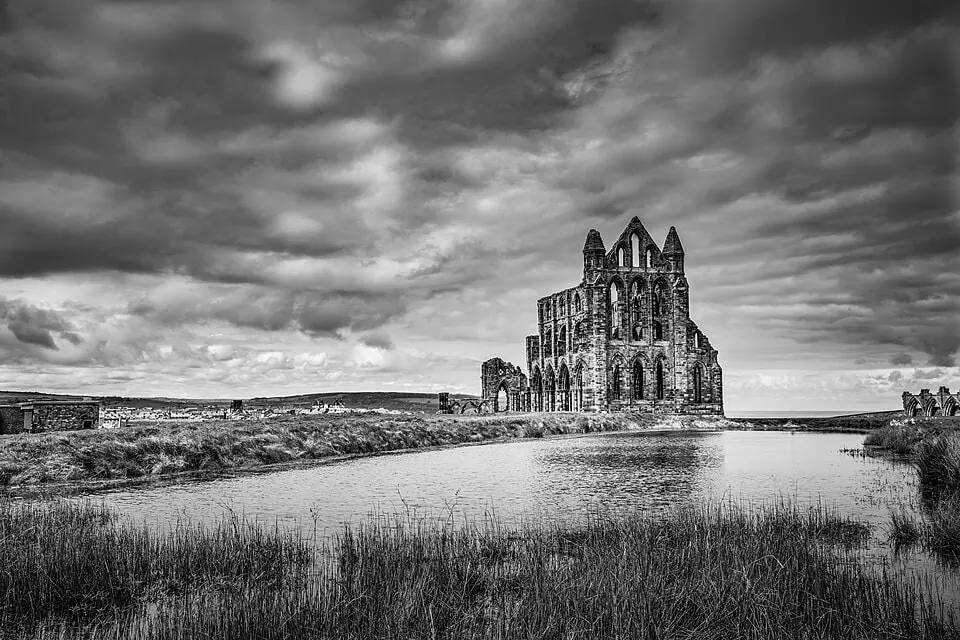
The ruins of Whitby Abbey
Born around 614 into the Northumbrian royal family, Hild, also known as Hilda, belonged to a generation that witnessed both the expansion of Christianity and the violent political struggles of the Anglo-Saxon kingdoms. She was baptised in 627 during the reign of her distant-uncle, King Edwin of Northumbria, whose conversion represented a significant moment in the religious history of northern England.
At around the age of thirty-three, Hild entered religious life. Under the guidance of Aidan of Lindisfarne, she became abbess of Hartlepool before establishing a monastery at Whitby, then known as Streaneshalch, in 657. The community developed into one of the most influential religious and intellectual centres in seventh-century England.
Whitby was what historians describe as a double monastery, accommodating both men and women under the authority of an abbess. Although its members probably lived in separate areas, Hild exercised leadership over the wider community, overseeing its discipline, religious education and administration. Such institutions offered aristocratic women opportunities to exercise authority that were otherwise difficult to obtain.
Bede was particularly impressed by Hild’s wisdom and reputation:
Her prudence was so great, that not only meaner men in their need, but sometimes even kings and princes, sought and received her counsel.
— Bede, Ecclesiastical History of the English People, Book IV, Chapter 23.
Several men educated at Whitby subsequently became bishops. Bede also credits Hild with recognising and encouraging the poetic abilities of Cædmon, a member of the monastic community whose religious verse is one of the earliest surviving examples of English poetry.
Hild’s political importance became particularly apparent in 664, when Whitby hosted a gathering of leading churchmen and members of the Northumbrian royal family to resolve disagreements over ecclesiastical practices, most notably the calculation of Easter. Although Hild appears to have supported the tradition associated with Iona, King Oswiu ultimately ruled in favour of Roman practices.
The Synod of Whitby illustrates both the extent and the limitations of Hild’s authority. Her monastery was sufficiently prestigious to host a gathering of considerable political and religious significance, yet the final decision belonged to the king.
Archaeological excavations at Whitby have identified remains associated with the Anglo-Saxon settlement, including a substantial cemetery. The spectacular abbey ruins visible today, however, belong predominantly to a much later medieval religious foundation and should not be confused with Hild’s original monastery.
As Luke Daly observes in Women of the Middle Ages, early medieval religious communities could offer women from ruling families opportunities to retain and exercise considerable authority. Hild’s career demonstrates that religious vocation did not necessarily entail withdrawal from political life; in certain circumstances, it provided an alternative means of participating in it (Daly, 2026, pp. 2–3).
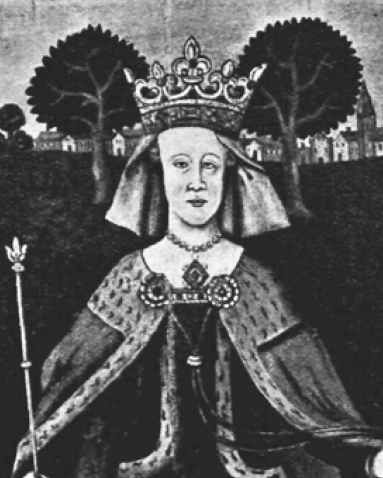
Fifteenth-century picture of Eadgifu in Canterbury Cathedral
Unlike Æthelflæd, historians do not primarily remember Queen Eadgifu of Kent for military achievements or territorial conquest. Instead, royal charters, property disputes, ecclesiastical patronage, and her position within successive generations of the West Saxon dynasty reveal her political significance.
The daughter of Sigehelm, an ealdorman of Kent, Eadgifu became the third wife of Edward the Elder. Their sons, Edmund and Eadred, both subsequently became kings of England. Following Edward’s death in 924 and the intervening reign of Æthelstan, her position as queen mother gave her considerable standing during the reigns of her sons.
Eadgifu’s career illustrates the importance of motherhood within Anglo-Saxon dynastic politics. A queen’s influence did not necessarily end with her husband’s death, particularly when her children inherited the throne. Widowhood, combined with wealth and royal connections, could create new opportunities for political and religious patronage.
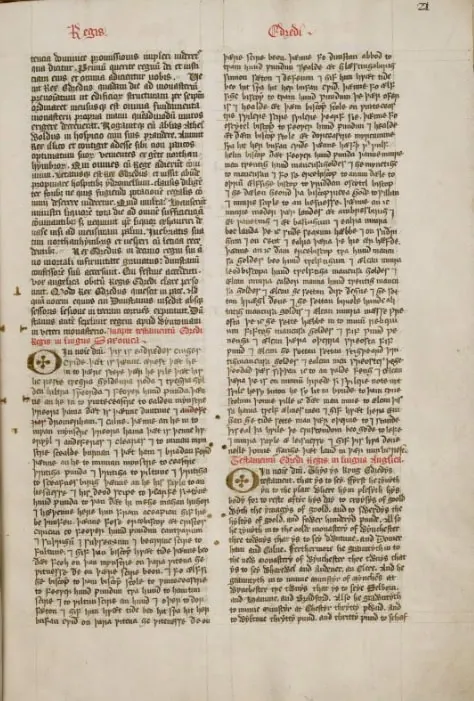
Will of King Eadred – BL Add MS 82931, f. 22r
The struggle for Cooling
One of the most revealing documents concerning Eadgifu is a charter generally dated to around 959 and catalogued by historians as Sawyer 1211. Preserved in the British Library as Stowe Charter 28, it records her donation of estates at Cooling and Osterland in Kent to Christ Church, Canterbury.
The document says that Eadgifu’s father borrowed thirty pounds from a man named Goda and promised to give him land as collateral. Before his death in battle, Sigehelm reportedly repaid the debt and bequeathed the estate to his daughter. Goda disputed the repayment and retained possession of the land.
The subsequent struggle involved legal proceedings, sworn testimony and intervention by successive kings. Eadgifu eventually recovered her property, although the dispute resurfaced after the death of her son Eadred in 955, when she lost her possessions during the reign of her grandson Eadwig.
Her fortunes improved when Edgar, another grandson, became ruler. The estates were restored, allowing Eadgifu to fulfil her intention of donating them to Canterbury. The charter describes how she took the documents that established her ownership and:
with her own hands laid them upon the altar, as the property of the community for ever
— Queen Eadgifu’s grant to Christ Church, Canterbury, c. 959 (Sawyer 1211).
The document is remarkable because it preserves an account of a woman’s prolonged efforts to defend her economic interests. It also reveals the importance of written records, legal procedures, family alliances and royal intervention in establishing ownership.
Historian Jonathan Tickle has argued that the charter should be understood not simply as a record of litigation but as a carefully constructed representation of Eadgifu’s identity and legal authority. Its account presents the queen as both a legitimate property owner and a Christian patron whose conduct was intended to command respect (Tickle, 2023).
Eadgifu last appears in the surviving documentary record in the New Minster Charter of 966, where she is identified as the king’s grandmother. Her precise date of death remains unknown.
Her experience offers particularly revealing insights into the relationship between wealth and political influence. Although her royal connections provided considerable advantages, they did not guarantee security. Her ability to retain her estates remained dependent upon legal recognition, political alliances and the changing fortunes of the royal family.
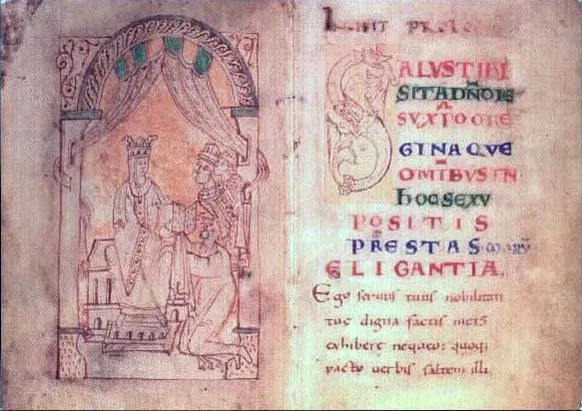
The Encomium Emmae Reginae – Queen Emma of Normandy – is depicted receiving the Encomium Emmae, with her sons Harthacanute and Edward the Confessor in the background.
Few women in early medieval England experienced political transformations as dramatic as those that Emma of Normandy encountered. Born into the Norman ducal family towards the end of the tenth century, Emma married King Æthelred II in 1002, establishing an important dynastic connection between England and Normandy at a time of renewed Scandinavian attacks.
The marriage produced several children, including the future Edward the Confessor and his younger brother Alfred. However, the continuing Scandinavian invasions placed the English monarchy under increasing pressure, culminating in the conquest of England by the Danish ruler Cnut in 1016, following the deaths of Æthelred and his son Edmund Ironside.
In 1017, Emma married Cnut, the ruler who had defeated her former husband’s dynasty. The marriage helped strengthen the new king’s position in England while preserving Emma’s standing within the royal court.
Her surviving children with Æthelred were still possible heirs to the English throne. Her marriage to Cnut produced another son, Harthacnut, and a daughter, Gunnhild, who later married Henry III, the future Holy Roman Emperor. Through these relationships, Emma forged connections with an extraordinary network of English, Scandinavian, Norman, and continental European dynasties.
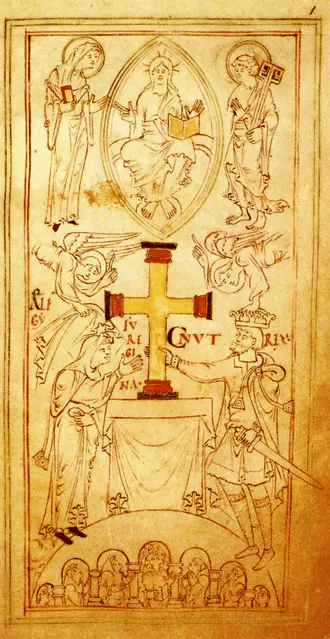
Cnut and Emma present a cross:
A contemporary depiction of religious patronage by the king and queen.
Credit: British Library, Stowe MS 944, fol. 6r. Public domain reproduction.
Queenship and Religious Patronage
Emma’s position under Cnut was particularly prominent. Surviving charters record her involvement in royal acts of patronage, including a grant made by Cnut to the archbishop of Canterbury at her request.
An illustration in the New Minster Liber Vitae, produced around 1031, depicts Emma and Cnut presenting a cross to the New Minster at Winchester. The representation is significant because it places both king and queen within a shared ceremonial expression of religious patronage.
Although such imagery should not be interpreted as proof of equal political authority, it demonstrates the public importance attached to Emma’s position alongside Cnut.
The struggle for the English throne
Cnut’s death in 1035 exposed the fragility of Emma’s position. Rival claims to the English throne emerged between his sons Harthacnut and Harold Harefoot, whose mother, Ælfgifu of Northampton, was herself an influential political figure.
With Harthacnut occupied in Denmark, Harold gradually established his authority in England. Emma was forced into exile in Flanders in 1037, while her son Alfred had already been captured in England and died following his brutal blinding in 1036.
Following Harold’s death in 1040, Harthacnut became king, allowing Emma to return to England. Her surviving son by Æthelred, Edward, subsequently joined Harthacnut in England and succeeded him in 1042.
Emma had thus survived the collapse of one royal dynasty, the establishment of another and a bitter succession struggle. Her political difficulties were not entirely over, however, as Edward confiscated much of her wealth in 1043. Historians continue to debate the reasons for his actions, which may have reflected longstanding tensions within the royal family.
A queen who commissioned her own history
One of Emma’s most remarkable achievements was commissioning the Encomium Emmae Reginae, a Latin historical work composed around 1041–1042 to celebrate her position and legitimise the political standing of her sons.
The work provides an invaluable source for historians, but its selective treatment of events also demands scrutiny. It largely avoids discussing Emma’s marriage to Æthelred and portrays the conflicts following Cnut’s death in ways that are favourable to both Emma and Harthacnut.
Ryan Lavelle, for example, questions the reliability of its account of the correspondence that preceded Alfred’s return to England and his subsequent death. The author attributes a supposedly fraudulent letter to Harold’s supporters, but Lavelle suggests that Emma herself may have communicated with her sons as part of her attempts to counter Harold’s ambitions (Lavelle, 2026, pp. 236–238).
The Encomium is therefore significant not only for what it reveals about eleventh-century political history but also because it demonstrates how a royal woman could commission a literary work intended to influence political memory.
Emma died in 1052, having been the wife of two English kings and the mother of two more. Her Norman ancestry also formed part of the dynastic background to the events of 1066, although the Norman Conquest resulted from far more complex political circumstances than her marriage alone.
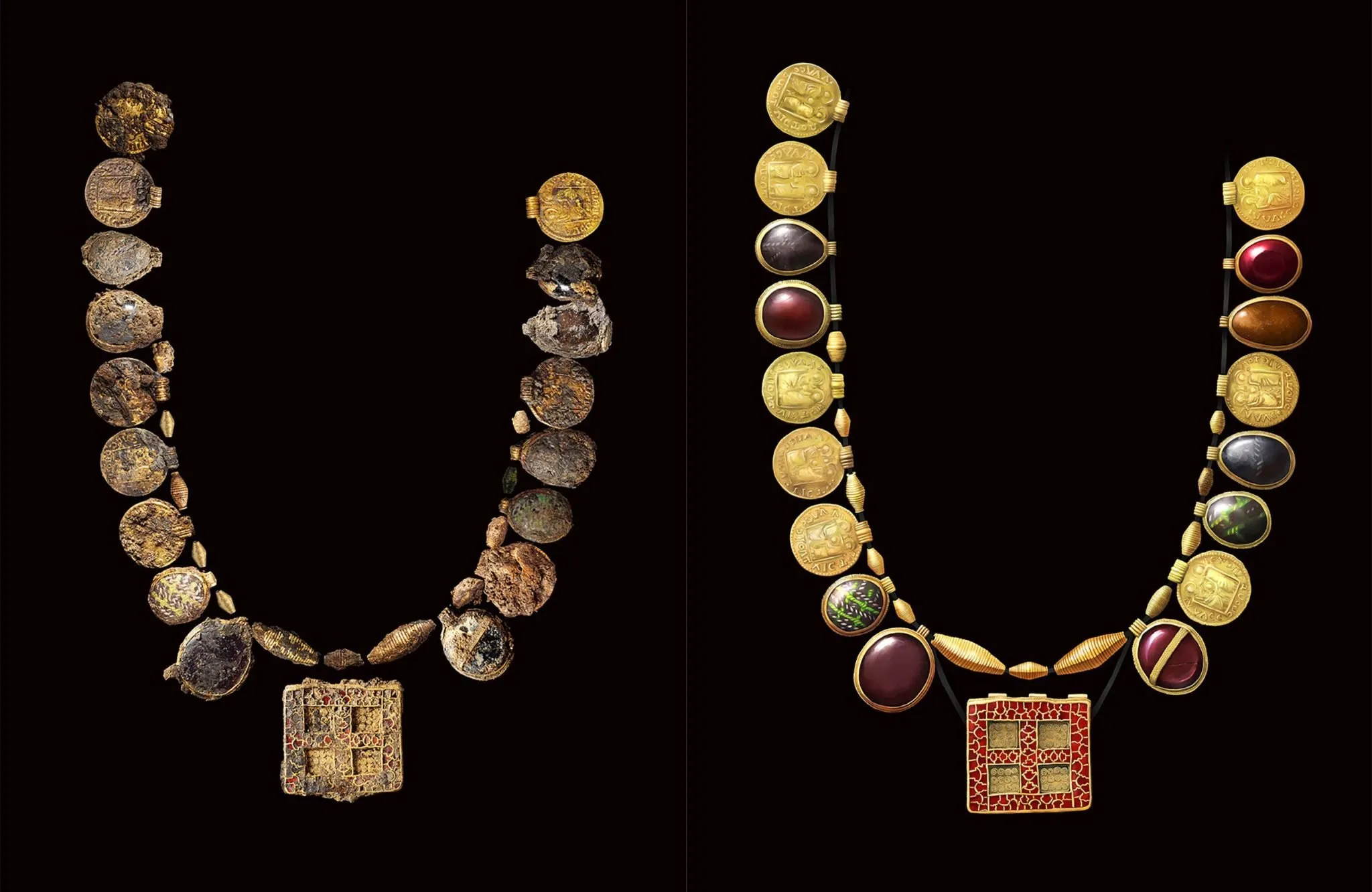
Harpole Treasure: The elaborate seventh-century necklace belongs to a wider archaeological phenomenon of richly furnished female burials during the Christian conversion period.
Museum of London Archaeology (MOLA).
The experiences of these five women provide compelling evidence of female authority, but they represent only a privileged minority of Anglo-Saxon society. Their visibility owes much to their connections with royal families, wealthy religious communities and institutions capable of preserving written records.
Monastic writers were particularly interested in women whose lives illustrated Christian virtue, religious conversion or divine favour. Charters recorded the activities of individuals and institutions possessing substantial property, while chroniclers concentrated predominantly upon rulers, warfare and political events.
For most women, consequently, archaeology provides evidence that is unavailable through conventional historical narratives.
The Harpole burial is particularly important when considered alongside other significant discoveries, such as the seventh-century bed burial excavated at Trumpington, near Cambridge. Here, a young woman aged between fourteen and eighteen was buried with an elaborate gold and garnet cross, jewellery and other personal possessions.
Scientific analysis of her remains suggests that she spent her early years outside England, possibly in a region of continental Europe. Her burial offers an intriguing comparison with the movement of aristocratic women across political and religious boundaries, although neither her identity nor the precise reasons for her journey are known.
Archaeologist Helena Hamerow has identified an increase in richly furnished female burials during the seventh century, suggesting that the prominence of royal abbesses and other influential Christian women in written sources may reflect broader changes in female religious and dynastic authority (Hamerow, 2016).
The interpretation remains necessarily cautious. Wealthy burials communicate status and the intentions of those responsible for the funeral, but they cannot independently establish whether the deceased held a particular religious office or exercised political authority during her lifetime.
Women, work and social inequality
Evidence of textile production, including spindle whorls, loomweights and other domestic artefacts, provides a different perspective on women’s contributions. The production of clothing and textiles was fundamental to the medieval economy, although archaeological tools cannot always establish the identity or gender of their individual users.
The tenth-century will of an aristocratic woman named Wynflæd provides valuable insights into this wider social landscape. Her bequests included estates, clothing, household possessions, books and enslaved individuals, some of whom were granted freedom while others were transferred to new owners.
Such documents remind us that social status profoundly shaped women’s experiences. Wealthy women could exercise considerable authority over their households and estates while participating in economic systems that restricted the freedom of others.
The history of Anglo-Saxon women must therefore encompass not only queens and abbesses but also agricultural workers, craftworkers, servants and enslaved women, whose labour sustained the institutions through which their more privileged contemporaries exercised power.





Luciano Anastasi
Luciano is the founder of the MedievalHistory platform and the LinkedIn History Enthusiasts Group, where he is dedicated to curating and sharing high-quality medieval history content. His goal is to engage scholars, teachers, students, and enthusiasts by fostering insightful discussions and promoting scholarly resources on topics from medieval warfare and religion to societal transformations and daily life in the Middle Ages.
Luciano is also an active book reviewer, focusing on academic publications related to medieval history. He recently collaborated with Yale University Press to review forthcoming medieval history titles, aiming to deepen educators' and researchers' understanding of the period. Alongside his history endeavors, he has over 40 years of experience in IT leadership roles across various industries, including the public sector, banking, insurance, airlines and consulting, and has contributed to United Nations projects.
With a Master of Arts in Business Process Management, Luciano combines his expertise in IT strategy and governance with his passion for medieval history. He leverages technology to bridge the academic community and the wider public, making historical scholarship more accessible through engaging online content.