


Pope Leo I the Great
Introduction
Pope Leo I, also known as Leo the Great (c. 391–461), stands as one of the most pivotal figures in the history of the early Christian Church. His papacy, from 440 to 461, came at a time of significant religious upheaval and political instability. Leo is remembered not only for his theological contributions—most notably the Tome of Leo, which helped shape orthodox Christology—but also for his celebrated encounter with Attila the Hun in 452, during which he persuaded the feared invader to turn back from Rome. As the first Pope to be called “the Great”, Leo’s leadership helped solidify the role of the Bishop of Rome as the spiritual head of Western Christendom.
Early Life and Rise to Power
Born into a Roman aristocratic family in Tuscany, Leo received an education fitting his noble heritage, which prepared him for administrative and ecclesiastical responsibilities. By the 420s, Leo had risen through the clerical ranks to become a deacon of the Roman Church, where he earned a reputation for diplomacy and doctrinal clarity. His influence reached beyond Rome; John Cassian, a prominent theologian, dedicated a treatise against Nestorianism to Leo, evidencing his authority in theological matters. In 440, while Leo was on a diplomatic mission in Gaul at the behest of Emperor Valentinian III to resolve a dispute between Aëtius and Albinus, news reached him of Pope Sixtus III’s death.
Leo’s Election and Early Papacy
Leo’s election as pope on 29 September 440 was met with unanimous support, a testament to his reputation among clergy and laity alike. Early in his pontificate, Leo confronted the spread of Pelagianism in northern Italy, directing bishops to ensure that former adherents made clear renunciations of their beliefs. In Rome, he acted decisively against the Manichaeans, who were possibly fleeing from Vandal Africa. His sermons condemned their doctrines, and under his guidance, Manichaean texts were burned and suspected members brought to trial. These actions illustrate his determination to uphold orthodoxy and preserve the spiritual integrity of the Church.
Defender of the Faith and Doctrine
Leo’s pastoral zeal extended across the Western Church. In 447, he addressed the rise of Priscillianism in Spain, writing an extensive rebuttal and calling for a synod to investigate episcopal adherence to the sect. He also linked ascetic discipline with charity, encouraging almsgiving and fasting, particularly during the Ember Days. His moral leadership provided stability in a Rome beset by famine, refugees, and social unrest. Leo also reinforced Rome’s spiritual customs, requiring conformity from regions like Sicily and Tuscany and rebuking deviations in liturgical practice.
The Tome of Leo and Christological Controversies
Perhaps Leo’s most enduring theological contribution was the Tome of Leo, written in 449 to Archbishop Flavian of Constantinople. This document articulated the dual nature of Christ—fully divine and fully human—united in one person “without confusion, change, division, or separation.” It was written to counter the teachings of Eutyches, who denied Christ’s human nature. The Tome’s precise language drew heavily from Augustine and Western theological tradition, and though initially ignored at the controversial Second Council of Ephesus, it became central to the deliberations at the Council of Chalcedon.
The Council of Chalcedon (451)
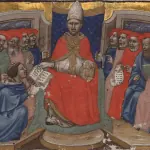
The Council of Chalcedon in 451 was a turning point for Christological doctrine in the Church. There, Leo’s Tome was read aloud, and the bishops present famously declared, “Peter has spoken through Leo,” affirming its orthodoxy and authority. The council condemned Eutyches and endorsed Leo’s teaching as a true expression of apostolic faith. However, Leo refused to accept certain disciplinary canons that elevated Constantinople’s ecclesiastical status, maintaining the primacy of Rome based on its Petrine foundation rather than political prominence.
Papal Authority and Ecclesiastical Jurisdiction
Leo was instrumental in asserting and defining the primacy of the Bishop of Rome. His interventions in Gaul, Spain, Africa, and Illyria reveal a concerted effort to centralise spiritual authority. In Gaul, he curtailed the claims of Hilary of Arles to regional supremacy by appealing to Emperor Valentinian III, who issued the 445 decree recognising the Pope’s primacy. In Spain and North Africa, Leo provided directives on clerical appointments and doctrinal discipline. He affirmed the Pope’s role as the arbiter of orthodoxy and custodian of apostolic tradition, a position he grounded in the legacy of St. Peter.
Relations with the Eastern Church
Leo’s relationship with the Eastern Church was complex and, at times, contentious. He clashed with Dioscorus of Alexandria over issues of Christology and ecclesiastical authority. The fallout from the Council of Chalcedon led to a schism with the Oriental Orthodox Churches, who rejected the Tome of Leo as too close to Nestorianism. Instead, they held to Cyril of Alexandria’s formula of “one nature of the Word incarnate” (mia physis), which they believed better preserved the unity of Christ’s person. The split was deepened by underlying tensions over patriarchal supremacy and Roman influence in eastern affairs.
Leo and Attila the Hun
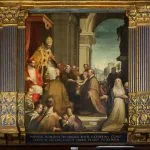
One of the most iconic moments of Leo’s papacy came in 452 when Attila the Hun advanced into Italy, sacking cities along the way. As panic gripped Rome, Leo, accompanied by two imperial envoys, met Attila near Lake Garda. The details of their conversation remain unclear, but Attila agreed to withdraw. While some contemporaries credited Leo’s authority and spiritual presence with the success, others suggested more practical causes, such as famine, disease, and the arrival of Eastern troops. Later legends added that Saints Peter and Paul appeared beside Leo during the encounter, terrifying Attila into retreat.
Later Years and Defence against the Vandals
Leo’s efforts to protect Rome continued during the Vandal sack of 455. When Genseric entered the city, Leo negotiated with him to prevent wholesale destruction. Though the Vandals looted Rome, arson and murder were limited, and key basilicas were spared. After the attack, Leo helped restore public order and religious life, reinforcing the Church’s role as a stabilising force amid the decline of imperial authority.
Leo’s Theological Vision
Leo’s theological vision centred on the mystery of the Incarnation and the dignity of the believer. His sermons and letters reflect a profound belief in Christ’s presence within the Church—in its liturgy, sacraments, and hierarchical structure. He stressed that Christ’s humanity and divinity must both be affirmed and that this mystery forms the basis for Christian life. His famous Christmas sermon, “Christian, remember your dignity,” exhorts believers to live according to their baptismal calling, as temples of the Holy Spirit and participants in divine grace. For Leo, Mariology was deeply connected to Christology: Mary’s role as the Theotokos (God-bearer) underscored Christ’s full humanity and divinity.
Legacy and Veneration
Pope Leo I died on 10 November 461 and was buried near St. Peter’s tomb in Old St. Peter’s Basilica. He was the first pope to be interred within the church, underscoring his stature. In 688, his remains were moved inside the basilica by Pope Sergius I. Leo was declared a Doctor of the Church in 1754 by Pope Benedict XIV, one of only two popes to receive this honour, the other being Gregory I. His feast day is celebrated on 10 November in the Roman Catholic Church and the Anglican Communion. Eastern Christian traditions commemorate him on other dates, reflecting his wide-reaching influence.
Conclusion
Pope Leo the Great emerged as a defining figure in late antiquity, navigating doctrinal crises, barbarian invasions, and shifting political landscapes with remarkable clarity and resolve. He was a gifted theologian, a shrewd diplomat, and an effective pastor. Through his teachings, negotiations, and tireless defence of Church unity, Leo laid enduring foundations for the papacy and the doctrinal development of Christianity. His legacy as “the Great” lies in his unwavering commitment to the truth of the Incarnation, his assertion of Rome’s primacy, and his embodiment of Christian leadership during a time of profound transformation in the Roman world.




Luciano Anastasi
Luciano is the founder of the MedievalHistory platform and the LinkedIn History Enthusiasts Group, where he is dedicated to curating and sharing high-quality medieval history content. His goal is to engage scholars, teachers, students, and enthusiasts by fostering insightful discussions and promoting scholarly resources on topics from medieval warfare and religion to societal transformations and daily life in the Middle Ages.
Luciano is also an active book reviewer, focusing on academic publications related to medieval history. He recently collaborated with Yale University Press to review forthcoming medieval history titles, aiming to deepen educators' and researchers' understanding of the period. Alongside his history endeavors, he has over 40 years of experience in IT leadership roles across various industries, including the public sector, banking, insurance, airlines and consulting, and has contributed to United Nations projects.
With a Master of Arts in Business Process Management, Luciano combines his expertise in IT strategy and governance with his passion for medieval history. He leverages technology to bridge the academic community and the wider public, making historical scholarship more accessible through engaging online content.




